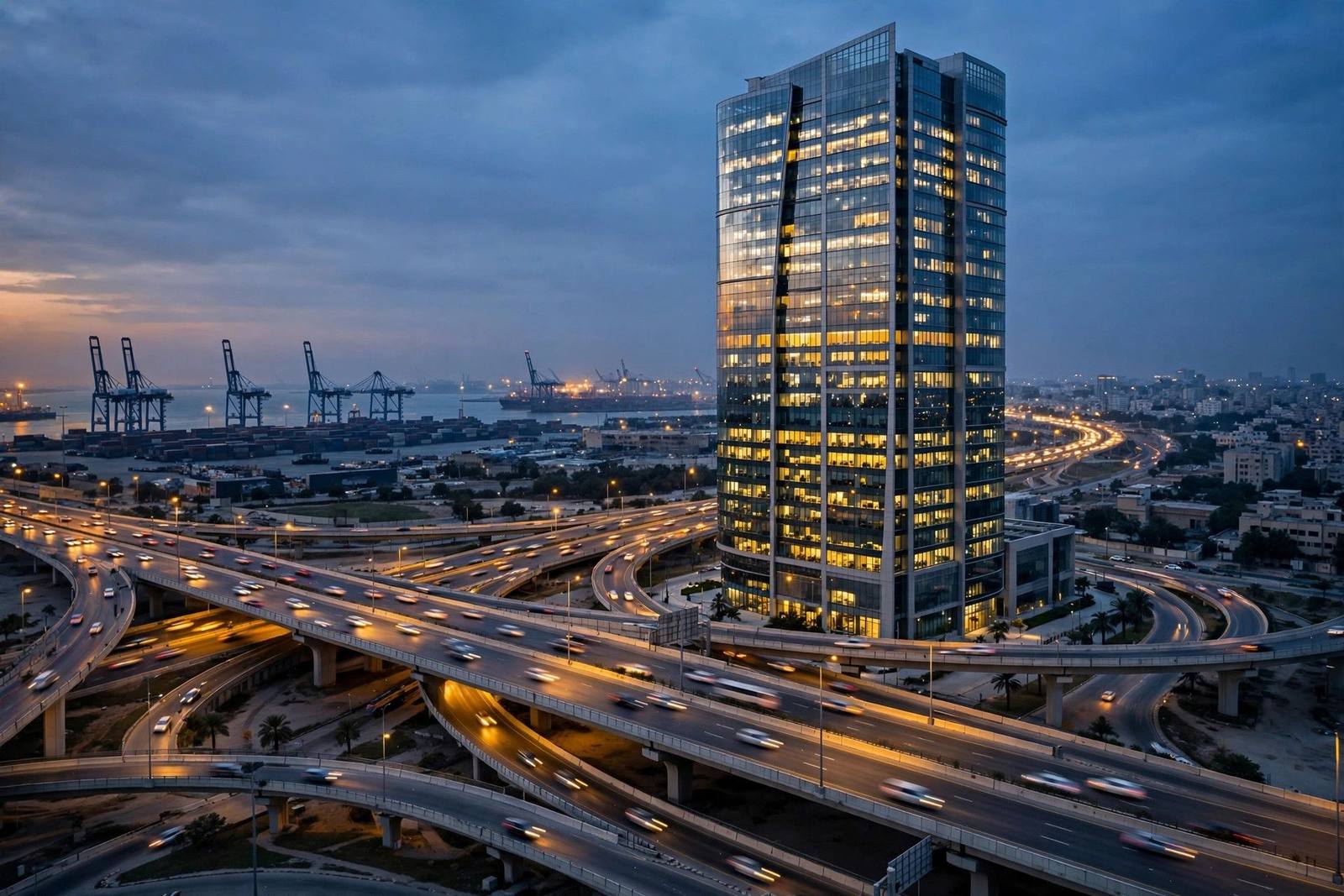
KARACHI: Drive over Karachi's KPT Interchange and one building announces itself above the port city's southern skyline: a sleek twenty-eight-storey office tower called Centrepoint. The company that built it, TPL Properties — TPLP on the Pakistan Stock Exchange — is Pakistan's most deliberate attempt to turn property development into an institutional, listed, professionally managed business. Established in 2007 as the real-estate arm of the TPL group, listed in 2016, it developed Centrepoint as its flagship, rented it to full occupancy, sold it to a bank as its head office in 2021 — and then reinvented itself a second time, as the sponsor of Pakistan's first large development REIT and a pipeline of green-certified mega-projects, including the Mangrove development in Korangi. Property in Pakistan is usually a family affair conducted in cash and files; TPLP is what happens when a group tries to run it like a fund. This profile explains the attempt, its structures, and its unresolved tensions.
The TPL group, and a property arm in 2007
TPL began life far from real estate: its name derives from Trakker, the vehicle-tracking business that made the group known, and the wider TPL family grew to include insurance — TPL Insurance and the group's takaful and life ventures — along with security services, mapping and technology businesses, held through the listed TPL Corp. TPL Properties was established in 2007 as the group's real-estate arm — described in its early rating reports as the real-estate arm of TPL Holdings — at the height of Karachi's mid-2000s property optimism, with a simple founding project: build one genuinely institutional office tower in a city full of commercial buildings that no multinational tenant would call international standard.
That project was Centrepoint. Initiated in October 2007 on a plot of about 2,914 square yards at the KPT Interchange — accessible, as the rating agency PACRA noted at the time, from most parts of the city — it was designed as a twenty-eight-storey tower with seventeen floors of office space, nine levels of car parking and two floors for services and equipment. The project's timeline slipped through Pakistan's turbulent years, but it was completed in January 2014 — company summaries usually date completion to 2013–14 — and PACRA awarded the completed project its highest project grading, PG1, in 2014, denoting an excellent ability of the developer to deliver on its terms. Following a rental model, TPL marketed the space and reached the kind of occupancy — around 90 per cent on long-term tenancies at the time of PACRA's 2015 review — that institutional developers promise and rarely deliver on a first project.
Listing in 2016, and the great Centrepoint exit
TPL Properties became a PSX-listed company in 2016 — the group's property arm taking public money to professionalise a sector that barely had listed pure-plays. The listing process included a pre-IPO placement in which the Swedish fund manager Tundra Fonder, a frontier-markets investor with a Pakistan focus, took a stake — a small but telling signal that the company's pitch was aimed at institutional standards of governance and disclosure. Through the late 2010s the company achieved full tenancy at Centrepoint, prepaid an OPIC facility that had part-financed the project, acquired HKC — a land-holding company — in 2017, and began assembling the pieces of a second act: a REIT management company, land for a technology park, and development capabilities inside a subsidiary.
The first act closed in 2021, when Centrepoint — the company's founding asset and for years effectively its whole balance sheet — was acquired by a leading bank for use as its head office, in the company's own summary phrasing. Selling your only mature asset is either an ending or a beginning. For TPLP it was designed as a beginning: the exit converted a single rented tower into capital and credibility for a platform model, in which the listed company would earn from developing, managing and investing through funds rather than from owning one building's rent roll. Whether that trade — certain rent for a development pipeline — was wise is the central question the share has traded on ever since.
The second act: REITs, development management and Mangrove
The platform that replaced the tower has four working parts, in the company's own description of its business lines. Real estate investment covers ownership of assets and investments in REITs. Development management, run mainly through the wholly owned subsidiary TPL Developments, offers turnkey development of commercial, residential, retail, hospitality and mixed-use projects — for the group's own funds and for outside clients. Asset and fund management sits in TPL REIT Management Company, licensed by the SECP as a REIT management company, and an associated investment-management arm. And property management provides facility management for completed buildings — the unglamorous, annuity-like work of keeping towers running.
The flagship vehicle is TPL REIT Fund I, described by the group as Pakistan's first and largest Shariah-compliant development-impact REIT fund, with a target size the group has put at Rs85 billion, which achieved its first close in the early 2020s. Its assets, per the group's presentations, combine development projects and yielding assets — among them the Korangi land being developed as Mangrove, a large mixed-use community planned with residential, commercial and retail components, designed to international green-building standards with LEED and EDGE certification targeted across the portfolio, and a technology park project on acquired land. The listed company launched its first sales office in Karachi to sell Mangrove and future projects directly to buyers. The model will be recognisable to readers of our explainer on REITs in Pakistan: outside investors' money goes into a regulated fund; the listed sponsor earns development fees, management fees and a carried stake in the assets' success — if the assets succeed.
How a listed developer is supposed to make money
Property development earns in lumps, and TPLP's post-Centrepoint structure is an attempt to smooth the lumps into layers. The base layer is fees: development-management fees on projects under construction, REIT management fees on fund assets, and facility-management fees on completed buildings — income that repeats while projects live. Above that sits investment exposure: the listed company's own stakes in the fund and in land and projects, which gain or lose value with Karachi property prices and with execution. Above that, in the old model at least, sat disposals — the Centrepoint sale being the proof of concept that a finished, fully let building can be sold to an institution at a price that rewards the developer's patience.
The costs and risks are equally layered. Development consumes capital years before it returns any: land, approvals, construction at Pakistani input prices, and financing at Pakistani interest rates, which can turn a sound project's arithmetic upside down between launch and completion. Fund economics depend on raising the next close — convincing pension funds, institutions and wealthy investors to commit to long property cycles in a market with a short institutional memory. And the listed vehicle's own share price must carry all of it: the market is asked to value land banks, part-built projects, fund stakes and fee streams today, with the evidence arriving half a decade later. That is a very different security from the rent-collecting landlord the company briefly was, and closer in spirit to the development risk described in our comparison of property versus stocks in Pakistan — except here the property is inside the stock.
Strengths, risks and the institutional experiment
The strengths are genuine firsts. Centrepoint demonstrated — with a top project grading and a blue-chip tenant roster — that the team could deliver an institutional building in Karachi and exit it to a bank. The REIT platform is a regulatory and structural first at its scale, with a Shariah-compliant design that widens its investor base, and the group's partnerships with international and local design and engineering firms, plus its LEED and EDGE ambitions, position it for the institutional and foreign capital that Pakistan's informal property market cannot touch. TPL group sponsorship brings insurance, technology and services siblings and a listed parent ecosystem behind the platform.
The risks are those of ambition meeting Pakistani macroeconomics. Construction cycles are brutal: inflation in cement, steel and energy, rupee falls that reprice imported systems, and interest-rate spikes that freeze both project finance and end-buyer mortgages have each, at times, stalled the wider market. Development REITs are new in Pakistan; their unit-holders, regulators and sponsors are all learning the model simultaneously, and a development fund carries construction risk that a rent-yielding REIT does not — a distinction our guide to Pakistan's REIT market draws carefully. Related-party complexity is the standing governance question: when the listed company, its subsidiaries, its REIT manager and its fund all transact with each other, minorities must trust the valuation machinery — the same trust question that runs through our guide to family and group businesses, in modern corporate dress. And the Centrepoint trade still frames the sceptical case: the company swapped a completed, income-producing icon for a pipeline whose value is prospective.
The name on the PSX: TPLP
TPLP has traded since 2016 as one of the exchange's very few pure real-estate plays — a scarcity that gives it a following among investors who want listed exposure to Karachi property without buying a plot file. It is a small-cap by index standards, more volatile than the market's heavyweights, and its news flow is project-shaped: fund closes, land acquisitions, sales-office launches and construction milestones rather than quarterly production numbers. Its relationship to the separately listed TPL REIT vehicle — the exchange also hosts a TPL REIT name, profiled in our library as TPL REIT Fund I's listed sibling — confuses newcomers, and is worth untangling before anything else: TPLP is the sponsor-developer; the REIT is a fund whose assets it develops and manages. Dividend expectations should be set by the developer model, not the landlord model: cash in development years is usually spoken for by the next project, and payouts follow the standard mechanics in how PSX dividends work when they come.
Context decides how the experiment should be judged. Karachi is a megacity still building its first generation of institutional real estate: Grade-A office towers can be counted without running out of fingers, most housing is built incrementally and informally, and the REIT framework itself — explained in our guide to how REITs work in Pakistan — is barely a decade into its practical life, with the regulator refining rules on development funds, valuations and distributions as the first vehicles operate. In that setting, TPLP is less a finished business than a test of whether Pakistani property can be financialised at all: whether outside capital, professional development and public disclosure can do buildings better than the plot-file economy described in our explainer on Pakistan's plot files. A successful Mangrove, delivered green and on schedule into a sceptical market, would be evidence for the whole model, not just for one sponsor — which is why property professionals who own no shares at all still watch this small listed developer's construction fences. Karachi, after all, has never lacked property wealth; what it has lacked is property paper that outsiders can buy, audit and sell. TPLP is the attempt to manufacture exactly that.
What kind of investor studies TPL Properties
TPLP suits the investor who thinks like a development partner: comfortable valuing land and part-built projects, patient across a five-to-ten-year build cycle, and diligent about the governance plumbing between a sponsor, its manager and its fund. The watch-list is concrete — REIT fund closes and deployments, Mangrove's tower launches and sales pace, construction cost inflation, occupancy and disposal news across the portfolio, and the fee income line that shows whether the platform model is becoming real. This article is educational content, not financial advice, and nothing in it is a recommendation to buy or sell any security.
Key takeaway: TPL Properties built and sold Karachi's Centrepoint, then bet its listed future on a platform model — developing and managing property through Pakistan's first large development REIT rather than owning a single tower's rent.