KARACHI: Every Pakistani building hides a small piece of Dadex Eternit. The water line running down from the roof tank, the drain leaving the bathroom, the corrugated roof over a warehouse or a village school — for more than six decades, a large share of that hidden plumbing and roofing has come from a company founded in Karachi in 1959, when Pakistan was barely a dozen years old. Dadex Eternit Limited, ticker DADX on the Pakistan Stock Exchange, is one of the market's true old-timers: a family-controlled building-products maker that began with cement roofing, added cement pipes, and then spent the following decades reinventing itself in plastic. Its story is a compact history of how Pakistan learned to build — and of how hard it is for a small, old manufacturer to keep its place once the materials change.
A Dada family venture in a new country
Dadex Eternit was incorporated in Pakistan as a public limited company on 13 April 1959, according to its Pakistan Stock Exchange profile. The founder chairman was Kassim Dada, head of a Memon trading and industrial family whose business interests long predated Partition and spanned trade across India, Burma and beyond. The Dada name was already an established one in Karachi commerce, and the family's industrial ventures in the young Pakistan included cement-based plants in more than one city. Dadex was the building-products arm of that world: a company created to make, locally, the pipes and roofing sheets that a new country was otherwise importing.
The second word in the company name is a clue to its origins. "Eternit" was the generic name widely used around the world for fibre-cement products — corrugated roofing sheets and pipes made by mixing cement with reinforcing fibres. Dadex started, by its own account, with the manufacture of chrysotile-cement roofing systems at its facility in Hyderabad. Roofing came first because the need was most obvious: factories, godowns, railway buildings, farm sheds and modest houses all needed a durable roof that could survive Sindh's heat and monsoon rain, and corrugated fibre-cement sheet was the standard industrial answer of the era.
Pipes followed. In 1966, again by the company's own history, Dadex moved into chrysotile-cement pipe systems and set up a dedicated manufacturing facility in Karachi for them. The logic was the same as for roofing, applied underground: growing cities needed water supply and sewerage lines, and every municipal scheme and housing colony laid pipe by the mile. A third plant, at Sunder Industrial Estate near Lahore, later completed the geographic triangle — Hyderabad serving lower Sindh, Karachi the port city and its industry, and Sunder putting production within reach of Punjab, where most of Pakistan's building happens.
From cement to plastic: the long reinvention
The defining tension in Dadex's history is material change. Fibre-cement was the technology of the 1950s and 1960s, but from the 1970s onwards, plastics steadily took over the pipe business worldwide. PVC, and later polyethylene and polypropylene, offered pipes that were lighter, easier to joint, corrosion-proof and cheaper to install. A cement-pipe maker that refused to change would have been left making a shrinking product for a shrinking set of buyers.
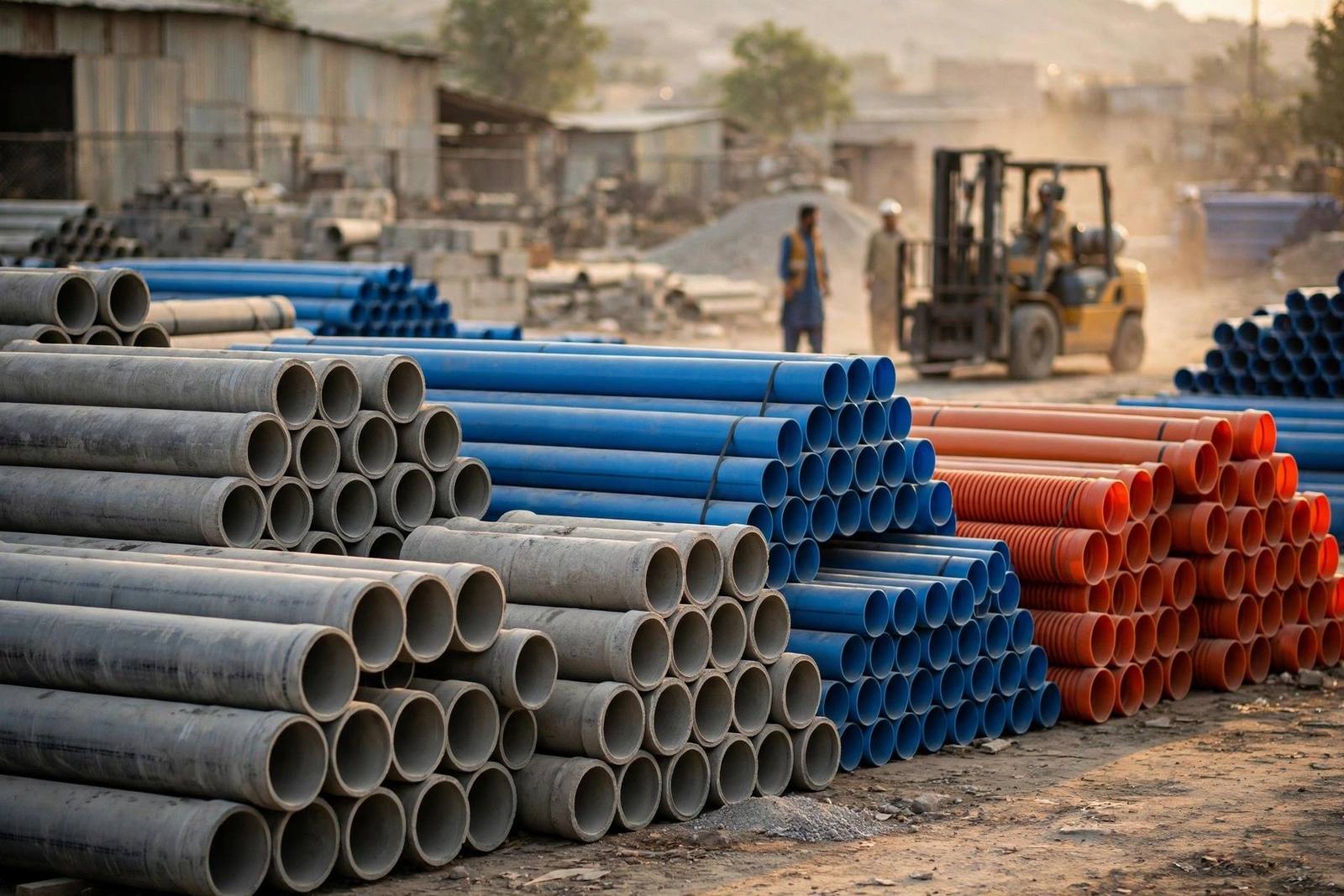
Dadex changed, gradually. Under Sikander Dada, who led the company in a later generation of the family, it introduced PVC pipe systems in Pakistan and, in 1993, launched polyethylene pipe systems as well. Its modern catalogue, as described in its PSX profile and annual reports, is organised into three segments: a chrysotile-cement segment making corrugated sheets, pipes and rubber rings; a plastic products segment covering PVC, polypropylene (sold under its Polydex name) and polyethylene pipes, including its T-Flex polyethylene range; and a smaller "all other" segment merchandising imported pipe fittings, accessories and other building products. The Karachi factory also houses the company's own rubber plant, producing the rubber rings that seal its pipe joints — a small but telling example of the vertical habits of an older manufacturer that preferred to make its own components rather than buy them.
The product list maps neatly onto a building's life. Thermoplastic pipe systems serve hot and cold water supply and distribution, gas distribution, cable ducting, air-conditioning lines, tube-well casing and screen pipes, and soil, waste and vent systems. Chrysotile-cement corrugated sheets and beams still roof housing, industrial and agricultural buildings, warehouses and site offices. The company has also offered irrigation solutions for agriculture and landscaping — a natural extension for a pipe maker in a country where moving water across fields is a permanent preoccupation.
Ownership: a family company in public clothes
Dadex has been a listed, public company for most of its life, but control has never left the founding family. The company's financial statements identify Sikander (Private) Limited as its holding company, holding roughly sixty-three per cent of the ordinary shares in recent published accounts, and members of the Dada family have chaired and led the business across generations — Kassim Dada as founder chairman, Sikander Dada as a later chief executive, with the family still at the centre of the board today. Head office remains Dadex House, on Shahrah-e-Faisal in Karachi's PECHS district, a short drive from where the Karachi pipe plant story began.
That structure explains much about how DADX behaves as a stock. With the holding company and associated holders owning the large majority of shares, the free float — the portion actually available to trade — is very small; the PSX equity profile puts it at only about five per cent. Small floats make for thin, jumpy trading: few orders can move the price a long way, long quiet stretches are normal, and the share is a study in patience rather than a trading vehicle. Our explainer of market capitalisation and free float sets out why two companies of similar size can trade in completely different ways.
How a pipe maker earns its money
The revenue model is manufacturing arithmetic. Dadex buys raw materials — cement and chrysotile fibre for the cement lines; PVC, polypropylene and polyethylene resins for the plastic lines; rubber for rings — converts them in three factories, and sells finished pipe, sheet and fittings through dealers, distributors, contractors and institutional buyers. Selling prices must cover not just materials but energy, labour, freight and the cost of carrying a wide catalogue of diameters and fittings, because a pipe system is only useful to a plumber or a water utility if every joint, bend and reducer is available when needed.
Each half of the business has its own cost weather. The cement side is exposed to cement and energy prices and to the freight cost of heavy, bulky products, which is why plants sit near their markets. The plastics side is exposed to resin prices, which are petrochemical-linked and largely imported, so the rupee's value runs straight through its margins: a weaker currency makes every tonne of resin dearer before a single length of pipe is sold. On the demand side, both halves ride the same cycle — construction activity, housing starts, municipal water and sewerage spending, and agricultural tube-well work. It is the same underlying cycle that moves the cement makers in our guide to PSX cement stocks and fellow building-products names such as Shabbir Tiles & Ceramics.
Competition is the other constant. The plastic pipe market in Pakistan is crowded with national brands, regional makers and unbranded producers competing hard on price, and specification-driven institutional work — government water schemes, large housing projects — is tendered keenly. Against that, Dadex's defences are the ones it has built since 1959: a recognised name among engineers and contractors, standards certifications the company points to (ISO 9001 and Pakistan Standards quality marks), technical support for designers and installers, and a full-system range that lets a buyer source pipe, fittings and accessories from one maker.
Strengths, risks and the chrysotile question
An honest profile has to address the word in Dadex's oldest segment. Chrysotile is a form of asbestos, and asbestos-containing products have been restricted or banned in many countries because inhaling asbestos fibres is hazardous to health. Pakistan has continued to permit chrysotile-cement manufacture under regulation, and companies in the sector argue that fibres locked in a cement matrix in finished roofing and pipe are a different risk from loose asbestos — but the global direction of travel is unmistakable, and it is one reason Dadex's centre of gravity has shifted toward plastics over the decades. A reader of its reports should watch how the segment mix evolves, because the legacy cement business carries a long regulatory and reputational shadow that the plastic business does not.
The financial risks are those of a small manufacturer in a hard decade. Pakistan's construction cycle has swung through inflation, very high interest rates and stop-start public development spending, and small building-products firms feel each swing in orders within a quarter. Recent years have been difficult for the company, with weak demand, high energy and finance costs pressing on results — the kind of stretch in which a tightly held, thinly traded company can go quiet for long periods while it defends its dealer network and waits for building activity to return. Add resin and currency exposure on the plastics side, and Dadex's earnings are best understood as a leveraged reading of the construction cycle rather than a steady compounder.
Set against that is genuine longevity. Surviving from 1959 through nationalisation-era Pakistan, the plastics transition, liberalisation and repeated macroeconomic crises is itself a corporate achievement, and the Dadex name still carries weight with the engineers, architects and municipal buyers who specify pipe and roofing. Compare it with Berger Paints, another 1950s building-products name that made a similar journey from an imported-technology start to local manufacture: the pattern of the era's survivors is the same — own the brand, own the distribution, and adapt the material before the market forces you to.
The name on the PSX, and who studies it
DADX sits in the exchange's building-products corner, far from the index heavyweights; it is not a stock that moves the KSE-100, and its dividend record, like that of most small cyclicals, has to be read as a reflection of profitable and unprofitable years rather than a promise. What it offers instead is a teaching case: a single-country, single-industry manufacturer whose annual report can be read end to end in an evening, and through which a new investor can learn how segment reporting, family control and free float shape a share's behaviour. The observation points are consistent — the balance between cement and plastic sales, gross margin against resin and energy costs, construction demand in Punjab and Sindh, and any sign of renewed volume in municipal and housing work.
Dadex tends to be studied by patient, value-minded readers of small companies and by students of Pakistan's industrial families, rather than by momentum traders. If you are building that reading habit, the Aktzien learning library covers the foundations — how to read an annual report, what free float means, and how dividends actually reach your account. This article is educational content, not financial advice.
Pipes in everyday Pakistani life
It is worth ending where the products end: out of sight. A Dadex pipe spends its working life buried under a street, chased into a bathroom wall or sunk into a tube-well in a wheat field, and its success is measured by nobody ever thinking about it again. That invisibility is the building-products maker's paradox — the better the product, the less anyone notices — and it explains why companies like Dadex sell trust as much as plastic or cement: the contractor who buries a pipe is staking his own name on a joint he will never see again. Generations of Pakistani plumbers, water-board engineers and farmers have formed that trust, or withheld it, one installation at a time since 1959, and the accumulated verdict is the real asset on this balance sheet.
Key takeaway: Dadex Eternit, founded by Kassim Dada in 1959, grew from chrysotile-cement roofing in Hyderabad and pipes in Karachi into a three-plant maker of plastic and cement building products — a family-controlled, thinly traded survivor whose fortunes still follow Pakistan's construction cycle.