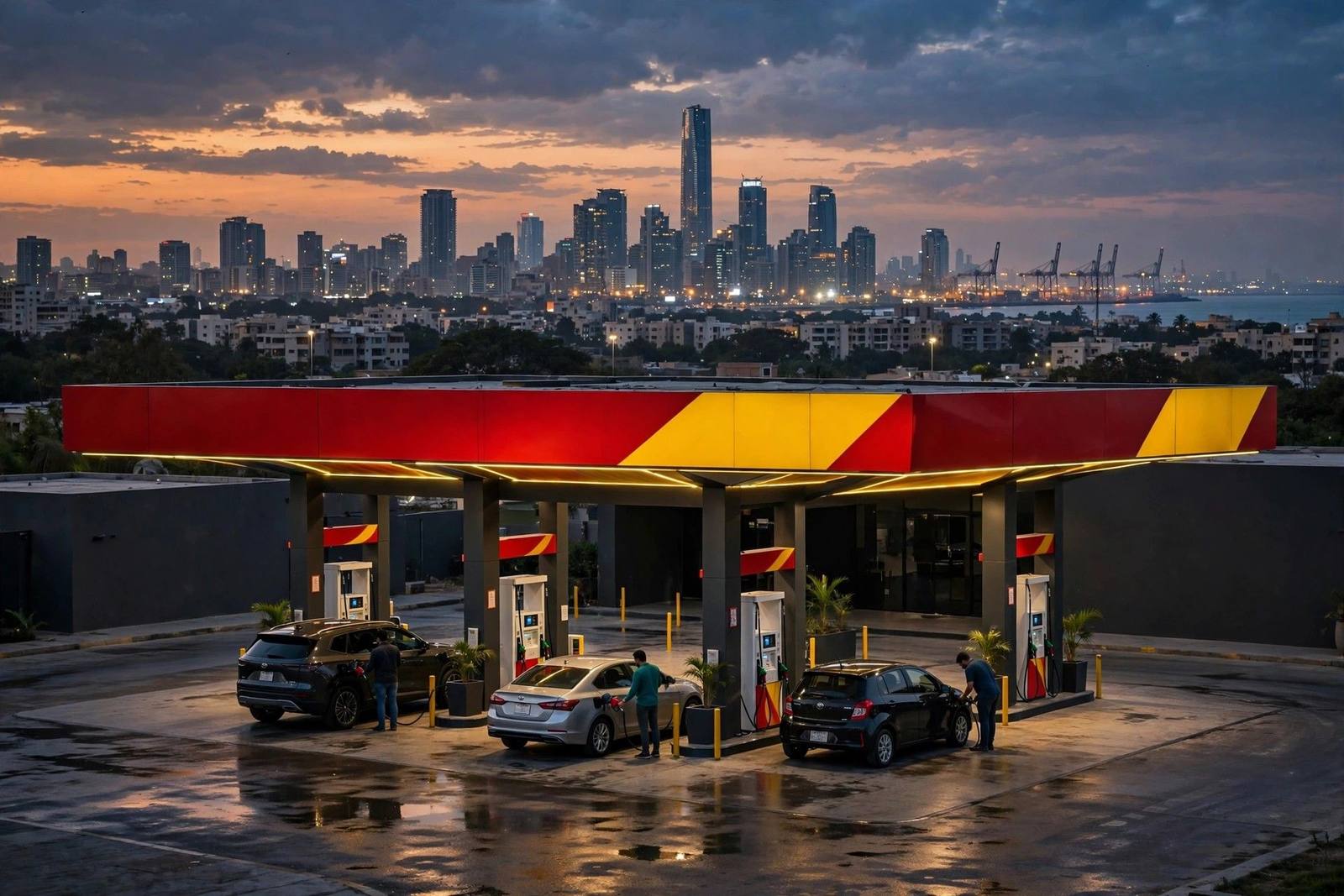
KARACHI: The yellow-and-red scallop over a Pakistani petrol pump is one of the most recognised signs in the country — and since January 2025 it has belonged, legally, to a company with a different name. Wafi Energy Pakistan Limited, ticker WAFI, is the business Pakistan knew as Shell Pakistan for three decades, and as Burmah-Shell for four decades before that: the marketer whose lineage in this territory runs back through a 1928 distribution alliance to the founding year of the country itself. In November 2024 the Saudi group Wafi Energy Holding, part of Asyad Holding, completed its purchase of Shell's controlling stake, ending the Anglo-Dutch major's direct equity presence after more than three-quarters of a century — while keeping the Shell brand on the pumps under licence. No profile in this series spans more history, or poses the present question more cleanly: what is a great brand worth when its owner changes? This article follows the sign from 1947 to Wafi.
From Burmah-Shell to Shell Pakistan: the long first act
The corporate ancestor was created by a 1928 agreement in which the Burmah Oil Company and the Royal Dutch Shell group combined the distribution of their oil products across the Indian subcontinent, trading as Burmah-Shell. Its Karachi office ran a vast territory in the 1940s — Sindh, Punjab, the North-West Frontier, Balochistan and beyond. Partition in 1947 divided the business along with the country, and the Pakistani share passed to a new sister company, the Burmah-Shell Oil Storage and Distributing Company of Pakistan, registered that year with its head office in Karachi's Cotton Exchange Building. Through the 1950s its kerosene lit rural homes — advertised, famously, with the voices of singers such as Mohammed Rafi — and in 1960 Burmah and Shell stood among the four parents of Pakistan Refinery, building the country's refining base alongside the marketing network.
The modern company's direct line begins on 28 June 1969, when Pakistan Burmah Shell Limited was incorporated in the west wing, structured as a genuinely Pakistani company: local investors, among them the state-backed National Investment Trust, held 51 per cent, with Burmah Oil and Shell Petroleum at 24.5 per cent each. The public issue was oversubscribed thirty-seven times — a detail that tells you how scarce listed industrial equity then was. The company survived the 1974 nationalisation of oil marketing that created PSO out of its state-owned rivals, remained the private sector's standard-bearer with roughly a quarter of the market through the 1980s, and moved into the Karachi headquarters, designed by Habib Fida Ali, that became known simply as Shell House. In February 1993 Shell Petroleum finally bought out Burmah's stake and a further slice from the market to reach 51 per cent, and the company was renamed Shell Pakistan Limited. Through the 1990s and 2000s Shell raised its holding further — past three-quarters by 2002 — built the premium end of the market with Shell V-Power and the Shell Select convenience format, took a 26 per cent stake in the Pak-Arab Pipeline Company in 2001, and ran one of the country's two great lubricant franchises on brands such as Helix, Rimula and Advance. The scallop, in short, was never just a logo: it was the private, international pole of a market otherwise dominated by the state.
The hard years and the decision to sell
The last Shell decade was not gentle. In June 2017 a tanker contracted to carry the company's fuel overturned near Ahmedpur East and exploded, killing more than 200 people who had gathered around it; the regulator OGRA held Shell responsible as licence holder despite the outsourced transport, fined it and ordered compensation to victims' families, which the company ultimately paid. In the June 2020 fuel shortage OGRA fined Shell and other marketers for supply failures. In August 2022 the company exited its aviation fuel business, in which it had been the country's second-largest supplier. None of these events alone explains the exit — Shell was simultaneously pruning smaller markets across the world — but together they describe a business whose final years as a major's subsidiary were spent managing decline in a regulated, low-margin market. In June 2023 Shell announced its intention to sell, and on 31 October 2023 it agreed to sell its stake — some 165.7 million shares — to Wafi Energy, the Saudi fuel retailer that already operated Shell-branded stations in Saudi Arabia under licence. The road to completion was contested: rival local interest, including from Pakistan Refinery and Air Link, fell away in April 2024; the Competition Commission approved the deal that July; agreed pricing — Rs118 a share for Shell's stake, with minority shareholders offered Rs155.11 in the mandatory tender — drew objections from some minority holders who argued higher offers had existed; and in November 2024 the acquisition completed at a total holding of 87.78 per cent for Wafi Energy Holding. Shareholders approved the new name on 27 November 2024, and the SECP's certificate made it official on 13 January 2025. On the exchange, the scrip that generations knew as SHEL trades on as WAFI.
What Wafi actually owns and sells
Strip away the century of branding and the company is Pakistan's premium oil marketer. It sells petroleum products, lubricants and compressed natural gas through a network reported at more than 600 — in the company's own recent descriptions, over 680 — Shell-branded retail stations: fuels including Shell Super and diesel and the premium V-Power grade, convenience retail under Shell Select, and a lubricants portfolio led by Helix for cars, Rimula for trucks and Advance for motorcycles, blended at its own lubricant blending plant and distributed nationally. Behind the pumps sit countrywide storage terminals and one genuinely strategic asset: the 26 per cent stake in the Pak-Arab Pipeline Company, PAPCO, whose 786-kilometre White Oil Pipeline moves diesel and petrol from Karachi's ports to upcountry depots — the company describes itself as the pipeline's largest private investor, alongside PARCO's majority and PSO's minority. That infrastructure position is the quiet difference between Wafi and a pure retailer: it owns pieces of the road its product travels on.
How the money works will be familiar from the other downstream profiles in this series, such as Hascol and Hi-Tech Lubricants: regulated per-litre marketing margins on fuels, richer margins on premium grades and lubricants, and non-fuel retail income, set against the financing of very large product inventories and dealer networks. Where Wafi has historically distinguished itself is mix — a deliberate tilt toward the premium motorist, the fleet customer and the lubricant shelf, where a litre carries brand rather than merely volume. The model now runs under new ownership logic: Wafi Holding is an operating fuel retailer, not a global major, and its strategic pitch — made repeatedly since the acquisition — is focused investment in the Pakistani network, new-generation fuels such as the relaunched V-Power, and the service-station experience, with the Shell licence keeping the product names and specifications Pakistani motorists trust. Why a Saudi group would pay for a Pakistani network is its own story: Gulf capital seeking downstream growth in a large, young, fuel-importing market, buying the strongest brand position in it at a regulated-market price.
Strengths, risks and the licence at the centre
The strengths are as visible as the signage. Wafi inherits the market's most trusted fuel brand, a premium-skewed network in the best retail locations accumulated over decades, the leading private lubricants franchise alongside the multinationals, a strategic pipeline stake, and an owner whose entire business is running fuel stations and who has described Pakistan as a long-term commitment. GCC ownership also plugs the company into a regional capital and trading ecosystem at a moment when European majors are leaving markets like this one.
The risks cluster, unusually, on a single word: licence. The company no longer owns the brand it trades under — it is a licensee of Shell brands, as its own disclosures state, and licences have terms, conditions and ends. The economics of the network under a licence, the investment the brand owner requires, and the arrangements' renewal are now the central documents of the investment case, and they are only partly visible to public shareholders. Minority investors sit, moreover, behind an 87.78 per cent holder: the free float is small, the takeover offer has passed, and the protections of the remaining shareholders are those of law and disclosure rather than of a contested register — the objections raised over the acquisition pricing in 2024 are a reminder that this register's minorities have already tested those protections once. Add the sector's standing weather — regulated margins, currency-driven inventory swings, the events of 2017 that showed how operational risk in fuel transport can become a national tragedy with the brand owner's name attached — and WAFI is a cleaner, better-capitalised story than most of the OMC sector, but never a simple one. The national context for all of it, a fuel system fed by imports, is set out in Pakistan's oil import bill explained.
What changed on day one — and what did not
For the motorist at the pump, the completion of the Wafi acquisition in November 2024 changed almost nothing, and that was the point. The stations kept the scallop, the fuels kept their names, the lubricants kept their packs, and the dealer network — the local families and companies who actually operate most sites — kept dealing with the same head office, now answering to Riyadh rather than The Hague. Behind the counter, though, the company's centre of gravity moved. A global major manages a country subsidiary as one cell in a worldwide portfolio, benchmarking it against returns available on other continents; a regional operator manages it as the business itself. Wafi's public commitments since closing — investment in the network, refreshed premium fuel, digital and service upgrades at the forecourt — are exactly the agenda of an owner for whom Pakistan is not a rounding error but the largest single market it runs. The new owner's Saudi business had itself operated under the Shell licence at home, so the licence relationship that now sits at the centre of the Pakistani company is a familiar instrument to the people who bought it.
What also did not change is the market's structure around the company. PSO still dominates volume from its state-owned height; Total Parco still holds the other multinational inheritance; the local marketers still fight on price and credit; and the regulator still sets the margin within which all of them live. Wafi's inheritance is a position, not a victory — the premium end of a hard market, with a brand whose rent must now be paid to its former owner. Holding that position, rather than merely acquiring it, is the work of the coming decade, and it will be measured in the unglamorous units of the trade: litres per site, lubricant shelf share, and dealer economics healthy enough that the best locations stay in the network.
WAFI on the PSX: a blue-chip past, a controlled present
The shares carry a blue-chip heritage — a KSE-100 constituent in recent compositions — but trade today in the conditions of a controlled company: the overwhelming sponsor stake leaves a thin float, liquidity is correspondingly modest, and the price discovery that remains is driven by the company's results, its dividend declarations under the new owner, and any development in the brand-licence or network-investment story. Followers watch operating rather than corporate items now: monthly market share in petrol and diesel, lubricant volumes against the premium rivals, V-Power and network-upgrade traction, inventory effects after oil-price swings, and the board's payout policy, which will reveal how Wafi Holding balances cash extraction against the network investment it has promised. For readers coming fresh to the name, what the KSE-100 index is explains the benchmark family the stock grew up in.
The investor who studies WAFI is buying, in the end, a judgement about continuity: that motorists will keep trusting the scallop whoever owns the company beneath it, that a specialist Saudi operator can run the network harder than a distracted global major did, and that the licence relationship endures. This article is educational content, not financial advice. A brand built in 1947 has already outlived an empire, a nationalisation era and a global major's exit — the Wafi chapter is the market's live experiment in whether it can outlive its own name changing, too.
Key takeaway: Wafi Energy Pakistan is Shell Pakistan under Saudi ownership — a premium, brand- and infrastructure-rich fuel retailer of 1947 lineage whose investment case now turns on the Shell brand licence and its new owner's investment intent.