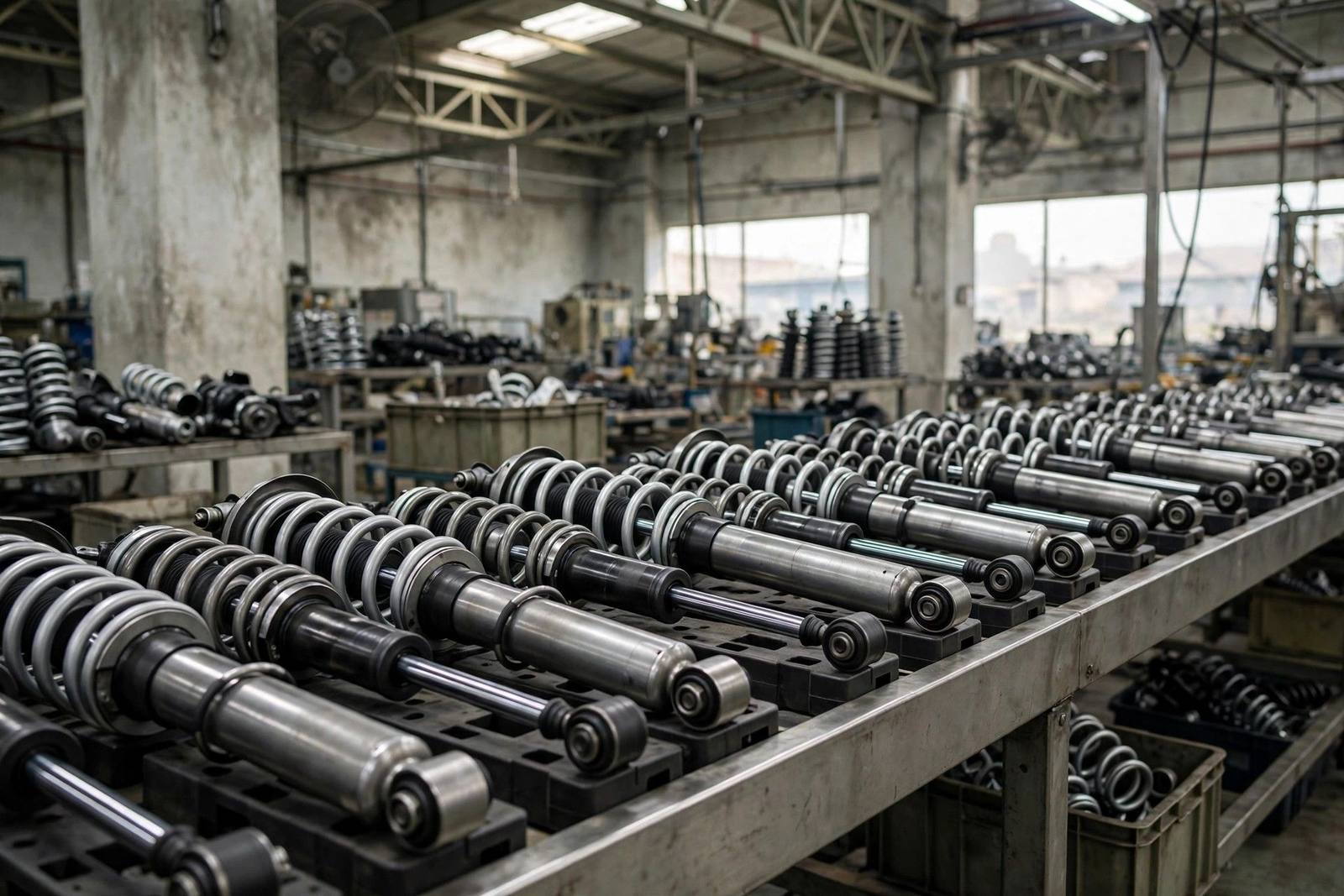
KARACHI: You have almost certainly ridden on Agriauto Industries' work without ever seeing its name. The shock absorbers that soften a pothole on a Karachi road, the struts under a locally assembled car, the camshaft turning inside a farm tractor — parts like these are where this company lives. Agriauto, traded on the Pakistan Stock Exchange as AGIL, does not sell cars, tractors or motorcycles. It sells the engineered components inside them, which makes it one of the purest listed plays on a simple question: how many vehicles is Pakistan building this year?
A parts maker, not a vehicle maker
Agriauto is an automotive components manufacturer in the private sector, supplying original equipment manufacturers — the assemblers who build the finished vehicle — as well as the replacement aftermarket, where worn parts are swapped out over a vehicle's life. That second channel matters more than beginners expect. Even in a year when new-vehicle sales slump, Pakistan's existing fleet keeps ageing, and ageing vehicles consume shock absorbers, dampers and other wear parts. The business therefore has two engines: assembly volumes, which are cyclical and sometimes violent, and the replacement demand of a large installed fleet, which is steadier.
The company sits in the components corner of the map set out in our guide to automobile stocks on the PSX, alongside tyre, battery and exhaust makers whose fortunes all rise and fall with the same assembly lines, but whose products wear out at very different speeds.
Incorporated in 1981, listed in 1984
Agriauto was incorporated in 1981 as a public limited company, and its shares were quoted on the stock exchange in 1984 — an unusually early listing for a components maker, and a reminder that Pakistan's vendor industry grew up alongside its assembly industry rather than after it. The earliest production lines were humble and agricultural in flavour: gaskets and engine sleeves in the founding year, then camshafts from 1984, serving the tractor makers who were then the backbone of local vehicle production.
The step that defined the modern company came through foreign technical collaboration. A technical assistance agreement with Gabriel of the United States in 1987 led to shock absorber production from 1988, and Agriauto became the maker of Gabriel-brand shock absorbers and struts in Pakistan. A further collaboration with Kayaba of Japan — the suspension specialist now known globally as KYB — followed in 1994, and strut production began in 1995. Through these partnerships the company tied itself to the two great traditions of the world's suspension industry, American and Japanese, at exactly the moment Japanese car assembly was becoming dominant in Pakistan.
What the plant actually makes
The product range is best understood by vehicle type. For cars and light vehicles, Agriauto makes shock absorbers, struts and related suspension assemblies. For motorcycles — by far the largest vehicle category in Pakistan by unit volume — it added motorcycle shock absorbers in 2004, after earlier work on pipe forks and case dampers. For agriculture, it makes camshafts and steering-related components for tractors, the machines built by the country's Massey Ferguson and Fiat-lineage assemblers. Around those core lines sit gaskets, cylinder sleeves and, from 2009, sheet-metal pressed parts.
Its historic customer list reads like a directory of Pakistani assembly: the Toyota and Suzuki car plants, the Hino truck and bus assembler, tractor makers, truck builders and motorcycle manufacturers. That breadth is deliberate. A vendor tied to a single assembler lives and dies by one customer's model cycle; a vendor qualified across cars, trucks, tractors and two-wheelers spreads the risk, because those segments rarely peak or collapse in the same year.
Quality certification is the industry's entry ticket, and Agriauto made a point of being early: it has presented itself as the first company in Pakistan to achieve the automotive TS 16949 quality certification, the demanding standard global assemblers require of their supply chains. For a beginner, the lesson is that in components, reputation is a balance-sheet asset even though it never appears on one — an assembler whose line stops for want of a faulty batch does not forgive quickly.
Inside the House of Habib
Agriauto belongs to the House of Habib, one of Karachi's oldest business houses, whose interests have spanned banking and insurance, automobile assembly and distribution, building materials and industrial ventures. Group membership matters for a company of Agriauto's size in three practical ways. It brings long relationships with the very assemblers the group itself has historically been involved with. It brings governance habits and banking relationships built over generations. And it places the parts maker inside a wider automotive ecosystem — glass, plastics, lamps, wiring and other components have all sat within the broader Habib orbit at various times — so the company is best read not as a lonely factory but as one workshop inside an industrial family.
The factory itself is at Hub in Balochistan, within trucking distance of Karachi's assembly belt — close enough to serve just-in-time delivery schedules, on land large enough for the machine shops and testing laboratories that suspension work demands.
How the money is made
Revenue is, at heart, units times content per vehicle. Every locally assembled car, tractor or motorcycle that carries Agriauto components contributes a small, contracted sum; multiply by assembly volumes and you have the OEM business. The aftermarket adds a second stream priced through distributors and retailers rather than assembler contracts. Costs are the mirror image: steel and other metals, bought-in components, energy, and the skilled labour and depreciation of precision machine tools. Because many inputs are metal-based and some are imported or import-priced, the rupee's exchange rate runs through the cost line, while selling prices to big assemblers are negotiated hard and adjusted with a lag — the classic vendor squeeze in an inflationary year.
Operating leverage cuts both ways. A components plant carries heavy fixed costs, so when assembly volumes surge — as they do when interest rates fall, car financing loosens and pent-up demand breaks loose — profits can rise far faster than sales. When volumes halve in a downturn, the same fixed costs sit on a much smaller revenue base. Readers comparing Agriauto with assemblers such as Indus Motor or Honda Atlas Cars will see the same cycle from opposite ends of the invoice: the assembler's slow year is the vendor's slow year, delayed by ordering patterns but never cancelled.
Strengths, risks and the honest caveats
The strengths are longevity, certification and breadth: four decades of assembler relationships, international technical partners, and a product range spanning four vehicle categories. The aftermarket gives a partial cushion that pure assembly suppliers lack, and group backing has carried the company through cycles that finished weaker vendors.
The risks are equally structural. Pakistan's car market is small, policy-sensitive and prone to boom-bust swings driven by interest rates, import rules and the exchange rate; tractor demand follows farm incomes and support schemes; motorcycle demand follows the real wages of lower-income households. Customer concentration is inherent — there are only a handful of large assemblers to sell to. Imported used vehicles and imported replacement parts compete at both ends of the business. And like every vendor, Agriauto invests ahead of demand: tooling for a model that sells poorly is money that returns slowly, if at all.
The name on the PSX
AGIL has been quoted since 1984, making it one of the longer-listed manufacturing names on the exchange. It trades in the automobile parts and accessories sector, well away from the index heavyweights, and its liquidity is that of a mid-sized industrial: present, but not the sort of counter where large orders move invisibly. Its dividend behaviour over the years has followed the auto cycle rather than any smooth policy — generous in strong assembly years, restrained when the industry contracts — so income-focused readers should treat the payout as cyclical, and check how dividends actually reach an account in our guide to how PSX dividends work. Announcements, results and corporate actions are filed through the exchange like any listed company's, and learning to read them is a skill our guide to opening a brokerage account pairs with the practical first steps.
What kind of investor studies AGIL
AGIL suits the student of industrial cycles: someone willing to track monthly vehicle production data, assembler announcements, steel prices and the interest-rate cycle, and to accept that a components maker's earnings will swing harder than the wider market's. It also appeals to readers who like businesses they can physically verify — its products are under vehicles on every road in the country. This article is educational content, not financial advice. The careful habit is to read Agriauto's results beside the assemblers' sales releases for the same period: when the two tell the same story, you are looking at the cycle; when they diverge, you are looking at market share, inventory or pricing — and that divergence is where the real analysis begins.
Reading the cycle like a vendor watcher.
Because Agriauto sells to assemblers rather than to the public, its results arrive as a commentary on other companies' sales. The Pakistan Automotive Manufacturers Association publishes monthly production and sales figures for cars, tractors, trucks and motorcycles, and those releases — free, prompt and specific — are the closest thing a components investor has to an order book. When car production falls for three consecutive months, Agriauto's OEM revenue will follow with the lag of its delivery schedules; when tractor production surges on a good harvest and supportive farm policy, the camshaft and tractor-parts lines feel it first. Learning to lay the association's tables beside the company's quarterly accounts is the core skill this stock teaches.
Localisation policy is the second text to read. Pakistan's auto industry has operated for decades under deletion programmes and tariff structures designed to force local content — rules that determine what share of a car must be made domestically and at what duty imported parts enter. Those rules are the vendor industry's charter: tighten them, and assemblers must buy more from companies like Agriauto; loosen them or admit waves of imported used vehicles, and the same companies lose volume to foreign supply chains. Every budget and auto policy therefore matters to AGIL out of proportion to the headlines it gets, and the company's annual report discussion of the policy environment is rarely boilerplate.
Finally, watch the balance between the two channels in the numbers management chooses to disclose. OEM sales tell you about this year's assembly lines; aftermarket strength tells you about pricing power and brand in the bazaar trade, where a Gabriel shock absorber competes with imports and informal-sector copies on the shop shelf. A year in which the aftermarket carries the result is a defensive year; a year in which OEM volumes carry it is a cyclical upswing. Confusing the two leads to exactly the forecasting errors this otherwise simple business punishes.
One last distinction is worth holding onto. Agriauto's fortunes are often lumped with the assemblers' in market commentary, but a vendor's cycle is the assemblers' cycle filtered through inventory: assemblers order parts ahead of production and run stocks down ahead of a slump, so the vendor feels both the acceleration and the braking earlier and harder. That is why AGIL's quarterly numbers can look startling against a merely soft car market, and why judging the company on a single quarter is the classic beginner's error with this stock. The business underneath — qualified, certified, embedded in the production plans of nearly every vehicle maker in the country — changes far more slowly than its reported profits do.
For the new reader, a closing practical note: AGIL is a June year-end company, reporting quarterly like the rest of the market, and its results season conversation is best held with the assemblers' production data open beside the accounts. Read in that order — volumes first, company second — the numbers stop surprising, and the stock becomes what it should be for a student of the market: a clean instrument for learning how a supply chain transmits a national cycle, one shock absorber at a time.
Key takeaway: Agriauto is the House of Habib's listed components maker — incorporated in 1981, listed in 1984, built on Gabriel and Kayaba suspension technology — whose profits amplify Pakistan's vehicle-assembly cycle, softened by the replacement demand of the fleet already on the road.