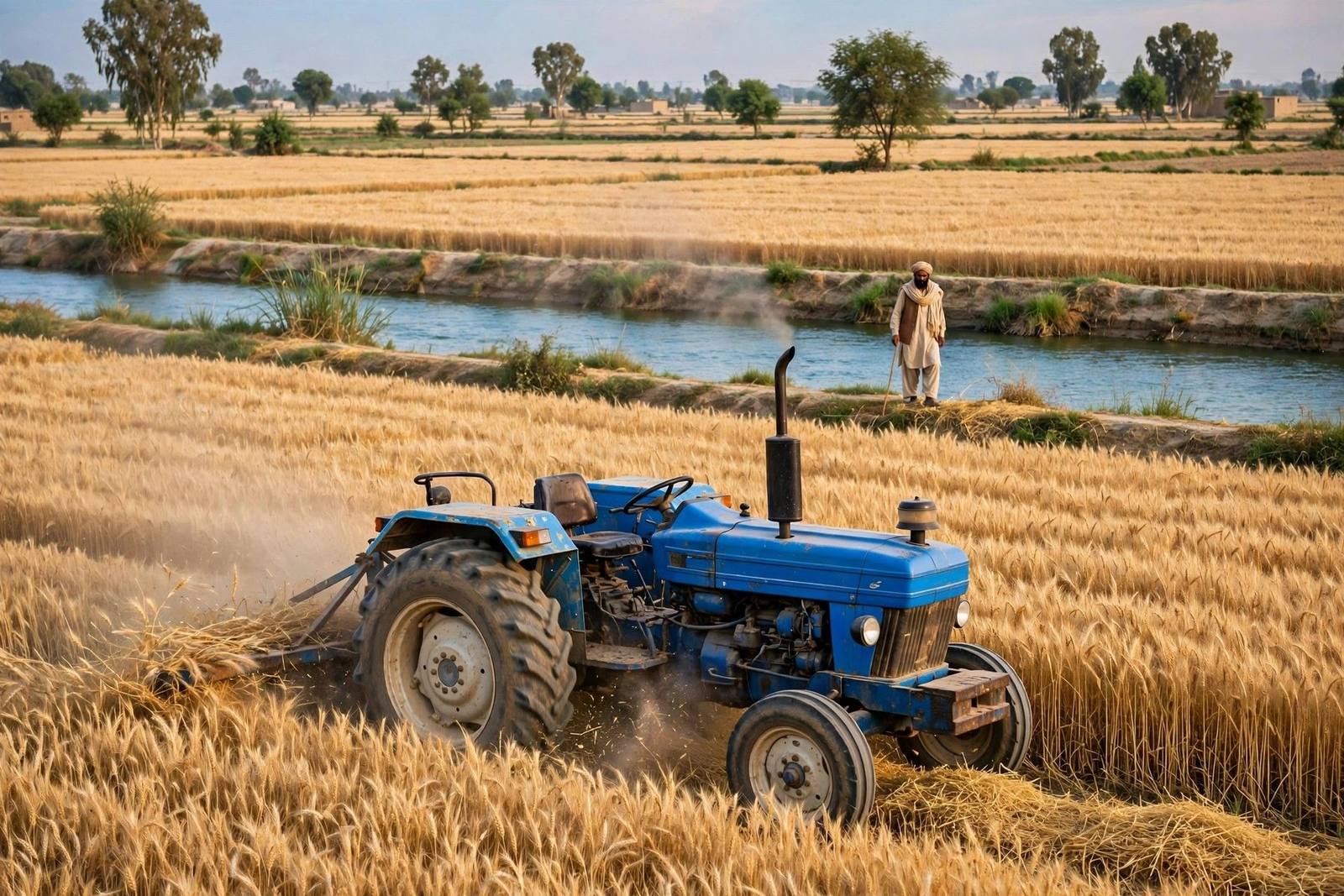
KARACHI: Some companies are names; Al-Ghazi Tractors is a colour. Across Punjab's fields and Sindh's farm roads, the blue New Holland tractors built by this company have been the shape of mechanisation for four decades — pulling cultivators, driving tube wells, hauling trailers of sugarcane and wheat. Al-Ghazi Tractors Limited, AGTL on the Pakistan Stock Exchange, is one of Pakistan's two great tractor makers, the Fiat/New Holland house against Millat's Massey Ferguson. Its plant sits in Dera Ghazi Khan, its head office in Karachi, and its ownership — a Dubai group and an Italian-American machinery giant — tells a compact story of Pakistani privatisation done unusually well. For a student of the PSX, it is the purest way to own a piece of the country's farm cycle.
Born of the state, privatised early
AGTL was incorporated on 26 June 1983 as a public-private venture — the then government's attempt to bring private capital and discipline into tractor manufacturing alongside the state. Production at the Dera Ghazi Khan plant began in February 1984, in a district 100 kilometres from Multan that was, in effect, a less-developed area being handed an industrial anchor. The company listed on the Karachi Stock Exchange in 1985, and from its early years it carried an unusual distinction: AGTL was the first automobile company in Pakistan to earn ISO-9002 quality certification, a badge it wore prominently at a time when Pakistani manufacturing was not famous for documented quality systems.
The decisive turn came in 1991. Offered for privatisation, the company was acquired by the Al-Futtaim Group of Dubai, which took over management control that December by acquiring about half of its shares. In the catalogue of Pakistan's privatisations, AGTL is a genuine success story rather than a contested one: a tractor plant bought outright, run continuously by its new sponsors, and grown for decades afterward. The Fiat/New Holland side of the partnership brought the machinery itself. AGTL manufactures New Holland tractors under an industrial collaboration agreement with CNH — the global agricultural-machinery house descended from Fiat's tractor business — which holds a large minority stake in the company alongside Al-Futtaim's controlling holding. Two sponsors, one technology stream, one plant: the shareholding structure has barely changed in over thirty years, and that stability is part of the investment character.
The plant's place in Dera Ghazi Khan deserves emphasis, because it explains the loyalty the company commands locally. When production began in 1984, a modern Fiat-standard factory — with its staff town, its vendor development and its hundreds of skilled jobs — was an event in the economic life of southern Punjab, a region that Pakistan's industrial map usually leaves to agriculture and extraction. Four decades on, AGTL remains one of the district's defining employers, and generations of local technicians have learned precision manufacturing inside its sheds. Companies that become local institutions acquire a kind of social licence that does not appear in any valuation model, yet shows up reliably in workforce stability and in the patience of the surrounding community when the cycle turns down.
What it actually makes
The product range is a ladder of horsepower. The familiar names — New Holland 480S, 640 and 640S, the Ghazi model, and the NH 55-56, NH 60-56 and NH 70-56 (four-wheel-drive) — are mostly descendants of Fiat designs: the 480S is the modernised heir of the Fiat 480, the 640 of the Fiat 640, adapted over the years with more power, power steering and larger tyres. Around the core tractor line sits a range of farm implements — cultivators, disc harrows, rotavators, ploughs, boom sprayers, front-end loaders — and, historically, diesel generators. With expansions carried out over the years, the Dera Ghazi Khan plant's capacity stands at more than 30,000 tractors a year in a single shift, built to Fiat/New Holland specifications, and the company has long claimed local content among the highest in Pakistan's auto sector — a wheel, a gearbox, a sheet-metal panel sourced from Pakistani vendors instead of imported.
Distribution is through a nationwide dealer network into every farming district, with the company's staff town at Dera Ghazi Khan making AGTL one of the largest formal employers in that part of southern Punjab. A tractor in Pakistan is rarely bought casually: it is the single largest capital purchase a farming household makes, often financed, often shared between brothers, and kept for a decade or more — which is why brand trust, resale values and spare-parts availability decide market share more than advertising. Our overview of automobile stocks on the PSX places AGTL in its proper sector company, alongside the car assemblers and parts makers that share its supply chains.
Ownership and the two-sponsor structure
The shareholding is unusually clean. Al-Futtaim Industries of Dubai holds the controlling stake — about half the shares — and CNH, the New Holland technology owner, holds the large minority. Together the two sponsors own the overwhelming majority, leaving a public float that is modest for a company of AGTL's visibility. The division of labour is understood rather than written into every announcement: Al-Futtaim provides the management and the Pakistani market ownership; CNH provides the product technology and the industrial discipline. Because both sponsors are long-term industrial holders rather than financial owners, the company's strategy has been correspondingly patient — plant expansions, quality systems and dealer-network depth rather than diversification adventures or balance-sheet engineering.
For the public shareholder, that register shape has a practical consequence: with the two sponsors holding the overwhelming majority, the float turns over in modest volumes, and the market's verdict on AGTL arrives through its results and dividends more than through daily price discovery. It also means strategic surprises are rare — sponsors of this kind do not sell quietly or merge opportunistically — and the investment question stays where it belongs, on tractors: volumes, mix, localisation and the discipline with which a cyclical manufacturer converts a good harvest year into balance-sheet strength for the lean ones.
How it makes money: tractors follow the harvest
Tractor demand rests on farm economics, and understanding AGTL starts there. A farmer buys a tractor when crop incomes allow — after good cotton or wheat years, in canal-irrigated districts, where diesel prices and loan availability make the arithmetic work. Two factors can switch demand sharply. The first is credit: subsidised and more recently green tractor finance schemes run by governments tend to pull forward thousands of purchases. The second is the general economy — a year of high interest rates, weak crops or flooding can halve industry volumes, and Pakistan's tractor market is famous for exactly these swings, booming down the same road it busts. AGTL's volume chart across the decades is, in effect, a chart of agricultural prosperity.
On the supply side, the economics are high fixed costs over variable volumes. Running Dera Ghazi Khan at full shift spreads its costs thin; running at a third of capacity makes every tractor dearer to produce. Margin defence therefore rests on localisation — every component made in Pakistan is a component not paid for in foreign currency — and on the product mix: larger, four-wheel-drive and implement sales carry differently from the entry tractors that lead the volume charts. Replacement demand provides the floor: the existing tractor fleet wears out and needs parts and successors, a dynamic that also feeds the wheel sales of suppliers such as Baluchistan Wheels, whose rims leave this plant under AGTL tractors. The industry's two-player structure — AGTL against Millat Tractors — means the competitive contest is over reputation, dealer reach and delivery time rather than ruinous price cutting.
Strengths, risks and controversies
Strengths: a global top-tier technology partner inside the shareholding, a proven privatisation governance story, high localisation, a plant embedded in its community, and a brand that farmers trust enough to name models after — the Ghazi badge is a nod in that direction. The company has a strong record of operating at the quality end of a demanding market, and in strong farm years its earnings have reflected sharp operating leverage.
The risks are cyclical first and structural second. Farm incomes, weather disasters, diesel costs and credit schemes can swing volumes violently; the blocked or subsidised credit schemes that boost one year also create the comparison that hurts the next. Competition from Millat is permanent, and cheap used or informal imports periodically muddy the lower end. Imported kits and components still tie part of the cost base to the rupee, and an exchange-rate shock raises prices to buyers whose incomes are prayer-dependent. None of these stresses tend to kill tractor companies — Pakistan's need to mechanise is too durable — but they do mean AGTL's dividends and margins fluctuate in a way that routine reporters mistake for company change rather than cycle. The sector's investors learn to buy the weather with their eyes open.
The name on the PSX
AGTL is one of the older tickers in the automobile sector, listed since the 1980s when the exchange in question was Karachi's alone. Trading activity tends to gather around industry volume figures, budget announcements — which often bring tractor incentives — and the company's results and dividends. In fat farm years, the company has had the capacity to be generous to shareholders; in lean ones, the prudent hoarding typical of Al-Futtaim-managed businesses took over. Market participants classify it as a classic cyclical value name, and its payout history is best understood through the frame of how PSX dividends work: announcements tied to the harvest cycle rather than the calendar.
The dealer, the farmer and the harvest calendar
Between the Dera Ghazi Khan plant and the wheat field stands the dealer network, and it is worth understanding what dealers actually do in the tractor trade. They demonstrate machines, arrange and shepherd bank and scheme financing, stock the fast-moving spare parts, and — most importantly in a business where a breakdown in sowing or harvest week is a catastrophe — provide the mechanic who comes to the farm. AGTL's market share in any district is built as much in that service yard as in the factory. This is also why the tractor business resists disruption: a cheaper entrant without parts on the shelf in every tehsil town is not really cheaper to a farmer whose whole season rides on one machine.
The demand calendar follows the agricultural year with a lag. Strong rabi and kharif harvests put cash in farmers' hands; canal water, support prices and the cotton and sugarcane economies of southern Punjab and upper Sindh decide which districts spend it on tractors. Government schemes — subsidised tractors and, more recently, green credit lines for farm machinery — can release pent-up demand in a single season, and both listed makers compete for the allocations. Investors learn to read AGTL's quarterly volumes against rainfall, crop prices and scheme announcements in roughly that order, and to distrust any single quarter as a verdict: the business is a metronome set by the monsoon, not by the marketing department. It is that metronome — plus the discipline of two industrial sponsors — that separates AGTL from the more speculative corners of the automobile sector, and that patient holders have historically been willing to wait through.
It is worth adding that the company's implements and parts trade cushions the tractor cycle at the margin: a farmer who cannot stretch to a new machine this year still buys the plough, the parts and the service to keep the old one earning, and a dealer network stocked for that reality earns in lean years what a showroom-only rival cannot.
What kind of investor studies AGTL
The investor drawn to AGTL usually wants exposure to Pakistan's farm economy without buying land: monsoon and canal reports, crop prices, interest rates and provincial tractor schemes become the research. It rewards those who accept the cycle as the price of admission — a two-sponsor, technology-backed, high-localisation manufacturer whose product begins in a Dera Ghazi Khan shed and ends in a wheat field. This profile is educational content, not financial advice; readers wanting a larger frame for cyclical businesses can continue in the Aktzien learning library.
Key takeaway: AGTL, founded in 1983 and privatised to Al-Futtaim in 1991 with CNH as technology partner, builds New Holland tractors at Dera Ghazi Khan — a stable, two-sponsor company whose fortunes rise and fall with Pakistan's harvests.