KARACHI: In a country of famous business groups, the Atlas Group is the one built like a Japanese partnership chart. Founded by Yusuf H. Shirazi in 1962, Atlas grew by persuading Japanese manufacturers — Honda above all — to build Pakistan together, company by company: motorcycles, cars, power products, and, from 1966, batteries. Atlas Battery Limited, ATBA on the Pakistan Stock Exchange, is that battery company: the maker of the AGS brand, one of the two or three names every Pakistani driver knows, produced at S.I.T.E. Karachi with Japanese technology and sold through one of the deepest dealer and service networks in the parts trade. Where its great rival Exide owns the generic word for a battery, Atlas owns something subtler — the trust transfer of the Atlas name, earned on two wheels and four, applied to the box that starts them both.
The Shirazi method, applied to batteries
The Atlas story begins with Shirazi Investments (Private) Limited, formed in 1962 by Yusuf H. Shirazi with a capital of half a million rupees and, in the group's own telling, two associates by his side. His motto — "organization development through self-development" — became the group's management creed, and his method became its expansion pattern: identify a product Pakistan imported, find the Japanese leader in it, and build a joint local company around the technology. Atlas Honda, founded in 1963, was the template. Atlas Battery followed in 1966 — the group's own chronology lists Atlas Battery Ltd. among its earliest companies, and the company was incorporated as a public limited company on 19 October 1966, with its shares quoted on the stock exchange.
The Japanese connection in batteries ran through the country's storage-battery industry — the technology line that today sits inside GS Yuasa, one of the world's largest battery makers, born of the merger of Japan's two historic battery houses. Company materials across the years describe Atlas Battery's focus on Japanese technology and after-sales service as its defining pitch, and the AGS marque itself carries the partnership in its initials, long read in the trade as Atlas–(Japan) Storage. The manufacturing home has been consistent: the plant and registered office at D-181, Central Avenue, S.I.T.E., Karachi — the same industrial estate that houses Hinopak and half of Pakistan's formal auto industry — with branches across Karachi, Lahore, Multan, Islamabad, Faisalabad, Sahiwal, Peshawar, Sukkur and Rahim Yar Khan.
What it actually makes
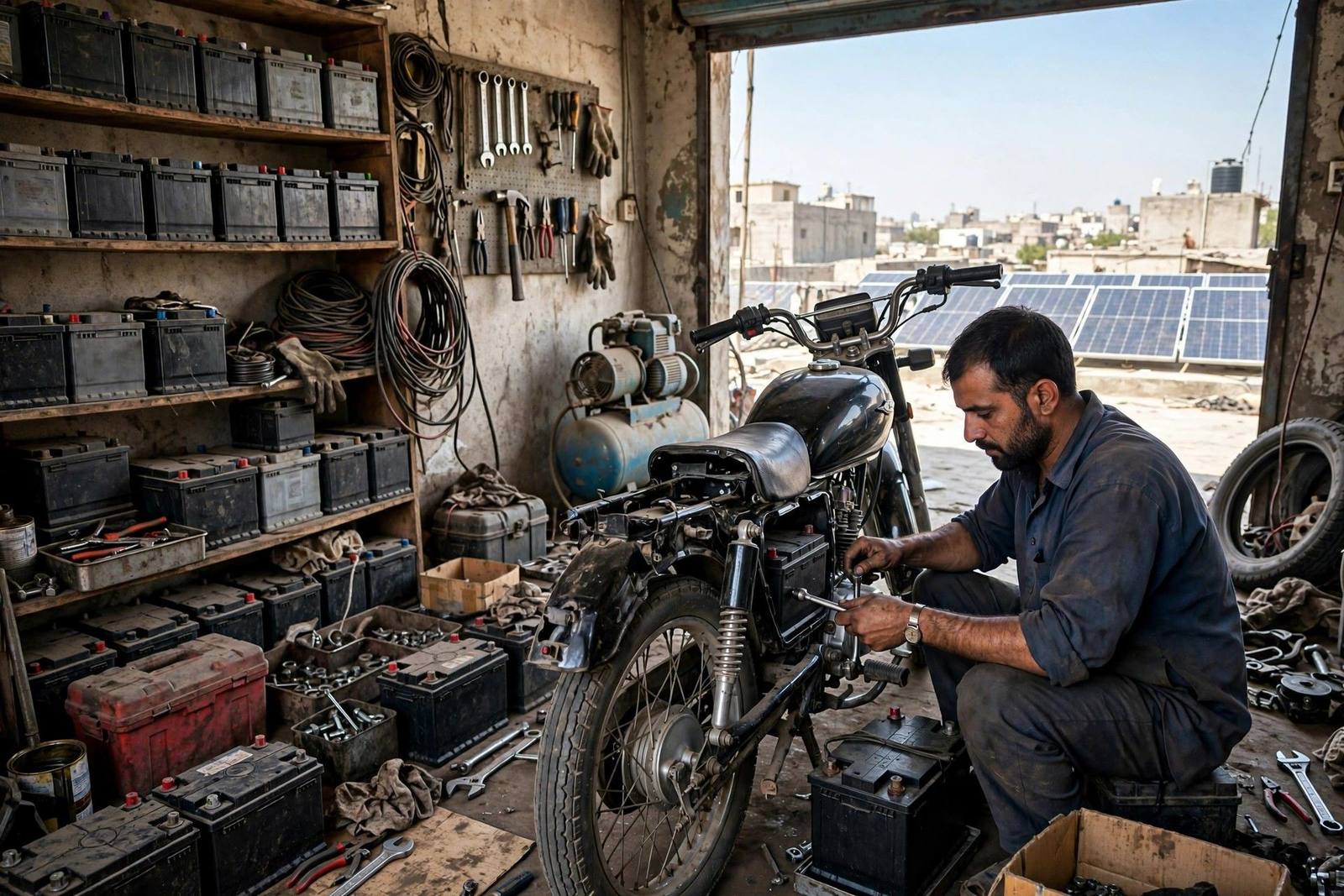
Atlas Battery manufactures and sells automotive, motorcycle and energy-storage batteries and allied products, under the AGS and Atlas brands. The catalogue is best understood by the jobs batteries do. Automotive lines span light, medium and heavy vehicle batteries, including maintenance-free and hybrid ranges, for cars, trucks, buses and tractors. Motorcycle batteries serve what is by unit volume Pakistan's largest vehicle fleet — and here the Atlas synergy is real, since the group's own Atlas Honda puts millions of motorcycles on the road, each a future replacement sale whichever brand the owner chooses. Energy-storage lines — deep-cycle, tubular and valve-regulated (VRLA) designs, and tall batteries aimed at solar installations — serve the UPS and rooftop-solar market, while allied products such as battery tonic (the distilled-water top-up of workshop tradition) fill out the shelf. Company reporting in recent years has explicitly framed its direction of travel: from conventional automotive and motorcycle batteries toward advanced energy storage, including tall batteries for solar applications and maintenance-free ranges — the same migration the whole lead-acid industry is attempting, stated in its own words.
The group context matters to how the company competes. Atlas Battery is a subsidiary of Shirazi Investments, which has held a majority of its issued capital in recent reporting periods, and it sits inside a group of around nineteen companies spanning engineering, power generation, trading and financial services — several of them listed, including Atlas Honda and Honda Atlas Cars. Shared group services, a common management philosophy and the Atlas name across the showroom give the battery company distribution credibility a standalone maker must buy.
The motorcycle side of the business is worth dwelling on, because it is where Atlas Battery's volumes quietly dwarf the car trade. Pakistan's motorcycle fleet numbers in the tens of millions, each machine carrying a small battery with a working life shortened by heat, vibration and irregular charging — a replacement rhythm far faster than the car parc's. Small batteries are individually cheap but collectively enormous, and they are bought overwhelmingly on the dealer's word at the moment of failure. A brand that keeps the motorcycle trade stocked, warranted and visited — through the same cities where Atlas Honda's machines were sold — owns a demand stream that no single year's car sales can switch off. It is the least glamorous line in the catalogue and, in volume terms, close to the most important.
How it makes money: the same lead, a different network
Battery economics are set by physics and by lead. As with its rivals, Atlas Battery's gross margin is substantially the spread between the cost of lead — the dominant input, substantially imported or priced off imports — plus plastics, acid and energy, and the prices its two markets bear. The original-equipment market supplies assemblers: motorcycle and car plants whose volumes follow the vehicle cycle. The replacement market supplies everyone else, through dealers and battery shops, and it is the replacement trade that rewards the company's investments in service — a battery is bought in distress, often at the roadside or the workshop, and the brand the mechanic stocks and the warranty the company honours decide the sale. Exports add a modest further outlet, with regional markets including Afghanistan and Yemen appearing in company-profile descriptions of its reach.
Demand cycles overlay the spread. Vehicle sales booms plant future replacement demand two to four years out; grid reliability cuts the other way for UPS demand, as rating commentary on the sector recorded when improving power supply shrank the backup-battery market at the end of the last decade; and rooftop solar rebuilds storage demand in a new form — larger, dearer batteries bought deliberately rather than in distress. Atlas's stated pivot toward solar and maintenance-free products is an attempt to be standing in the right aisle as that demand rearranges itself. Seasonality is a real feature too: Pakistani summers are hard on batteries, and the trade's calendar — pre-summer replacement peaks, monsoon stresses — shows through in quarterly results for those who read them in sequence.
Service is the other half of the product, and the Atlas system treats it as such. A battery's warranty is only as good as the nearest place that will honour it, so the branch map — Karachi to Peshawar, Sukkur to Rahim Yar Khan — functions as the brand's promise made geographical. Company material over the years has returned to the same pairing, Japanese technology and unmatched after-sales service, because in a distress purchase the second half closes the sale the first half earned. Investors sometimes underrate this: the moat is not the plate design, which rivals can approach, but thousands of counters where an AGS claim is settled without an argument, repeated weekly for decades.
Strengths, risks and honest caveats
The strengths are brand, network and parentage. AGS is a top-tier name in a market where the purchase is trust-based; the branch and dealer skeleton reaches every province; and the Atlas Group provides governance ballast — professional management institutionalised over generations is the group's explicit claim, and the battery company's longevity is evidence for it. Japanese technology heritage supports the quality end of the market, where margins live.
The risks are the industry's shared list, sharpened by competition. Lead prices and the rupee squeeze margins between price revisions. The branded oligopoly that rating agencies describe — a few large makers holding most of the formal market — is contested by smaller assemblers and informal supply at the cheap end, and by imported lithium storage at the premium end, particularly in solar, where lithium's longer life attacks lead-acid's last growth shelf. Motorcycle and car cycles transmit vehicle-market downturns into OEM volumes immediately and into replacement volumes with a lag. The company has lived through loss-making stretches in weak industry years within living memory, a useful reminder that even the best battery brands cannot repeal the lead price. Its shares, like its rival's, form a small specialist register rather than a liquid index name.
The name on the PSX
ATBA trades in the automobile-parts sector with a June financial year-end — one of the few calendar alignments it shares with the mainstream of Pakistani reporting. Its dividend character, in evergreen terms, has followed group practice: distributions in solid years, restraint when the industry cycle or lead markets squeeze, with the standard mechanics set out in how PSX dividends work. For students, ATBA's accounts repay a particular comparison: set them beside EXIDE's, and two different answers to the same industrial question — independent brand house versus group-anchored technology partner — appear in the numbers. The sector frame is in our overview of automobile stocks on the PSX.
AGS in the solar age
The energy-storage half of Atlas Battery's range is where its future is being negotiated. Pakistan's rooftop-solar adoption — households and small businesses escaping grid prices and outages panel by panel — created a storage market that did not exist when the company was designing UPS batteries, and it is a market with a genuine fork in it. Lead-acid tubular batteries, Atlas's home ground, offer lower upfront cost, local manufacture and a national service network. Lithium packs offer longer life and deeper discharge at a higher price, mostly imported. The company's public direction — tall batteries for solar, maintenance-free designs, a sustainability-framed product renewal in its recent annual reporting — shows it contesting the first fork with everything its brand carries. The outcome will not be decided by chemistry alone: financing, warranties honoured in Rahim Yar Khan as reliably as in Karachi, and the recycling value of a spent lead battery all enter the customer's arithmetic, and all of them favour a local incumbent that organises for them.
Reading Atlas Battery's results
A battery company's accounts are best read in a particular sequence. Begin with volumes implied by the vehicle market — motorcycles and cars registered in the preceding years tell you the size of the replacement wave now arriving. Then the lead cost line: gross margin in this industry is substantially a commodity spread, so a margin move needs attributing to lead and the rupee before it is credited to management. Then working capital — dealer receivables and the inventory of finished batteries and metal — where the trade's health shows first. Finally, the dividend, which in Atlas-group practice tends to be a considered signal of the board's view of the year rather than a mechanical payout of it. Read that way, ATBA's reports become a compact course in Pakistani consumer-industrial cycles, taught twice a year.
None of this should be read as insulation. Group parentage steadies governance; it does not repeal the lead price, the summer, or the dealer's freedom to stock a rival. The company's own history across industry downturns shows it sharing the sector's weather — with, its holders would argue, a better umbrella than most.
What kind of investor studies Atlas Battery
ATBA attracts the investor studying Pakistani business groups at their best: how a founder's method — Japanese partnerships, professional managers, patience — compounds across six decades and nineteen companies, and how a 1966 battery plant stays relevant through the motorcycle age, the UPS age and into the solar age. It is a smaller, clearer window on lead economics and brand economics than the giants offer. This profile is educational content, not financial advice; the Aktzien learning library holds the foundations for readers starting out.
Key takeaway: Atlas Battery, incorporated in 1966 as one of Yusuf Shirazi's first Atlas companies, makes AGS batteries with Japanese technology at S.I.T.E. Karachi — a group-anchored brand now steering from vehicle batteries toward solar energy storage.