KARACHI: Pakistan moves on two wheels. Motorcycles outsell cars many times over, rickshaws fill the gaps the buses leave, and tractors do the heavy work of the farm economy — and nearly all of them run on tyres that wear out and must be replaced, again and again, for as long as the vehicle lives. Panther Tyres Limited, ticker PTL on the Pakistan Stock Exchange, built its business precisely on that replacement rhythm. Founded in Lahore in 1983 under a different name, it was the first company in Pakistan to make tyres locally for two-wheelers and then for three-wheelers, and it has grown into one of the leading names in the country's automobile parts and accessories industry. Its story is the story of Pakistan's roads told from the tyre up.
Beginnings: Mian Tyre and Rubber, 1983
Panther Tyres was incorporated on 24 October 1983 as a private limited company under the companies law of the time, under its original name, Mian Tyre and Rubber Company Limited. Commercial operations began the same year from a manufacturing facility on Sheikhupura Road, outside Lahore — a location that put the plant in Punjab's industrial belt, close to the country's largest concentration of vehicle owners, assemblers and farmland. The company remained a private, family-run manufacturer for its first two decades before converting into a public limited company in October 2003, an early step on the long road toward a stock-market listing.
The founding bet was on the bottom of the vehicle pyramid. In 1984, by the company's own account, it became the first business in Pakistan to manufacture tyres locally for two-wheelers, and in 1993 it repeated the first with tyres for three-wheelers. Those two categories — motorcycles and rickshaws — were then, and remain now, the volume heart of Pakistani road transport. Imported tyres served the market before local production; a domestic maker that could match quality at a local price, and supply the replacement market through neighbourhood tyre shops, had an enormous and constantly renewing customer base, because a motorcycle tyre is a consumable, not a lifetime purchase.
The name change came in October 2011, when Mian Tyre and Rubber became Panther Tyres Limited — a shift from a family trading name to a consumer-facing brand, of the kind that matters in a market where the end customer, standing in a tyre shop, asks for a brand by name. The Panther identity fronts the company's push into every segment it has added since: tyres and tubes for tractors, light commercial vehicles, trucks and buses, and even the off-the-road category, where the company says it has produced the largest and heaviest tyre made in Pakistan.
What Panther actually makes and sells
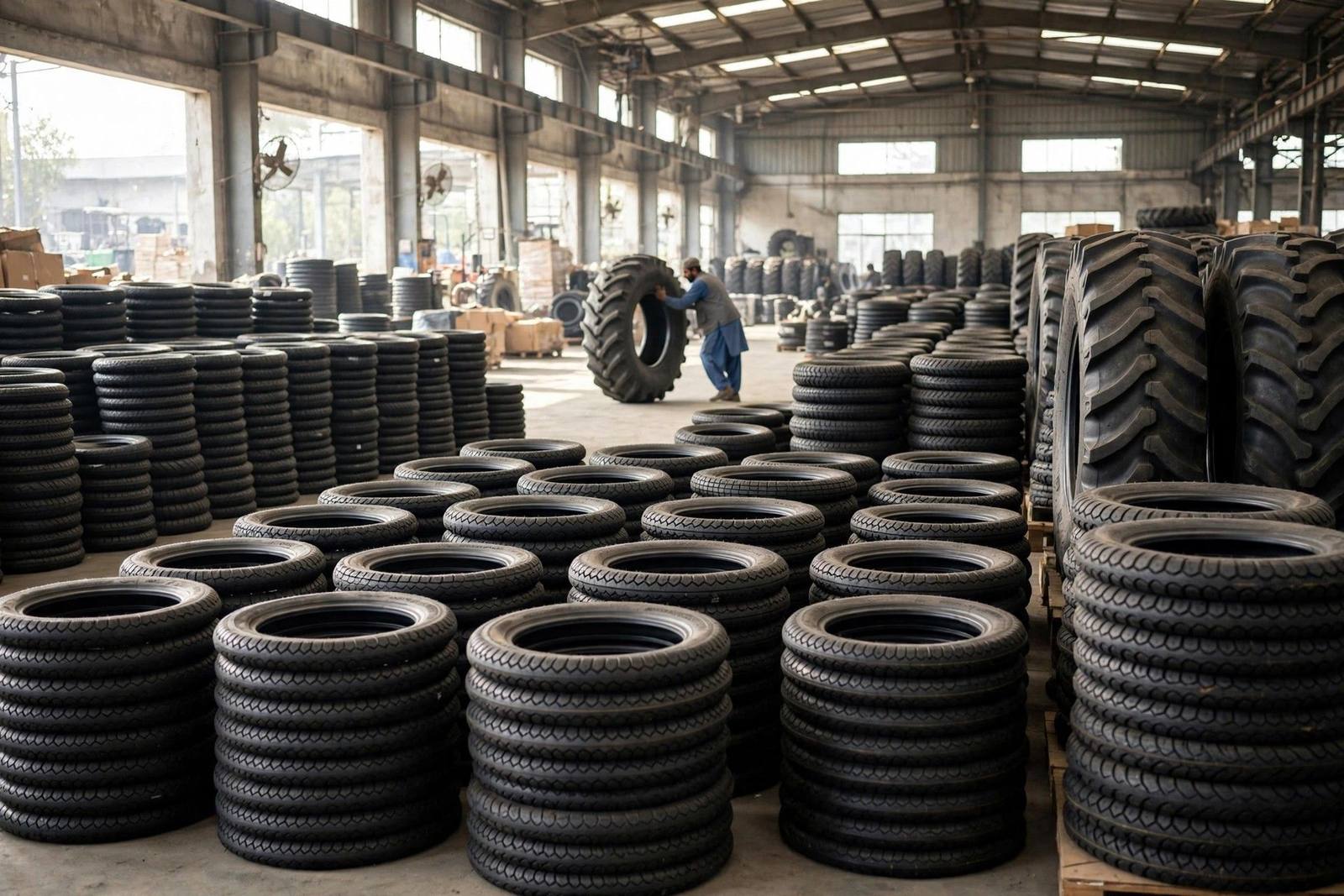
The core product is the bias tyre and its tube, made for the vehicle classes that dominate Pakistani transport. For two-wheelers and three-wheelers, Panther is an original-equipment supplier to local assemblers as well as a replacement-market brand — the dual channel that defines tyre economics, since a motorcycle leaves the factory on one maker's tyres but may be re-shod several times, by several brands, over its life. Tractor tyres serve Punjab and Sindh's farms, where the replacement cycle follows seasons and hours of field work rather than kilometres alone. Light commercial vehicle, truck and bus tyres take the company into fleet sales, including government and large corporate operators, where contracts are won on cost per kilometre and durability under overload and rough-road conditions that are simply a fact of Pakistani freight.
Around that core sit two extensions. In April 2018 the company moved into trading automobile lubricants and spare parts, using its distribution reach — more than five hundred direct business partners, by its own reporting — to sell more products through the same channel. And exports have been part of the model for decades: Panther says it began shipping locally made wheelbarrow tyres and tubes to European markets in 1996, won the national export trophy in its category repeatedly in the years that followed, and now sells motorcycle, tractor, rickshaw, light-commercial and truck tyres across markets in Asia, Africa, Europe and beyond. A Lahore plant exporting a heavy, low-value-density product like a tyre is competing on cost and reliability against much larger Asian makers, which makes the export book a useful quality signal as well as a source of foreign-currency earnings.
Quality certification underpins both channels. The company highlights its retention of ISO 9001 quality certification, alongside the occupational-health and environmental standards it lists in its annual reporting — the paperwork that assemblers and export buyers demand before a supplier is approved. In tyres, approvals are sticky: once an assembler qualifies a maker's tyre for a model, or a fleet standardises on a brand, the relationship tends to persist until quality or price gives a reason to switch.
The road to the stock exchange
For most of its life Panther was a private family business, and its 2003 conversion to a public limited company changed its legal form long before it changed its ownership. The listing itself arrived on 22 February 2021, when the company's shares began trading on the Pakistan Stock Exchange — a pandemic-era debut that placed Panther among a wave of industrial companies that came to the market in those years. The PSX equity profile records a free float of about a quarter of the shares, the balance held by sponsors and associated holders, which is a typical shape for a newly listed family manufacturer: the family keeps control, and the public holds a meaningful but minority slice.
Listing changed the company's obligations more than its business. A tyre plant is a tyre plant; but a listed Panther must publish audited accounts, announce results and material information to the exchange, and submit to the reading habits of analysts and shareholders. For followers of the stock, that transparency is the point: the segments, margins and capacity debates that were once private are now an open book, updated every quarter.
How a tyre company makes money
Tyre economics begin with a pile of commodities. Natural and synthetic rubber, carbon black, steel cord, fabric and process chemicals go into a plant; moulded, branded tyres come out. Most of those inputs are imported or import-priced, so Panther's cost line moves with world rubber and oil-linked chemical prices and with the rupee. Against those costs, revenue is volume multiplied by mix: a tractor tyre or a truck tyre earns far more per unit than a motorcycle tyre, but motorcycles sell in far greater numbers and replace far more often. Managing the mix — chasing fleet and export orders without starving the two-wheeler replacement trade that pays the bills — is the central commercial judgement in the business.
Three demand engines drive that volume. The first is the original-equipment channel: every motorcycle, rickshaw and tractor assembled in Pakistan needs tyres before it needs anything else, so Panther's factory-gate sales rise and fall with local vehicle production, the story told across our guide to PSX automobile stocks. The second, and larger over a vehicle's life, is replacement demand, which depends on the total fleet on the road, how hard it is used, and how much money owners have for maintenance — resilient in downturns, because a bald tyre cannot wait for better times, but sensitive to price when households trade down to cheaper brands or imports. The third engine is exports, which smooth local cycles when they grow and expose the company to freight costs and foreign competition when they do not.
The competitive frame is worth spelling out. In two-wheelers and tractors, Panther's historic first-mover position meets rivals including the other listed tyre maker in this series, Ghandhara Tyre and Rubber — the company Pakistan long knew as General Tyre — alongside unlisted local producers and a permanent tide of imported tyres, new and used, that caps prices at the budget end. In tractors specifically, Panther's fortunes are tied to the same farm economy that drives Al-Ghazi Tractors: when farmers are buying and working tractors, tyre demand follows, in both the factory-fit and replacement channels.
Strengths, risks and honest caveats
Panther's strengths are position and spread. It was first into the two- and three-wheeler segments that generate Pakistan's steadiest tyre volumes; it covers almost every road-vehicle category from wheelbarrow to off-the-road; it sells to assemblers, replacement buyers, fleets and export markets at once; and it has layered lubricants and parts trading onto a distribution network that took four decades to build. Few Pakistani auto-parts businesses can point to that combination of breadth and history.
The risks match the cost stack. Rubber and petrochemical inputs are priced in dollars while much of the selling happens in rupees to price-sensitive buyers, so currency slides squeeze margins until price rises can be pushed through — and price rises are contested by imports and by informal competition. Original-equipment demand is hostage to the vehicle-assembly cycle, which in Pakistan can halve in a bad year of high interest rates and import restrictions. Energy costs matter to a plant that cures rubber with heat all day. And as with many mid-sized listed manufacturers, the share's trading can be uneven, with the sponsor-held majority limiting the float available on any given day.
There is also a technology caveat that careful readers keep in view. Panther's home ground is the bias-ply tyre, the construction that suits Pakistan's dominant vehicle classes and price points; the global industry's centre of gravity, especially in cars, has long shifted to radial tyres. Panther's chosen segments have been slower to radialise, which has protected its model — but any follower of the stock should watch how quickly its categories change, and what investment the company makes to change with them.
The name on the PSX, and who studies it
PTL trades in the exchange's automobile parts and accessories sector, a mid-sized name whose results give a quarterly reading on the health of Pakistan's two-wheeler economy — as close to a consumer staple, in transport terms, as the market offers. Its dividend behaviour should be read the way one reads any growing manufacturer's: payouts compete with the plant's appetite for working capital and expansion, and vary with the cycle rather than arriving on a utility's schedule. Our guide to how PSX dividends work explains the announcement and book-closure mechanics behind any payout.
Panther tends to attract investors who like understandable, asset-backed businesses tied to real-economy volumes: motorcycle sales, tractor demand, fleet replacement and export orders. The observation points are stable — volumes by segment, gross margin against rubber prices and the rupee, the balance between assembler and replacement sales, export growth, and how much of the profit converts into cash after working capital. New readers can set those points against the foundations in the Aktzien learning library, from reading an income statement to understanding what a free float does to a share price. This article is educational content, not financial advice.
The tyre shop as a national institution
There is a social layer to Panther's market that its accounts only imply. The neighbourhood tyre shop — part workshop, part credit counter, part advice bureau — is where the replacement market actually happens, and the brands that shop stocks and recommends shape demand as surely as any advertising. A rider in a small Punjab town does not comparison-shop global tyre science; he asks the shopkeeper what lasts on his roads, at his loads, for his money. Panther's decades in that conversation, through more than five hundred direct business partners and the distributors and retailers beyond them, are a distribution asset of the slow-built kind. It is also why the company's expansion into lubricants and spare parts through the same channel made strategic sense: the counter that sells the tyre is trusted for the oil change too.
Panther's export history carries one more lesson for a new reader of the company. Shipping a bulky, price-sensitive product like a tyre from Lahore to buyers on three continents means surviving on manufacturing cost and consistency rather than on brand romance: foreign distributors reorder what performed, and drop what did not. A decade of export recognition in the company's early export years, and a continuing presence in competitive markets, is therefore evidence about the plant floor as much as the sales office — and it is the part of the Panther story most worth testing against each new annual report.
Key takeaway: Panther Tyres began in 1983 as Mian Tyre and Rubber, was first in Pakistan to make two- and three-wheeler tyres locally, and listed in 2021 — a Lahore manufacturer whose earnings ride motorcycle and tractor volumes, replacement demand and the price of rubber.