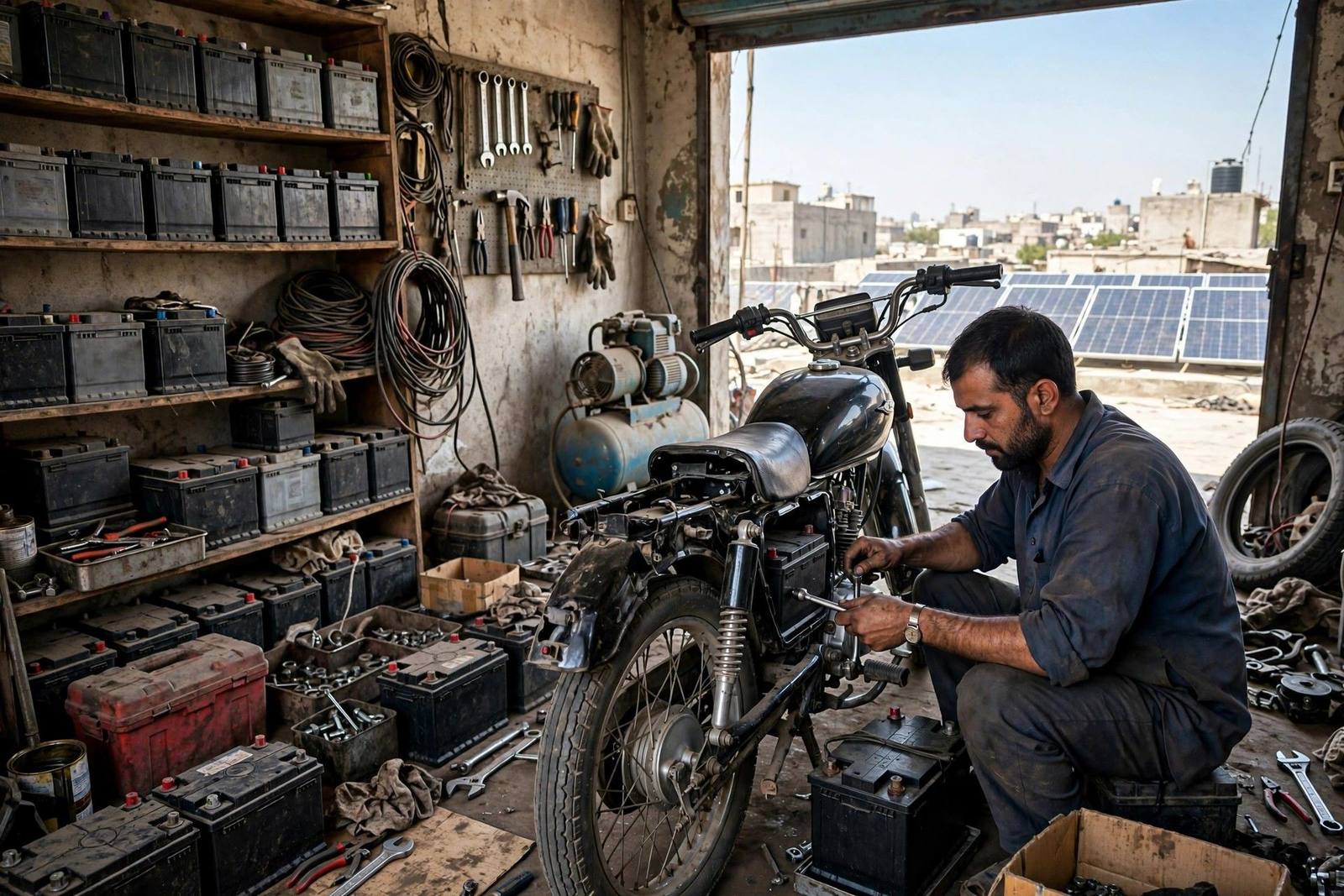
KARACHI: There is a compliment no marketing department can buy: when customers ask for your product by your company's name whatever brand they eventually take home. In Pakistan's battery trade, that name for generations has been Exide. Ask a mechanic in any city to check "the Exide" and he knows you mean the battery — the black box under the bonnet, in the UPS cabinet, beside the solar inverter. Exide Pakistan Limited, EXIDE on the Pakistan Stock Exchange, is the company behind that word: a Karachi battery manufacturer incorporated in 1953, maker of automotive and industrial batteries, chemicals and acid, and — in a sign of where its market is travelling — a seller and installer of solar energy systems. Its history is a history of Pakistan's electricity problem and the ingenious, expensive ways households learned to live with it.
Roots in the Chloride era
The company's corporate records date its incorporation to 1953 — the first industrial decade of the new state, when Karachi was assembling the basic manufactures of a modern economy. Its lineage runs through the Chloride battery world that once spanned the Commonwealth: the British Chloride electrical-storage tradition supplied the technology and the name behind much of the subcontinent's early battery industry, and the connection survives in Exide Pakistan's own structure today through its subsidiary, Chloride Pakistan (Private) Limited. The Exide name itself is a global inheritance — coined abroad in the early battery age as a contraction of "excellent oxide" in the usual telling — but in Pakistan it was naturalised completely, becoming the generic word for a storage battery in workshop Urdu and English alike.
Rating-agency histories of the company date its established presence in the modern Pakistani market from the late 1960s, and across the following decades it built the apparatus of a national battery brand: manufacturing in Karachi, and warehouses and service centres in Lahore, Rawalpindi, Peshawar, Multan, Sukkur and Faisalabad — the skeleton any serious battery maker needs, because batteries are heavy, warranty claims are local, and a dead battery is always an emergency. The company reports on an April-to-March financial year, a small administrative oddity it shares with a handful of older companies on the board.
That branch skeleton also tells you how the company weathered the industry's great demand rotation. When vehicle production boomed, the OEM contracts filled the factory; when the grid improved and UPS demand sagged at the end of the last decade — the squeeze rating agencies documented at the time — the replacement and industrial books carried more of the load; and when solar arrived, the same warehouses became the distribution spine for panels, inverters and the storage to go with them. A battery network is, in the end, a logistics business for heavy, hazardous, warranty-backed boxes, and Exide's six-city warehouse map, built over decades, is harder for a challenger to copy than any single product in its catalogue.
What it actually makes
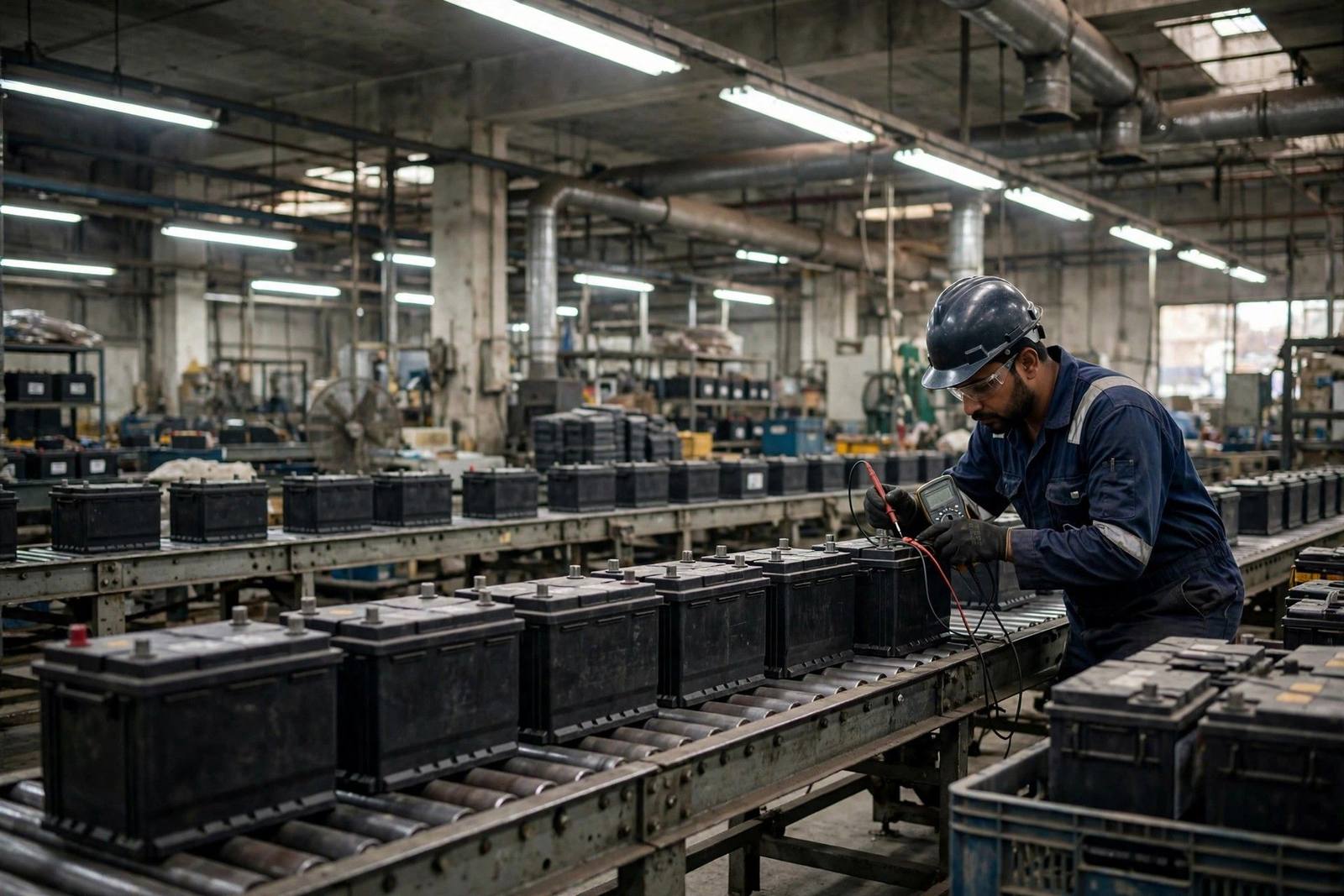
Exide Pakistan manufactures and sells batteries, chemicals and acids — the last two are not side-lines but the industry's raw anatomy, since a lead-acid battery is, in essence, lead plates, sulphuric acid and a plastic case, and controlling acid and chemical quality is controlling the product. The battery range covers the country's stored-energy needs in layers. Automotive batteries serve cars, motorcycles, light transport and heavy vehicles — the starting, lighting and ignition work every engine demands. Industrial batteries serve factories, locomotives and standby applications where failure costs far more than the battery. Household batteries — the deep-discharge units behind the UPS systems that carried Pakistani homes through the loadshedding years — complete the consumer range. And in recent years the company has added the trading, installation and maintenance of solar energy systems: the natural extension for a firm whose customers' real purchase was never a battery but the promise of power when the grid fails.
Its two demand engines mirror those of the tyre makers: original-equipment sales to vehicle assemblers, and the replacement market, which for batteries is unusually powerful. A battery is a consumable with a working life measured in a few years of Pakistani summers; every vehicle and UPS in the country is a scheduled future sale. Rating agencies describing the sector have long characterised it as an oligopoly of a few large branded makers — Exide among a leading group holding the bulk of the formal market — with a long tail of small assemblers and informal products beneath them.
How it makes money: lead, the grid and the replacement cycle
The economics of a lead-acid maker turn on one metal. Lead — much of it imported, or recovered from recycled batteries — dominates the cost of every unit, so EXIDE's gross margin is substantially a spread between the world lead price, expressed in rupees, and the prices dealers and assemblers will accept. When lead spikes or the rupee slides, margins compress until price lists are revised; when lead eases, the same mechanism flatters them. Skilled battery executives are, in large part, lead-market managers with factories attached.
Demand has a second, Pakistani driver: the state of the electricity grid. The severe loadshedding era built the UPS-battery market into a household necessity, and rating-agency commentary at the end of that decade noted the flip side clearly — as power supply improved, UPS battery demand diminished, competition intensified and new entrants crowded in. Solar changes the equation again rather than removing it: rooftop solar still needs storage for the night, and the tall tubular battery beside the inverter is the direct descendant of the UPS battery beside the meter. Exide's move into selling and maintaining complete solar systems is best read as following its own customer through that transition — from backup box to energy supplier. Exports and industrial contracts add steadier threads, but the consumer cycle — vehicles sold, batteries replaced, summers endured — remains the heartbeat. Readers comparing business models can set EXIDE beside Atlas Battery, its great branded rival, and beside the wider sector in our overview of automobile stocks on the PSX.
Recycling deserves an honest paragraph in any battery profile, because it is where the industry's economics and its environmental duties meet. A spent lead-acid battery is not waste in the commercial sense — most of its lead can be recovered and re-used, and the trade-in value of an old battery is built into how Pakistan buys new ones. The formal makers sit at the top of that recovery chain and carry the compliance costs of handling a toxic metal properly; the informal sector, which melts and recasts without those costs, undercuts on price while exporting its hazards to its neighbourhoods. For a listed maker like Exide, the spread between those two worlds is both a margin problem and a policy argument — and regulators' willingness to police the informal chain is, in a real sense, part of the company's competitive environment, as surely as the lead price itself.
Ownership and character
Exide Pakistan is a sponsor-led company with a long-serving management culture — the Shehzada family name has run its chief executive's office across recent reporting periods — rather than a subsidiary reporting to a foreign battery multinational, despite the global resonance of its brand. That independence cuts both ways in the standard Pakistani pattern: strategy is set locally, by people who know the replacement trade's seasons intimately; and the technology and buying scale of the global Exide organisations are not automatically at its disposal. The listed register around the sponsors is small — the company has a modest share count — which shapes its market behaviour, as discussed below.
Strengths, risks and honest caveats
The strengths begin with the name itself: category-defining brand recall is a distribution asset money struggles to replicate, and it is supported by a national service footprint in a product where the warranty experience decides the next purchase. The replacement cycle gives the business a recurring-revenue character that pure assemblers envy, and the solar extension opens a growth shelf adjacent to the core competence rather than a diversification leap.
The risks are lead, lithium and the long tail. Lead-price and rupee swings squeeze margins faster than price lists can follow. Lithium-ion packs — imported, falling in price, and increasingly the default for solar storage and premium applications — attack the lead-acid value proposition from above, while informal and low-priced local assemblers attack it from below on the only argument they need: a cheaper box today. Vehicle electrification is a slower threat in Pakistan than elsewhere but points the same direction over decades. Environmental scrutiny is a permanent feature too — lead smelting and battery recycling carry real hazards, and regulators and communities rightly hold the formal industry to standards the informal sector escapes, a cost asymmetry the big makers themselves frequently cite. Finally, the stock's small float means thin trading: prices can sit quiet for long periods and move sharply on modest volumes.
The name on the PSX
EXIDE trades in the automobile-parts grouping with an April-to-March year-end. Its dividend history follows the sector pattern — payouts in comfortable years, conserved cash when lead and demand squeeze together — and should be read in that cyclical frame using the mechanics in how PSX dividends work. It has never been an index heavyweight; it is a specialist's stock, followed by investors who track lead prices, summer temperatures, grid reliability and battery demand the way cement followers track coal and power followers track the circular debt.
The battery shop: how the replacement trade really works
To understand EXIDE's durability, spend an imaginary hour in a Pakistani battery shop. The customers arrive in distress — a car that would not start at a wedding, a UPS that died in the night shift of a small factory — and they buy speed, certainty and a warranty card as much as a battery. The shopkeeper's recommendation carries the sale, which is why the real competition between Exide, Atlas and the rest is fought in dealer margins, claim-settlement speed and the van that collects warranty returns, not in advertising. Old batteries flow back the other way as trade-ins — the scrap value of their lead is a meaningful part of the transaction's economics and feeds the recycling stream that supplies the industry's metal. A maker plugged properly into that loop holds its dealers through slumps; a maker that settles claims slowly discovers, one season later, that the shelves have quietly changed their allegiance.
The solar chapter is rearranging the shop's furniture. Where the UPS customer bought reluctantly and replaced resentfully, the solar customer buys deliberately, compares chemistries, and reads specification sheets — a customer Exide's new solar trading, installation and maintenance business is designed to serve whole, rather than losing the storage sale to an imported lithium brand with a better brochure. Whether lead-acid's price advantage and local serviceability outlast lithium's falling costs is the central strategic question of the company's next decade, and it will be answered in shops like these, one installation at a time.
The category word cuts the other way in one respect: when any battery fails early, the shopkeeper hears that "Exide" failed, whichever badge was actually on the box. Category names collect the whole trade's complaints as well as its compliments — one more reason the company's warranty discipline matters out of proportion to its cost.
What kind of investor studies EXIDE
EXIDE suits the investor interested in how necessity brands endure technological change: whether a name built on lead-acid can ride the solar transition, how replacement cycles cushion industrial downturns, and what a category-defining brand is actually worth when cheaper chemistry arrives. It is Pakistan's electricity story told from the cupboard under the stairs. This profile is educational content, not financial advice; the Aktzien learning library covers the foundations behind it.
Key takeaway: Exide Pakistan, incorporated in 1953 with Chloride-era roots, turned its name into Pakistan's word for a battery — earning from lead-priced automotive, industrial and household batteries, and now following its customers into solar.