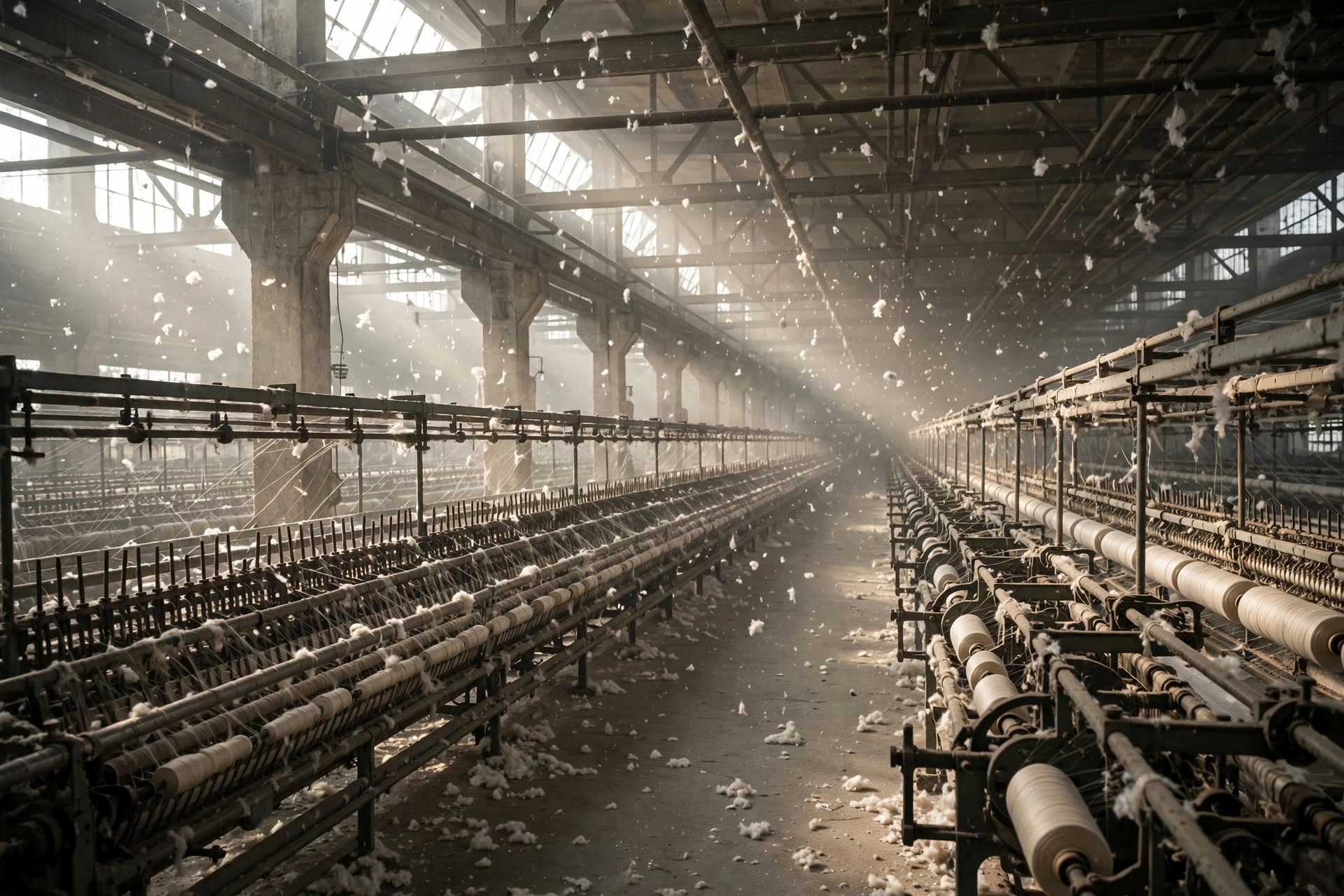
KARACHI: Almost everything Pakistan's textile industry sells to the world — the bed sheets in European supermarkets, the towels in American hotels, the knitwear on high streets — begins as yarn. Before fabric can be woven or knitted, raw cotton and man-made fibre must be cleaned, carded, drawn and twisted into thread strong and even enough for high-speed looms. That unglamorous first stage is called spinning, and one of its largest Pakistani practitioners is Gadoon Textile Mills Limited, known on the Pakistan Stock Exchange by its ticker GADT. From its original mill at Gadoon Amazai in Swabi district and a second complex near Karachi, the company spins cotton and blended yarns, knits bedding products, dyes fabric and supplies the mills and exporters further down the chain. It is a business most consumers never see, sitting quietly at the base of Pakistan's biggest export industry — which is precisely why it rewards a closer look.
A mill named after a place, in an estate built for a purpose
Gadoon Textile Mills was incorporated in Pakistan on 23 February 1988, and commercial production began in 1990. The name comes from its first home: the Gadoon Amazai area of Swabi district in what is now Khyber Pakhtunkhwa. The industrial estate developed there in the late 1980s was itself an unusual piece of economic policy — industry was deliberately encouraged into a remote, mountainous area to create factory employment and alternative livelihoods for local communities. A spinning mill fitted that logic well. Spinning is labour-intensive, it does not need a port on its doorstep, and its raw material could be brought in by road while finished yarn — far more valuable per truckload than raw cotton — travelled out.
The young company started modestly, with an initial installation of around 14,400 spindles. A spindle is the rotating unit that twists fibre into yarn; spindle count is the spinning industry's basic measure of size, much as loom count is for weaving. From that small base, Gadoon expanded in stages over the following three decades — adding modern automatic machinery, broadening its product range and eventually growing, helped by a merger with Fazal Textile Mills, into an operation with hundreds of thousands of spindles across its sites. That trajectory — small provincial start, relentless reinvestment, group backing — is a common pattern among Pakistan's surviving textile companies, and Gadoon is one of its clearest examples.
Inside the Yunus Brothers Group
Gadoon does not stand alone. It is part of the Yunus Brothers Group, usually shortened to YBG, one of Pakistan's largest business groups. The group traces its origins to a trading house established in 1962 by the Tabba family, and it grew from trading into manufacturing across textiles, cement and building materials, energy, chemicals, pharmaceuticals, food and automobiles. Its best-known listed company internationally is Lucky Cement, but textiles were the group's industrial foundation, and Gadoon sits alongside sister textile businesses such as Lucky Textile Mills within that side of the empire.
For Gadoon, group membership matters in practical ways. A majority of its shares are held through the group's holding structure, which gives the company a stable sponsor rather than a dispersed, shifting shareholder base. Group affiliation can ease access to bank finance, because lenders look at the sponsor's overall strength as well as the single company's accounts — credit rating assessments of Gadoon explicitly note the sponsor profile of the Yunus Brothers Group as a supporting factor. It also means Gadoon earns more than spinning income: the company holds long-term investments in associated companies and receives recurring dividend income from them, a secondary earnings stream that sits alongside its manufacturing profit and softens the textile cycle a little.
What the mills actually make
Gadoon's principal activity is the manufacture and sale of yarn, and its range is unusually wide. The mills process all categories of cotton and man-made fibres — polyester, viscose and blends — and produce yarns by several different technologies, each with its own economics and end uses:
- Ring-spun and compact yarn — the traditional premium route, producing strong, smooth yarn for quality fabrics. Gadoon was an early mover in compact spinning in Pakistan and built a reputation in compact and core-spun yarns, where an elastic or filament core is wrapped in cotton for stretch fabrics.
- Jet and vortex-spun yarn — high-speed air-based spinning (including Murata jet and vortex systems) that produces yarn quickly and with a distinctive structure suited to knitted garments.
- Open-end and blended yarns — coarser counts, slub effects and poly-cotton blends for denim, towels and everyday fabrics.
Beyond yarn, the company has moved a step downstream into knitted bedding products and dyed fabric, and it offers dyeing services — in other words, it sells not only thread but some finished and semi-finished home-textile products, which carry better margins than commodity yarn. In a further diversification that surprises many first-time readers of its accounts, Gadoon also produces and sells milk, a small agribusiness sideline that rating reports list among its activities. The core, however, remains spinning: the company is fundamentally a very large, flexible yarn factory selling business-to-business, both to Pakistani weavers and knitters and to buyers abroad, with its products exported to markets in North America, Europe and Asia.
Two plants, north and south
Geography is a deliberate part of the model. The Swabi plant sits in the north, in Khyber Pakhtunkhwa, closer to cotton-growing areas of Punjab and to northern customers, while the Karachi-area plant in Sindh sits near the port, the country's largest industrial market and export shipping. Running both ends of the country lets the company balance freight costs in both directions — raw material in, finished yarn out — and serve export orders through Karachi without hauling everything from Swabi.
Like most large Pakistani spinners, Gadoon also had to solve the energy problem for itself. Spinning mills run around the clock, and grid interruptions damage both machinery schedules and yarn quality, so the company developed captive power generation at its sites to keep spindles turning, and in recent years, like much of the industry, it has invested in solar capacity to trim energy costs. Energy is not a footnote for a spinner: after raw cotton, it is typically the largest cost of making yarn, and the gap between mills that manage energy well and those that do not shows up directly in margins.
How a spinning mill makes money
The economics of spinning can be reduced to a spread. On one side is the price of the input: raw cotton, bought in a global market where Pakistani mills compete with the harvest at home and prices abroad, plus polyester and other man-made fibres whose prices follow petrochemical markets. On the other side is the price of yarn, set by demand from weavers, knitters and garment exporters at home and overseas. Between the two sits the mill's conversion cost — labour, energy, maintenance, finance and depreciation. Profit is what remains when the yarn price minus fibre cost exceeds that conversion cost, multiplied by a very large number of kilograms.
Three features of that arithmetic shape Gadoon's results. First, utilisation: spinning machinery is expensive and largely fixed in cost, so a mill running near full capacity spreads those costs thinly, while a half-idle mill bleeds. Gadoon has historically reported high capacity utilisation, and its flexibility — the ability to switch between yarn counts and fibre types as orders change — helps keep spindles loaded. Second, product mix: fine, compact and speciality yarns earn more per kilogram than coarse commodity counts, which is why the company emphasises its compact and core-spun capability and its knitted-bedding and dyeing activities. Third, the cotton cycle: when cotton prices spike, mills holding cheaper inventory gain briefly, then face dearer replacement stock; when prices collapse, inventory bought dear must be sold into a falling yarn market. Managing the timing and hedging of cotton purchases is as much a part of a spinner's skill as running the machines.
Exports add a currency dimension. Yarn and bedding sold abroad are priced in dollars, while much of the cost base — wages, local overheads — is in rupees, though cotton itself is effectively dollar-linked through import parity. The net effect is that spinners behave partly like exporters: a weaker rupee generally supports rupee margins on export sales, while a strong domestic cotton crop supports them from the cost side. Our guide to PSX textile stocks explains how spinning, weaving and composite companies across the sector share these drivers to different degrees.
Gadoon's place in the cotton chain — and in the index
Pakistan's textile chain runs from ginning and spinning through weaving, processing and stitching to the garments and home textiles that dominate the country's export basket. Spinners like Gadoon are the chain's foundation and its shock absorber: when global apparel demand slows, orders stop first and hardest at the fabric and yarn stage, and when demand recovers, spinners feel the restocking rush early. Gadoon is regularly described in industry and rating coverage as one of the country's larger spinning operations, and its membership of the International Textile Manufacturers Federation, which it joined as a corporate member in 2022, reflects that standing among global peers.
For stock-market readers, Gadoon's KSE-100 membership is itself instructive. The index is not a list of Pakistan's biggest companies in the abstract; it is a free-float, market-capitalisation-weighted selection reviewed periodically, as our explainers on how the KSE-100 is calculated and index rebalancing set out. A mid-sized industrial company can hold a seat when its tradable shares and market value qualify, and can lose it at a review if they no longer do. Understanding market capitalisation — share price multiplied by shares in issue — helps explain why a company most Pakistanis have never heard of can sit in the same benchmark as the country's largest banks.
Surviving the textile cycle
Longevity in Pakistani spinning is itself an achievement, because the industry's history is littered with mills that expanded at the top of a cotton or export boom and failed in the downturn that followed. The pressures are structural. Domestic cotton production has struggled for years with pests, weather and competing crops, pushing mills toward imported cotton and exposing them to global prices and shipping costs. Energy tariffs have risen repeatedly, eroding the cost advantage that cheap labour provides. Interest rates in Pakistan can climb to levels that make carrying large cotton inventories — a spinner must buy much of its year's fibre in a short harvest window — painfully expensive. And demand is set abroad, by apparel retailers in the United States and Europe whose ordering swings Pakistani mills can only react to.
Gadoon's responses to that environment are visible in its profile: scale large enough to buy fibre and machinery on good terms, two plants to balance freight and energy options, investment in its own power and in newer, more efficient spinning technology, a product range skewed toward higher-value compact and speciality yarns rather than the coarsest commodity counts, and a move into knitted bedding and dyeing that captures one more step of margin before the product leaves the group of processes it controls. The backing of a diversified group with interests far beyond textiles does not remove the cycle, but it has historically given the company more staying power through it than a thinly capitalised standalone mill would have — one reason the business that began with a few thousand spindles in Swabi is still, well over three decades later, a benchmark constituent.
What followers of Gadoon typically watch
Readers who track spinning companies tend to focus on a consistent set of observation points, and Gadoon is no exception. Cotton prices and the size and quality of the domestic crop come first, because they set the input side of the spread. Yarn export demand and prices in Pakistan's main markets come next, together with the exchange rate. Energy tariffs and availability matter constantly, given spinning's power intensity and the company's investment in self-generation. Capacity utilisation and any expansion or modernisation spending indicate whether management expects demand to hold. Finally, for Gadoon specifically, the dividend income from group investments and the performance of the wider Yunus Brothers Group provide context that a pure standalone spinner would not have. None of these points, alone or together, amounts to a verdict on the shares — they are simply the dials that explain why profits move when results are announced, a habit of reading the Aktzien learning library encourages for every sector.
Aktzien, the investing app being built for Pakistan, plans to present company information in this same plain style — what a business does and how it earns, before any numbers. This profile is educational content, not financial advice, and nothing in it is a recommendation to buy or sell GADT shares.
Key takeaway: Gadoon Textile Mills is the Yunus Brothers Group's spinning anchor — founded in Swabi in 1988, now running large mills in the north and near Karachi, turning cotton and blended fibres into yarn, knitted bedding and dyed fabric whose profits live or die on the spread between fibre costs and yarn prices.