KARACHI: Few companies on the Pakistan Stock Exchange can claim to have been American, Pakistani-private, state-owned and Pakistani-private again — under two different names — while staying in the same line of work throughout. Ghandhara Industries Limited, ticker GHNI, is one of them. From its plant in Karachi's S.I.T.E. industrial area it assembles and markets Isuzu trucks, buses and the D-Max pickup, and it does so on a site whose motor-industry history runs back to General Motors in the years just after independence. Nationalised in 1972 and renamed National Motors, privatised in 1992 and renamed back in 1999, GHNI is simultaneously a modern Japanese-franchise truck business and a living museum of Pakistan's industrial policy — every era of that policy has left its name on this company's letterhead.
General Motors comes to Karachi
The story begins before Pakistan's own auto industry had a name. Company histories trace the operation to a mobile assembly plant set up in Karachi in 1942 to support wartime military needs, and General Motors formalised its presence after independence: a Karachi branch of General Motors Overseas Distribution was inaugurated in 1949, construction of a permanent plant began in 1951, and the facility to assemble trucks and buses began operating in July 1953. In 1956 a car line was added, producing models under GM's Chevrolet, Bedford and Vauxhall badges. For a young country with almost no engineering industry, this plant — welding, painting and assembling vehicles in Karachi — was a foundation stone: it trained the first generation of Pakistani auto workers, supervisors and parts vendors on whom the whole later industry was built.
The GM chapter ended in the early 1960s. The facility was shut in October 1963 and acquired by Lieutenant General Habibullah Khan Khattak, the founder of what became the Bibojee Group, who renamed the business Ghandhara Industries Limited. Under Khattak the plant added GM-linked Holden and Opel models — the Opel Kadett among them — alongside its Bedford truck work in the mid-1960s. The Ghandhara name, borrowed from the ancient civilisation of the north-west, thus entered the motor trade, where the Khattak family's companies still carry it today. Political change soon complicated ownership: after the fall of President Ayub Khan's government, in which Khattak's son-in-law Gohar Ayub Khan was a prominent figure, the family's shareholding passed for a time to state investment institutions — a foretaste of the full nationalisation to come.
National Motors: the state years, 1972–1992
In 1972 the Government of Pakistan nationalised Ghandhara Industries along with much of the country's large-scale industry, and the company became National Motors Limited. The renamed state enterprise continued producing Vauxhall cars and Bedford trucks and buses into the 1970s, while imports of American Chevrolets ended. The state years kept the plant and its workforce alive but narrowed its world: model development froze around the franchises it already held, and the industry's centre of gravity began to shift. A marker of that shift came in 1984, when the Toyota franchise the company held was transferred to the new Toyota Indus venture — the Japanese wave that would dominate the next four decades of Pakistani motoring was arriving, and National Motors was not to be its vehicle.
Privatisation returned the company to its founding family. In January 1992, under the government's privatisation programme, Bibojee Services acquired National Motors Limited — reported at the time at a price of about Rs 150 million — and the Khattak heirs once again owned the plant GM had built. The circle was formally closed on 27 November 1999, when the company dropped the National Motors name and resumed its original identity as Ghandhara Industries Limited. Few Pakistani companies wear their country's economic history quite so literally in their own name changes.
The Isuzu company
Under restored private ownership, GHNI's defining decision was its franchise. The company became the authorised assembler and manufacturer of Isuzu vehicles in Pakistan, and Isuzu — the Japanese maker specialising in diesel trucks and commercial vehicles — has been its identity ever since; the business trades in the market as Isuzu Pakistan. The range is built around Isuzu's global truck architecture:
- N-series light trucks (the Elf family) — the urban delivery workhorses sold to distributors, courier and goods businesses;
- F-series medium and heavy trucks (the Forward family) and prime movers for intercity freight;
- C and E-series heavy trucks (the Giga family) for the largest haulage work;
- Bus chassis, on which GHNI and body-builders fabricate bus and load bodies — the company fabricates bodies in-house as part of its operation;
- The Isuzu D-Max double-cabin pickup, which takes the truck maker's durability pitch into the consumer and corporate pickup segment contested by rival Japanese and, increasingly, Chinese models.
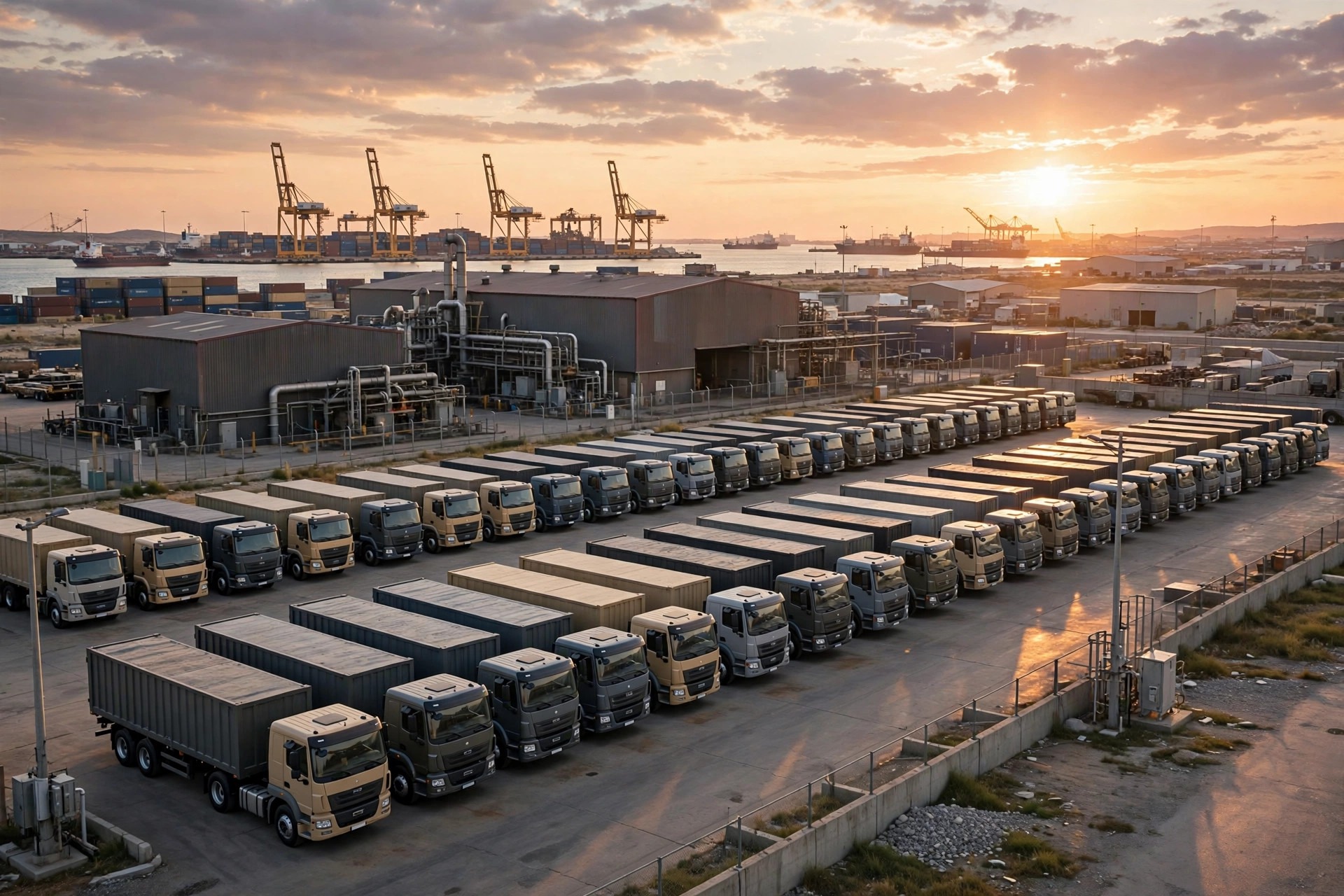
Assembly takes place at the S.I.T.E., Karachi plant through progressive manufacturing — the industry term for steadily deepening local content — and sales run through a countrywide dealer network, with after-sales parts and service as an integral part of the offer. Company reporting describes a range running to some 38 truck and bus models and variants, plus a half-dozen D-Max variants, sold through 3S (sales, service and spares) dealerships in the major cities. The customer list is notably institutional as well as commercial: alongside private fleet owners, the company counts the armed and paramilitary forces and federal and provincial government departments among its buyers — the kind of fleet business, won on durability and service coverage rather than showroom appeal, on which a truck franchise is built.
The principal behind the franchise has a pedigree of its own. Isuzu's roots run back to 1916 in Tokyo, where the shipbuilding and gas-and-electric companies that became Isuzu began planning automobile production; in 1919 the venture built what is regarded as Japan's first truck. A century of concentrating on diesel commercial vehicles — rather than spreading across every category of motor car — is exactly the specialism GHNI bought into, and it explains the shape of the Pakistani range: light, medium and heavy trucks, bus chassis and one pickup, and nothing else. The D-Max's modern chapter in Pakistan opened formally in February 2019, when Ghandhara and Isuzu launched the full D-Max range at a ceremony in Karachi, presenting the pickup — already sold in more than a hundred countries — as a locally assembled contender rather than an imported indulgence. That launch marked the moment GHNI's identity completed its shift: no longer the inheritor of the Bedford era, but Isuzu Pakistan in name, range and strategy.
The company also exports in small volumes to markets in Africa and the Indian Ocean, and in 2017 it earned a place on Forbes Asia's "Best Under a Billion" list of notable small and mid-sized listed companies in the region — a rare international nod for a Pakistani truck assembler. Its shareholding keeps it firmly inside the family group: the largest stakes are held within the Bibojee fold, including by its sister company Ghandhara Automobiles (GAL), the multi-brand assembler whose own story runs in parallel.
How a truck assembler makes money
GHNI's economics follow the CKD assembly model described in our guide to PSX automobile stocks, with a commercial-vehicle accent. Kits and major components come from Isuzu in Japan, priced in foreign currency; local vendors supply a growing share of parts; the Karachi plant welds, paints and assembles; dealers sell and support the finished trucks. The profit inside each truck is the selling price minus kit cost, local parts, plant costs, distribution and finance — and every term in that subtraction moves:
- Freight demand sets volumes. Trucks are bought when goods need moving — cement and construction booms, harvests, container traffic, infrastructure projects — so GHNI's order book is a derivative of the whole economy's activity, and of replacement demand from fleets whose old trucks wear out.
- The yen and the rupee set kit costs. A weaker rupee raises the landed cost of Japanese kits and forces the price revisions that flow, with a lag, into truck prices across the industry.
- Interest rates set affordability. Many trucks are bought on bank and leasing finance, so the policy rate reaches GHNI's showrooms as directly as it reaches a car maker's.
- Localisation and body-building add margin at home. Fabricating bus and load bodies and deepening local parts content captures value that a pure kit assembler leaves on the table, and cushions currency exposure.
- Parts and service smooth the cycle. The parc of Isuzu trucks already on Pakistani roads needs genuine parts and workshop support every year, whatever new-truck sales do.
Trucks also differ from cars in the showroom psychology: the buyer is usually a business calculating cost per kilometre and downtime, not a family choosing comfort. That makes durability reputation and resale value — areas where Isuzu's diesel heritage is the company's core sales argument — commercial assets as real as the plant itself, and it makes fleet orders lumpy: a single transporter's decision can move a quarter's numbers, for better or worse.
GHNI beside GAL: one family, two strategies
Reading GHNI next to its sister clarifies both. GAL spread its bets across several principals — Dongfeng, JAC, Renault Trucks, and a sequence of car ventures — accepting the churn of contracts as the price of breadth. GHNI concentrated on a single principal and a single specialism, trucks and buses, accepting dependence on Isuzu's model cycle and Pakistan franchise as the price of depth. Both strategies live inside the same group and the same industry forces; their results diverge mainly when a principal relationship changes (GAL's history) or when the truck cycle turns (GHNI's exposure). Pakistan's roads run on both: the intercity freight that GHNI's F-series and Giga trucks haul is the same economy GAL's lighter vehicles distribute into cities.
The Bedford inheritance and the vendor economy
Older Pakistanis still use "Bedford" almost as a generic word for a truck, and that is GHNI's inheritance in folk memory: for decades the plant's Bedford trucks and buses — the famous, colourfully decorated workhorses of intercity roads — were the face of Pakistani road transport. The badge is gone, but two legacies of that era remain commercially relevant. The first is mechanical familiarity: generations of Pakistani mechanics learned their trade on this plant's vehicles, and a nationwide informal knowledge of how to keep its trucks running is a quiet competitive asset for any successor franchise, Isuzu included. The second is the vendor economy the plant created. Progressive manufacturing requires local suppliers of seats, springs, radiators, exhausts, glass, wiring and hundreds of smaller parts; around the S.I.T.E. plant and its dealer network sits a web of Pakistani engineering firms whose order books rise and fall with GHNI's production schedule. When readers ask what a single mid-sized assembler contributes to the wider economy, that supplier web — plus the transporters whose businesses run on its trucks — is most of the answer.
The D-Max deserves a note of its own in this context, because it represents the truck maker's bridge into a market its founders would not have recognised: the double-cabin pickup as a family and lifestyle vehicle. Pakistani demand for such pickups grew with construction wealth, agricultural incomes and a taste for vehicles that can work on weekdays and travel on weekends. For GHNI, success in that segment diversifies it away from pure fleet cyclicality; difficulty there leaves it more exposed to the freight cycle. Either way, the segment's contest — against the entrenched Toyota Hilux, newer Chinese entrants including its own sister company's JAC pickups, and imported used vehicles — is one of the most visible competitive stories in the industry.
What followers of GHNI typically watch
Observers tend to track monthly commercial-vehicle production and sales, the freight and construction indicators that precede truck demand, the rupee–yen exchange rate, and the financing conditions that govern fleet purchases. Company-specific points include the D-Max's progress against entrenched pickup rivals, any expansion of local content or body-building, export orders, and the state of the Isuzu model range in Pakistan. GHNI's KSE-100 membership, like every constituent's, is recalculated through free-float market value at each review — the process set out in how the KSE-100 is calculated and market capitalisation explained. This profile is educational content, not financial advice, and Aktzien — the investing app being built for Pakistan, whose learning library teaches the assembly model, index mechanics and dividend basics behind stories like this — presents these points as ways to understand the business, never as a recommendation to trade its shares.
Key takeaway: Ghandhara Industries began as General Motors' Karachi plant in 1953, was acquired by the Bibojee founder in 1963, nationalised as National Motors in 1972, reprivatised to the same family in 1992 and renamed back in 1999 — and today earns its living assembling Isuzu trucks, buses and D-Max pickups whose fortunes track Pakistan's freight economy.