KARACHI: Some listed companies keep the same name and the same product for half a century. Ghandhara Automobiles Limited — GAL on the Pakistan Stock Exchange — is not one of them. It began life in 1981 as Ghandhara Nissan, the Pakistani partner of Japan's Nissan, spent decades defined by that single relationship, and then, as the economics of Pakistan's car industry changed, reinvented itself as something rarer: a multi-brand assembler. Today its plants at Port Qasim, Karachi, assemble Dongfeng and JAC trucks and pickups and Renault Trucks heavy vehicles, and its recent history includes assembling Chery sport-utility vehicles. In April 2023 the company formally caught up with its own transformation, dropping "Nissan" from its name to become Ghandhara Automobiles Limited. Its story is a compact history of Pakistan's automobile industry itself — Japanese partnerships, long fallow periods, and the arrival of Chinese brands.
The Bibojee inheritance
GAL belongs to the Bibojee Group, a Karachi-based conglomerate founded by Lieutenant General Habibullah Khan Khattak, a former senior army officer known by the nickname "Bibo" or "Bibojee", from which the group takes its name. Khattak began building the group around 1960, starting with a textile mill in Kohat and an insurance company, and in 1963 he and his family acquired the Karachi plant of General Motors' overseas distribution business, renaming it Ghandhara Industries — the sister company profiled separately as Ghandhara Industries (GHNI). The group's companies are owned by Khattak's heirs, and its listed interests have spanned textiles, tyres, insurance, construction and automobiles.
The name the family chose — Ghandhara — reaches back to the ancient Gandhara civilisation of the Peshawar valley region, a piece of branding that roots a thoroughly modern truck business in deep local history. Within the group, the two automobile companies eventually divided the work: GHNI became the Isuzu specialist, while the company now called GAL became the group's flexible assembler, taking on successive foreign partners. The two remain connected — GAL has held an investment stake in its sister company — and at times GAL's underused car plant has even carried out contract assembly work for group vehicles, a reminder that in Pakistani industry, capacity is often shared inside families of companies.
1981: a Nissan company is born
Ghandhara Nissan was incorporated in 1981, initially to distribute completely built-up Nissan vehicles imported into Pakistan. Through the following decade it deepened the relationship: a technical assistance agreement with Nissan Motor and a joint venture arrangement with Nissan Diesel — the truck arm later known as UD Trucks — for the progressive local assembly of passenger cars, light commercial vehicles and heavy-duty trucks and buses. In 1992 the company became a public listed company on the Karachi Stock Exchange, giving ordinary investors a share in the franchise.
Local car production followed in the mid-1990s, when the Nissan Sunny began rolling out of the company's plant. The Sunny era defined GAL for a generation of Pakistani motorists: a Japanese sedan, locally assembled, competing against the Toyota Corolla and Honda Civic and City that dominated the segment. But the car business never achieved the scale of its two big Japanese rivals, whose volumes funded deeper localisation and stronger dealer networks. Around 2010, local production of Nissan cars ceased, and the car assembly plant — built for about 6,000 cars a year on a single shift — spent long stretches underused, kept relevant by truck assembly and contract work. That long gap between the end of the Sunny and the arrival of new partners is the central fact of GAL's middle history: a listed assembler with plants, licences and skills, waiting for the right principals.
Reinvention: Dongfeng, JAC and Renault Trucks
The reinvention came from China and Europe rather than Japan. GAL built a business assembling and distributing Dongfeng commercial vehicles — the Chinese group's trucks range from light delivery models to heavy prime movers — establishing a dedicated Dongfeng venture in the early 2010s and making Chinese trucks the backbone of its volumes. JAC Motors, another Chinese maker, followed: JAC light and medium trucks, and the JAC X200 pickup-style loader that became a familiar sight in Pakistani cities, gave GAL a second Chinese franchise in the lighter segments. In 2018 it added Renault Trucks, the European heavy-truck brand, assembling models for long-haul and construction work. Step by step, the "Nissan company" had become a three-brand commercial-vehicle house, with two plants at Port Qasim — a truck plant and the car plant — and a dealer and service presence beyond Karachi.
Two attempts to revive the car side the conventional way did not survive. A plan announced in 2016 for Renault to assemble cars in Pakistan with Ghandhara Nissan was shelved after the French group pursued the project with a different partner structure, and a 2018 manufacturing and licensing agreement with Nissan to produce Datsun models locally was suspended before production began. The lesson those episodes taught the market was that in Pakistan's policy-driven auto industry, an announced partnership is not a product — a distinction GAL's own history illustrates better than most.
The SUV chapter and the pickup present
The car plant finally returned to regular passenger-vehicle work through China. In February 2021 GAL announced it would assemble Chery vehicles in Pakistan, and Chery's Tiggo 4 Pro and Tiggo 8 Pro SUVs followed, putting GAL back in showrooms with modern, feature-rich crossovers aimed at the segment then being reshaped by new entrants. Industry reporting in early 2025 indicated the Chery arrangement had run its initial course after several years, underlining again how principal relationships in this industry are contracts with lifespans, not permanent marriages. GAL's response was to deepen the franchise it already had: in January 2025 it launched the locally assembled JAC T9 Hunter, a double-cabin 4x4 pickup pitched against the established Japanese pickups, and demand at launch was strong enough that bookings were temporarily paused within days to protect delivery schedules — the kind of problem the company had rarely enjoyed during the quiet Nissan-less years.
That sequence — Sunny, silence, Chery, T9 — also explains the 2023 renaming. A company called "Ghandhara Nissan" that no longer assembled Nissans, and whose growth was coming from Dongfeng, JAC and Renault Trucks, was carrying a name that described its past rather than its present. On 18 April 2023, Ghandhara Nissan Limited became Ghandhara Automobiles Limited, keeping the GAL ticker and the Ghandhara heritage while freeing the brand to host whatever principals come next.
How an assembler makes money
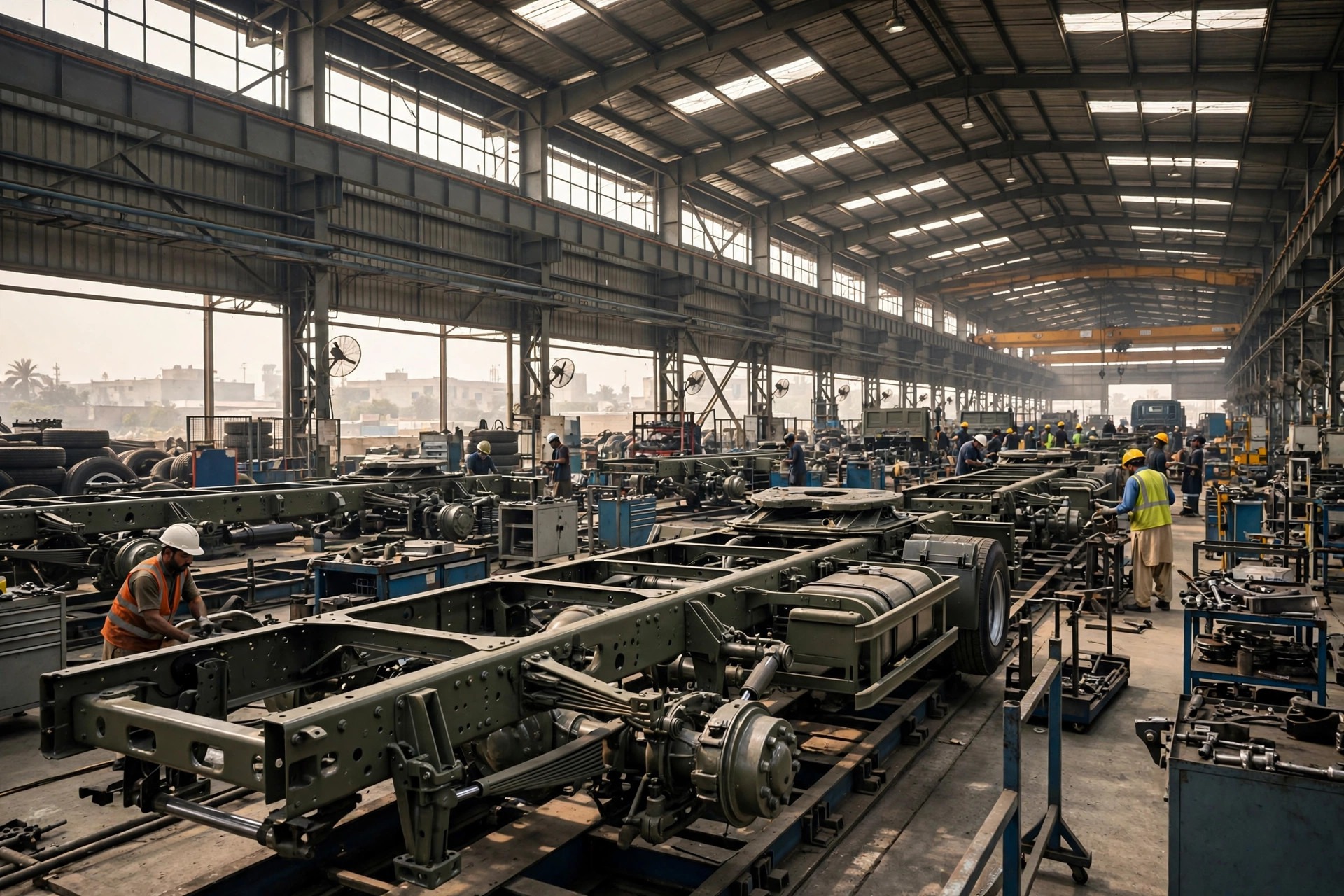
Assembly is a distinct economic model from both importing and full manufacturing, and GAL is a clean example of it. The assembler buys completely knocked-down (CKD) kits and components from its foreign principal, combines them with locally made parts from Pakistani vendors, and performs the capital-intensive middle steps — welding, painting and final assembly — before selling finished vehicles through dealers. Revenue is simply vehicles sold multiplied by their prices, but the margin inside each vehicle is a negotiation among forces the assembler does not control:
- Kit prices and the exchange rate — CKD kits are priced in the principal's currency, so a weaker rupee raises the cost of every vehicle before a single local expense is counted; assemblers respond with the price increases Pakistani car buyers know well.
- Localisation — every part sourced from a Pakistani vendor instead of the imported kit reduces the foreign-exchange content and usually the cost, which is why government policy has long pushed assemblers toward progressive localisation, and why vendor industries cluster around the plants.
- Volume and capacity use — a plant's fixed costs are spread over however many vehicles it builds; GAL's history shows both ends of this, from an idle car plant to a sold-out pickup launch.
- Mix — heavy trucks, light trucks, pickups and SUVs carry different margins and different demand cycles: trucks follow freight, construction and fleet budgets, while pickups and SUVs follow consumer and corporate spending.
Alongside assembly, GAL earns from importing and selling built-up vehicles and parts, from contract assembly for other companies, and from the after-sales ecosystem of parts and service that an installed base of trucks generates year after year. Commercial vehicles also behave differently from cars across the economic cycle: truck demand tracks the whole economy's movement of goods — cement, fuel, containers, harvests — which is why our guide to PSX automobile stocks treats truck assemblers and car assemblers as related but distinct animals.
GAL's place in Pakistan's roads and in the KSE-100
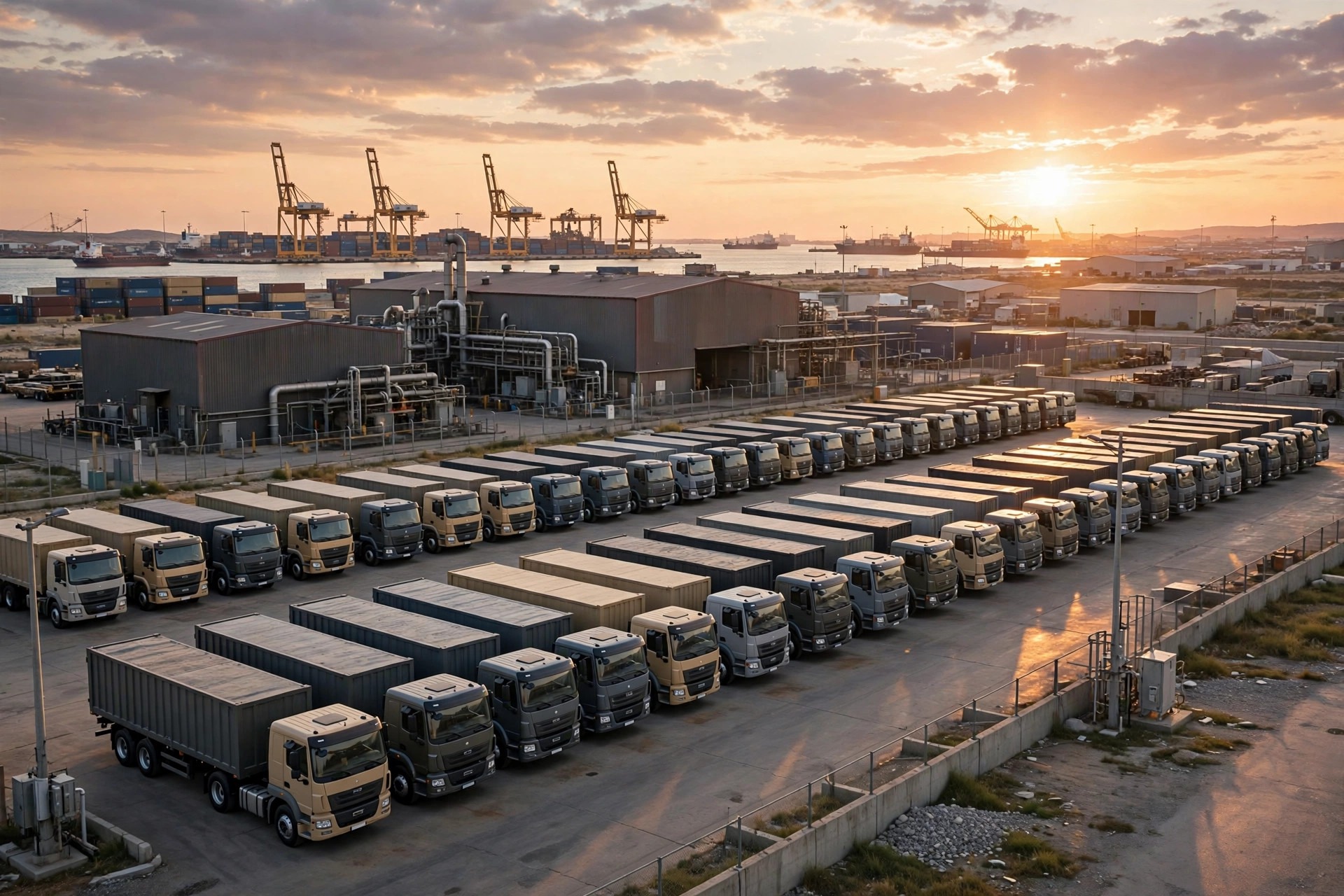
Walk any highway out of Karachi and GAL's output is part of the traffic: Dongfeng prime movers hauling containers from Port Qasim, JAC loaders delivering goods in city bazaars, Renault Trucks on long-haul routes, and a growing number of JAC pickups. The company's significance is less its share of any single segment than its role as evidence that Pakistan's auto industry is no longer a closed Japanese club — Chinese and European principals now compete through local partners, and GAL is one of the partners they have used. Its presence in the KSE-100, through the free-float market value of its shares, follows the mechanics explained in our guides to market capitalisation and KSE-100 rebalancing: membership is recalculated at each review, and an assembler whose fortunes swing with auto policy and the rupee can move in or out as its traded value changes.
Trucks are a service business too
One reason commercial-vehicle franchises suit GAL's structure is that a truck is not a one-time sale. A prime mover or delivery truck earns its owner money every day it runs, so fleet buyers choose assemblers partly on the strength of parts availability and workshop coverage along the routes they drive — a breakdown far from a service point costs more than the repair itself. Assemblers therefore invest in dealer and service networks, parts warehousing and technician training alongside the plant, and the installed base of vehicles already on the road generates recurring parts and service demand that continues even in years when new-truck sales slump. For GAL, whose brands include workhorse Dongfeng and JAC models bought by transporters, distributors and small fleet owners, that after-sales layer is a stabiliser: it ties the company's income partly to the size of the fleet it has already sold, not only to this year's assembly line.
The same logic explains why the Bibojee Group's spread of related businesses — tyres through Ghandhara Tyre, insurance through Universal Insurance, and the Isuzu range through GHNI — is more than a collection of trophies. Vehicles, tyres, insurance and financing are bought by the same customers, and a group present at several points of that chain understands its buyers better than a single-product rival. Whether that breadth is being converted into results in any given year is a question the published accounts of each listed group company answer separately, which is why readers often study GAL and GHNI side by side rather than in isolation.
What followers of GAL typically watch
Observers of GAL tend to start with its principal agreements — which brands it assembles, on what terms, and when arrangements are renewed, expanded or ended — because the company's history shows these matter more than any single quarter's sales. Monthly industry production and sales data show volumes by segment; the rupee's direction indicates kit-cost pressure; interest rates shape how many trucks and pickups buyers can finance; and government auto policy, from localisation rules to import restrictions on built-up vehicles, sets the protective frame within which local assembly earns its margin. Plant utilisation, new model launches and the balance between commercial vehicles and passenger vehicles complete the picture. This profile is educational content, not financial advice: those are observation points for understanding the business, not a recommendation to buy or sell GAL shares. Readers building the underlying knowledge will find the full sequence in the Aktzien learning library, and Aktzien — the investing app being built for Pakistan — plans to organise company pages around exactly this kind of story-first explanation.
Key takeaway: Ghandhara Automobiles is the Bibojee Group's multi-brand assembler: founded as Ghandhara Nissan in 1981, listed in 1992, renamed in 2023, it now builds its business on Dongfeng, JAC and Renault Trucks partnerships and the economics of CKD assembly at Port Qasim.