KARACHI: Some listed companies make one thing. Ghani Global Holdings Limited — GGL on the Pakistan Stock Exchange — sits at the top of a small industrial family and owns pieces of the businesses underneath it. It began life in 2007 as Ghani Gases Limited, a maker of the industrial and medical gases that hospitals and factories breathe, listed on the exchange at the start of 2010, and was later reorganised and renamed into the holding company investors see today: a Lahore-based parent whose value lives mainly in its subsidiaries, including the separately listed Ghani Chemical Industries and Ghani Global Glass. To understand GGL you therefore have to understand two invisible product families at once — gases you cannot see, delivered in tankers and cylinders, and pharmaceutical glass so specialised that Pakistan imported almost all of it before the Ghani group learned to make it at home.
Origins: a gases company, incorporated in 2007
Ghani Global Holdings Limited was established in Pakistan on 19 November 2007, under its original name, Ghani Gases Limited. The founding business was gases: separating air into oxygen, nitrogen and argon, compressing and liquefying them, and selling them to the customers who cannot function without a continuous supply — hospitals first among them, followed by steel mills, chemical plants, food and beverage producers, glassmakers and metal fabricators. It was a deliberate choice of industry. Pakistan's industrial gases market had long been served by established multinational-linked suppliers, and a local entrant with modern air-separation capacity could compete on service, coverage and price while riding the growth of the hospitals and factories around it.
The company came to the market quickly. Ghani Gases was listed on the stock exchange on 5 January 2010, after an initial public offering in late 2009 — a young company by listed standards, barely two years old, which tells you the listing was part of the growth plan from the start: public capital to fund plants, tankers and the working capital that a gases distribution network consumes. Through the following decade the group around it widened. Pharmaceutical glass tubing — the clear, chemically neutral glass from which vials and ampoules are formed — was added through Ghani Global Glass, founded in October 2007, which began trial production of glass tubing on 6 August 2015 under European supervision, an event the group presents as a first for Pakistan's industrial sector. Calcium carbide and other chemicals rounded out the portfolio.
From operating company to holding company
The defining change in GGL's life was structural. The operating gases and chemicals businesses were reorganised under Ghani Chemical Industries Limited, which itself became a listed company, while pharmaceutical glass sat in Ghani Global Glass Limited, also listed. Ghani Gases, the original listed vehicle, was renamed Ghani Global Holdings Limited and took on the role its current name describes: its primary activity, in the group's own summary, is to manage its trading activities and its investments in subsidiary and associated companies. Public descriptions of the group put GGL's holdings at about 50.10 per cent of Ghani Global Glass and about 55.96 per cent of Ghani Chemical Industries, with Ghani ChemWorld among its other associated interests.
That reorganisation is the single most important fact about the stock, and it puts GGL in the same analytical family as Pakistan's other listed holding companies: what you own when you buy GGL is not a plant but a portfolio, priced by the market at whatever relationship to the value of its listed subsidiaries it chooses on the day. Beginners meeting this structure for the first time can usefully compare it with a very different gases business, Pakistan Oxygen, which still operates its plants directly — GGL once did the same, and its history only makes sense as the story of an operator that climbed one level up.
What the businesses underneath actually do
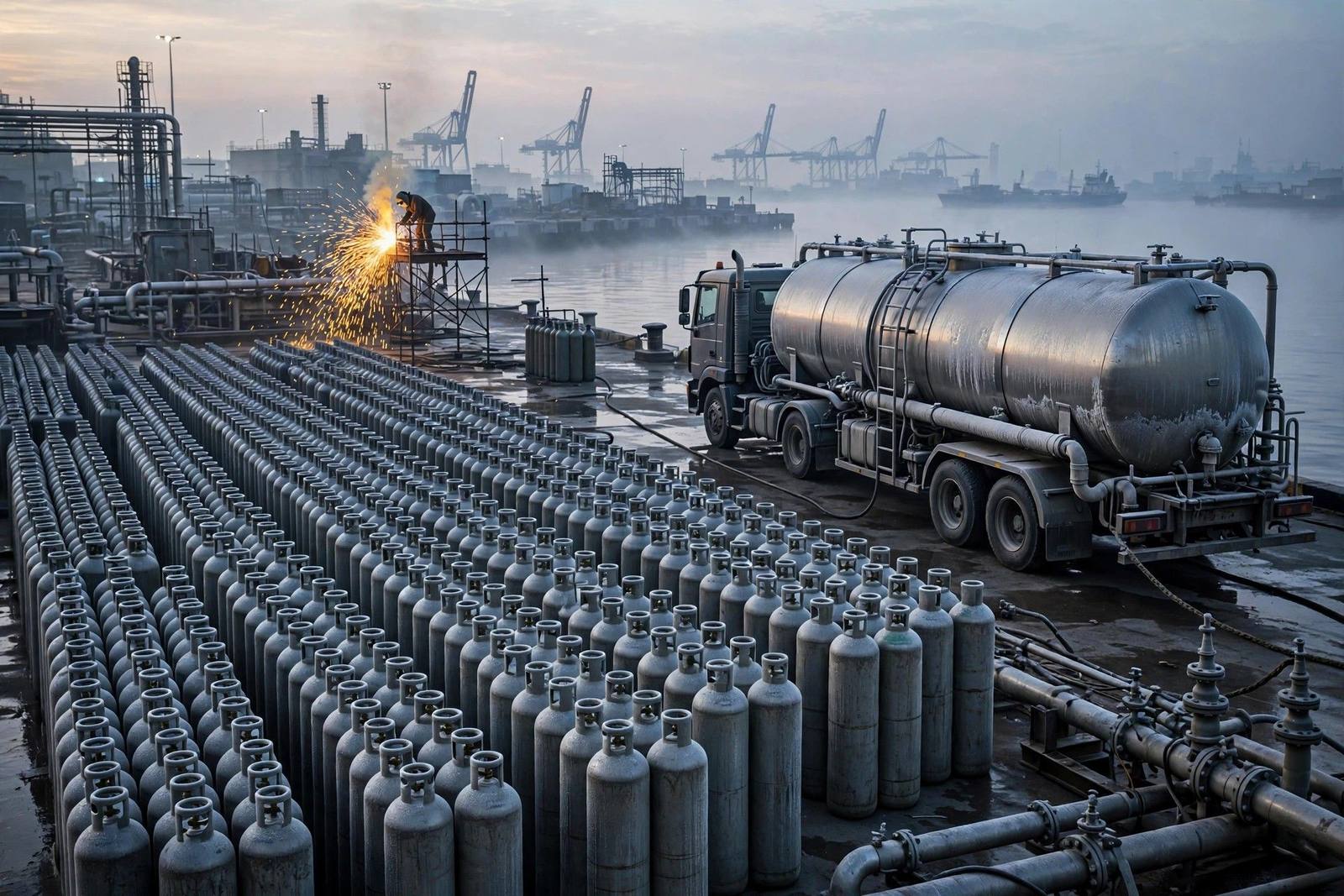
Start with gases, the founding trade, now housed mainly in Ghani Chemical Industries, which the group describes as Pakistan's largest manufacturer of medical and industrial gases. An air-separation unit takes in ordinary air and electricity and produces oxygen, nitrogen and argon; some output is delivered by pipeline or tanker as liquid to large users, and some is filled into cylinders for the long tail of hospitals, workshops and small factories. Medical oxygen is the reputationally critical product: the group emphasises round-the-clock supply to hospitals with a fleet of cryogenic tankers, and purity checked against European Pharmacopoeia standards. The chemicals side deals in products including calcium carbide — used for welding gas and in industry — and welding and shielding gases and materials.
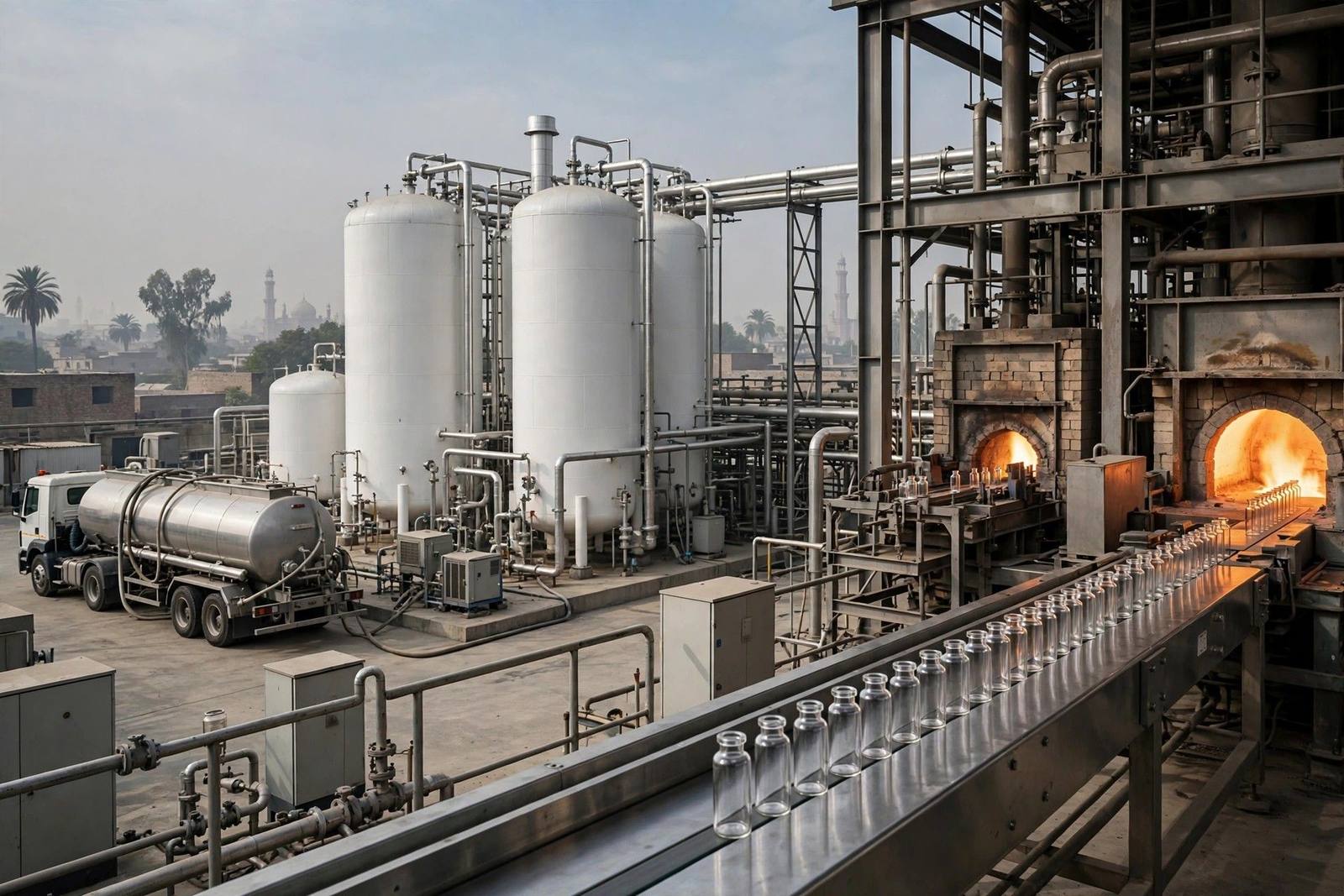
Glass is the second leg. Ghani Global Glass manufactures pharmaceutical-grade neutral glass tubes, and the vials and ampoules formed from such tubing, using European technology for Pakistan's pharmaceutical industry, with exports reported to several countries. The logic is import substitution in its purest form: Pakistan's large, export-earning pharmaceutical sector needs packaging glass of certified quality, historically bought from abroad, and a domestic maker that meets the standard captures both the sale and the foreign-exchange saving. Together the two legs explain the hook in this profile's title — a holding company for gases and glass — and they share a hidden common thread: both are businesses where the customer is buying reliability and certification as much as the physical product.
How a holding company like GGL makes money
GGL's own income statement is not where the action is, and learning to read around that is a useful skill in itself. At the operating level, money is made underneath: gases earn a margin between the cost of electricity, plant and distribution and the price charged per cubic metre or cylinder; glass earns a margin between batch materials, energy and forming costs and the price pharma companies pay for compliant tubing and containers. Those profits reach GGL's shareholders through the value and dividends of its subsidiaries, through any income GGL earns on its own trading and investments, and through management of the group's structure — buying, building or reorganising holdings when the group sees an opening.
Costs and risks follow the same two-level pattern. At the operating level, gases are an electricity business in disguise — air separation is power-hungry, so tariffs matter enormously — and both gases and glass are capital-hungry, needing continuous investment in plants, cylinders, tankers and furnaces. At the holding level, the questions are governance ones: how the listed parent treats minority shareholders of its listed subsidiaries, how transactions between group companies are priced, and how much of subsidiary success actually shows up in the parent's consolidated results. Our explainer on market capitalisation is a helpful companion here, because holding companies are where market value and underlying asset value most visibly part company.
Strengths, risks and controversies
The strengths are real. Medical and industrial gases are about as defensive as manufacturing gets — hospitals do not stop needing oxygen in a recession — and the group built domestic capacity in two import-dependent niches, gases and pharmaceutical glass, where certification creates a moat: a hospital or a drug company does not switch gas or vial suppliers casually. Being early and local in both gave the Ghani businesses a service network and customer list that a new entrant would take years to replicate.
The risks begin with complexity. Three listed Ghani names — the holding company, the chemicals company and the glass company — plus unlisted affiliates make the group hard for an outsider to map, and holding-company shares everywhere tend to trade at values that wander around the worth of their contents rather than tracking it faithfully. Energy prices squeeze the operating subsidiaries; pharmaceutical customers squeeze glass prices; and expansion funded by debt at any level of the structure lands, eventually, on the same shareholders. Periods of rapid group restructuring, however well intentioned, also ask minority investors to trust that each reorganisation treats every listed company's shareholders fairly — a judgement each reader has to make from the disclosures themselves. None of this is unusual for a family-built industrial group on the PSX, but GGL concentrates the pattern in a single ticker.
The name on the PSX
GGL trades in the exchange's chemical sector, a classification inherited from its gases origins, and it has generally been a more actively traded small-to-mid-sized share than sleepy holding companies elsewhere — gases and glass give retail investors a story they can follow, and the group's restructuring announcements periodically put the name back in the news. It is not a heavyweight of the KSE-100, and its dividend character should be read as a holding company's: payouts depend on what subsidiaries distribute and what the parent chooses to pass on, so they are inherently less predictable than an operating utility's. Anyone comparing GGL with its own subsidiaries is doing the classic holding-company exercise — adding up the parts, comparing them with the whole, and asking why the gap exists — which is one of the more instructive exercises the PSX offers a learner. The Aktzien learning library covers the underlying valuation ideas in plain language.
What kind of investor studies GGL
GGL is studied by investors who like group structures and are willing to do arithmetic: followers of Pakistan's industrial gases market, of pharmaceutical supply chains, and of the broader pattern of sponsor families listing successive layers of a group. The observation points are subsidiary results first — gas volumes and margins at the chemicals business, utilisation and exports at the glass business — then the parent's disclosures on holdings, inter-company dealings and dividends. It rewards readers who enjoy consolidated accounts and punishes anyone expecting a simple one-plant story. This article is educational content, not financial advice, and nothing in it recommends buying or selling any security.
A group still being assembled
Most company profiles describe a finished thing. GGL describes a group still being arranged — founded as an operator in 2007, listed in 2010, expanded into glass in the middle of the following decade, and then lifted into a holding-company shape with listed businesses beneath it, including a chemicals arm built around the original gases trade and ventures such as Ghani ChemWorld at the edges. Whether that layering ultimately simplifies the Ghani story or complicates it is the live question hanging over the ticker, and it is why GGL, for all its modest size, teaches more about how Pakistani business groups actually organise themselves than many larger names do.
Gases and glass in everyday life.
It is worth pausing on how ordinary the group's products are, because their invisibility is the investment story. Medical oxygen reaches the patient through systems most families only notice in an emergency; nitrogen blankets food and chemical processes; argon shields welds; carbon dioxide carbonates drinks. Pharmaceutical glass is similarly unglamorous and similarly essential: every injectable medicine made in Pakistan needs a vial or ampoule that will not react with its contents, survive sterilisation and travel safely — and before domestic tubing capacity existed, that glass journey began in a foreign factory. A holding company built on such products will never have the glamour of a consumer brand, but it sits inside supply chains that hospitals, drug makers and factories cannot pause. That is the context in which to read the group's import-substitution pitch: the claim is not that gases and glass are exciting, but that Pakistan was paying foreign suppliers for essentials it could make itself, and that the Ghani companies organised themselves — gases first, glass alongside, a holding company on top — to capture that spending at home.
One last point belongs in any honest profile of a holding company: the discount question never goes away, it only changes size. When the market is optimistic about gases and glass, GGL can trade close to, or even above, a simple sum of its listed parts, because buyers are paying for the group's deal-making and the possibility of the next reorganisation. When sentiment turns, the same shares can lag the subsidiaries badly, because a holder of the parent owns an extra layer of cost, tax and uncertainty between themselves and the plants. Neither extreme is permanent, and the oscillation between them is itself the trading character of the stock. A student who follows GGL alongside its two listed subsidiaries for a single results season — comparing three sets of accounts that describe substantially the same furnaces, tankers and order books from three different heights — will learn more about consolidated reporting, minority interests and group valuation than from any textbook chapter, which is reason enough for this small holding company to earn its page.
Key takeaway: Ghani Global Holdings began in 2007 as Ghani Gases, listed in 2010, and was reorganised into a holding company above listed gases, chemicals and pharmaceutical-glass subsidiaries — so studying GGL means studying the businesses underneath it first.