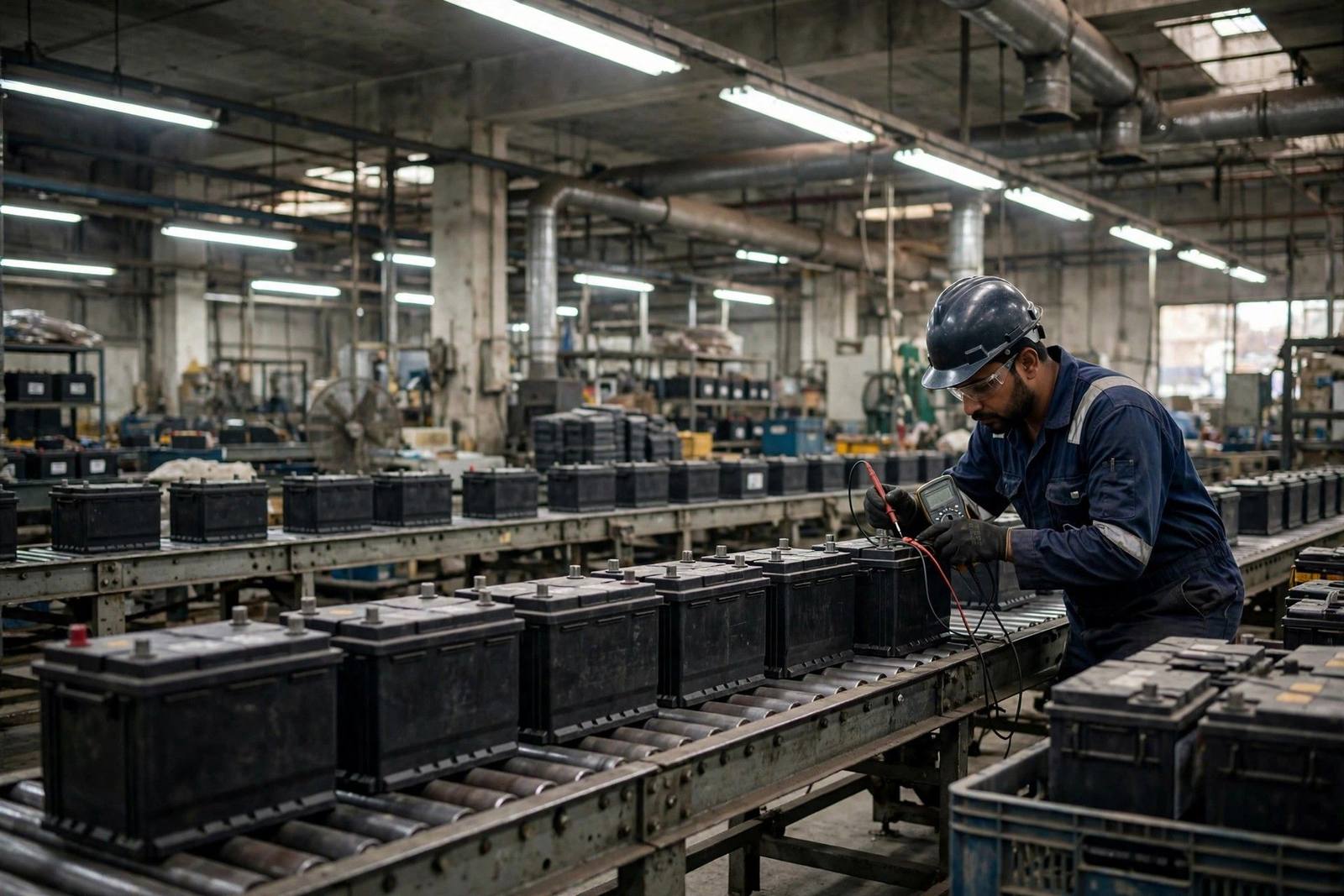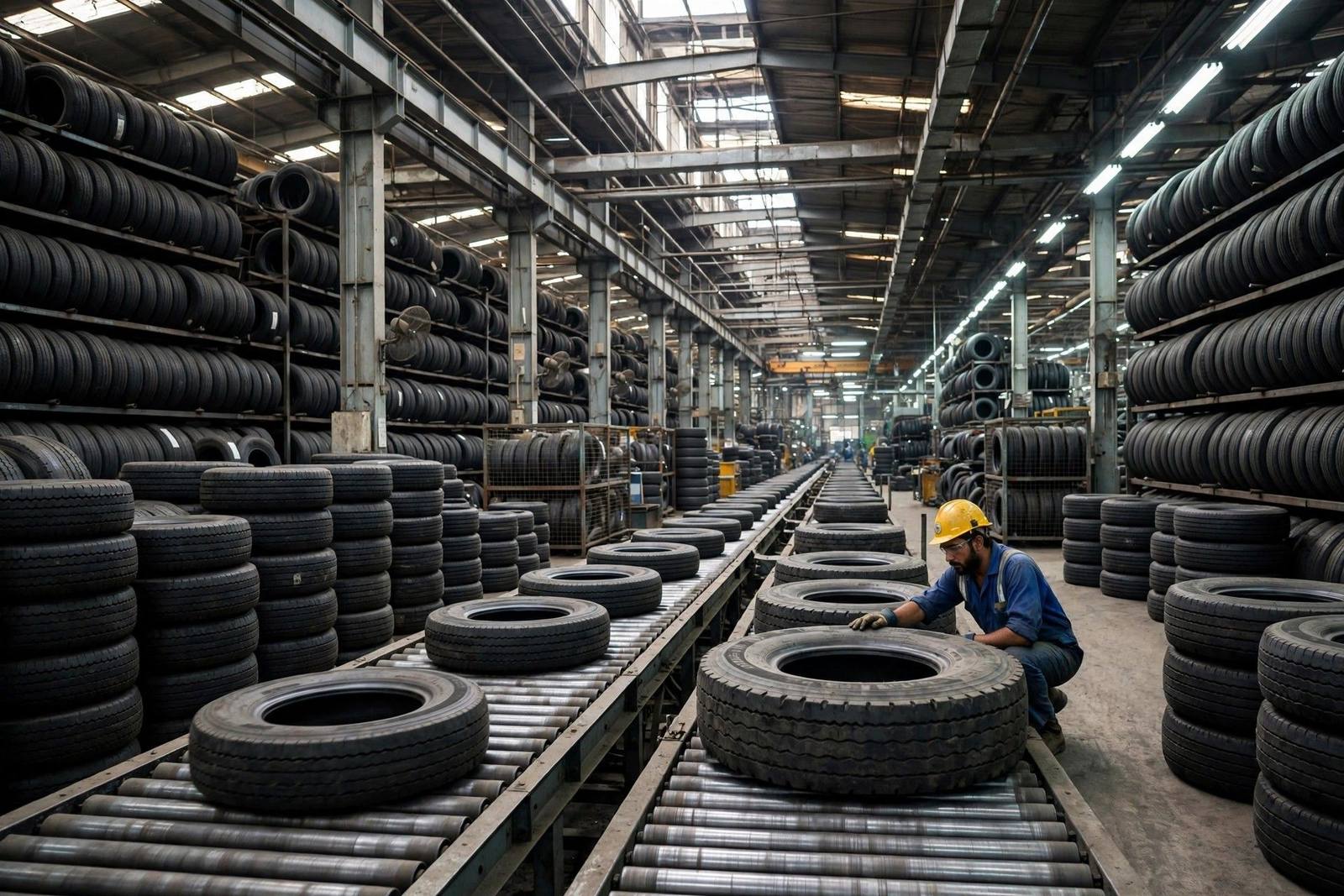
KARACHI: For nearly sixty years, the name on the sidewall of Pakistan's tyres was General. General Tyre — founded in Karachi in 1963, built at Landhi by an American tyre corporation, and for generations the default rubber under the country's cars, trucks, tractors and motorcycles. In December 2021 the company took a new name: Ghandhara Tyre and Rubber Company Limited, GTYR on the Pakistan Stock Exchange. The renaming closed a corporate chapter — the General brand belonged to a foreign owner whose shareholding era had ended — but the factory, the product and the market position carried straight on. GTYR is Pakistan's tyre industry in a single listed company: import-dependent on raw materials, protected and pressed by imports in turn, and as close to a pure play on the country's vehicle parc as the exchange offers.
An American foundation at Landhi, 1963
The company was incorporated in Pakistan on 7 March 1963 as a private limited company, founded by the General Tire International Corporation of the United States to build a tyre plant at Landhi, Karachi, on a 25-acre plot. Production commenced in 1964 with a modest capacity of about 120,000 tyres a year — in a country whose vehicle fleet then numbered in the tens of thousands, that was ambition. Landhi was becoming Karachi's industrial belt, and the tyre plant grew with it, in step with the assembly industry it supplied: as Pakistan put more cars, trucks and tractors on its roads, every one of them needed tyres to leave the factory and replacements thereafter.
The ownership turn came in 1977, when General Tire International sold 90 per cent of its shares to the present anchor owners, Bibojee Services (Private) Limited — the investment house of the Bibojee group, the Khattak family's business empire whose interests have long spanned textiles, insurance and industry in Pakistan's north-west and beyond. The American parent retained 10 per cent. The company was listed on the Karachi Stock Exchange in 1982, and completed a major expansion in 1985 that lifted capacity fivefold to about 600,000 tyres a year. In 1987 the story took one more international turn: Continental AG of Germany acquired General Tire International, thereby inheriting that residual 10 per cent stake in the Pakistani company, and with it a technical-assistance relationship — skills, formulations, equipment and raw-material purchasing support — that shaped the plant's technology for decades. Continental's era eventually wound down (the German group publicly signalled its intention to exit the shareholding in 2017 reporting), and when the company renamed itself Ghandhara Tyre and Rubber in 2021, it was formalising what the register had long said: this is a Pakistani-owned tyre maker with an international education.
What it actually makes
GTYR manufactures and trades in tyres and tubes for automobiles and motorcycles from its Landhi plant, with regional offices in Lahore, Multan and Islamabad. The catalogue spans the road: passenger-car tyres, tyres for SUVs and 4x4s — a segment it extended in April 2021 when it began manufacturing SUV tyres — light-truck and truck-and-bus tyres, motorcycle tyres and tubes, and tyres for agricultural and off-road machinery. Company descriptions put current capacity in the millions of tyres annually across the automotive and motorcycle ranges — a long road from the 120,000 of 1964, travelled in successive expansions of the same Landhi site.
Its two markets behave differently, and the distinction runs the business. The original-equipment market sells tyres to assemblers — every locally assembled car, tractor or motorcycle leaves on somebody's rubber, and those contracts are won on specification, consistency and commercial terms with powerful buyers like Al-Ghazi Tractors and Hinopak. The replacement market sells to the country's vehicle owners through dealers and tyre shops, where the brand the customer asks for by name decides the sale. Replacement demand is the larger and steadier of the two — Pakistan's existing fleet wears out tyres in all economic weathers — and it is where the old General brand equity, carried now by Ghandhara, does its quiet work.
Consider what the range must cover in a single catalogue. A motorcycle tyre is a price-sensitive consumable sold in every bazaar in the country. A tractor tyre is a traction tool, sized for implements and field conditions, bought by farmers who judge it over seasons. A truck-and-bus tyre is a fleet-economics decision — cost per kilometre, retreadability, failure rates at speed. And a passenger radial is a comfort and safety product judged against imported brands on the same shelf. Holding OE approvals and replacement credibility across all four worlds at once, from one Landhi complex, is the operational fact beneath the brand's longevity — and the reason capacity figures for the plant have kept climbing, in successive expansions, from the 120,000 tyres of 1964 to the multi-million-tyre operation of today.
How it makes money: rubber, oil and the replacement cycle
A tyre is a bundle of commodities wearing a brand. Natural rubber, synthetic rubber (itself a petroleum derivative), carbon black, steel cord and textile fabric go in; mixing, building, curing and finishing happen at Landhi; and the spread between those input costs — most of them imported and dollar-priced — and the prices assemblers and dealers will pay decides the margin. Two exchange rates therefore live inside GTYR's results: the rupee, which sets its cost base, and the policy environment that decides how much imported competition it faces. Legal imports, grey-channel imports and smuggled tyres have been the industry's perennial complaint for decades — a tyre that evades duty can undercut a Landhi tyre without being better — and the company's fortunes have always partly depended on how seriously the state polices its own tariff wall. Our overview of automobile stocks on the PSX sets that protection-and-competition tension in its sector context.
The technology chapter is still being written. In September 2024 the company entered a technical assistance agreement with Shandong Huasheng Rubber of China — a large Chinese tyre-technology provider — for a period of seven years, and in December 2024 it signed a memorandum of understanding with the same partner to explore a joint venture for truck-and-bus and passenger-car radial tyres, focused on export markets and subject to feasibility and approvals. Radialisation is the industry's direction of travel — truck and bus fleets worldwide have shifted from bias-ply to radial tyres for life and fuel economy — and for GTYR the partnership is the route to technology its German-assistance era once supplied. Whether the joint venture proceeds is, at the time such announcements are made, an open question by design; the direction of intent is the fact to carry forward.
Ownership and group
Control rests with the Bibojee sphere: Bibojee Services is among the largest shareholders, and Pakistan Kuwait Investment Company — the joint Pakistan–Kuwait sovereign investment institution — holds another of the register's largest blocks, an unusual sovereign presence on a mid-cap industrial register. The Khattak family's leadership of the board connects GTYR to the wider Ghandhara-named industrial family on the exchange — the name itself, taken in 2021, echoes Gandhara, the ancient civilisation of the Peshawar valley from which the family's businesses draw their identity. For minority shareholders, the register means a professionally anchored but sponsor-shaped company: strategy is set by long-horizon holders, and the dividend and expansion cadence reflects that temperament.
Strengths, risks and honest caveats
The strengths are incumbency and breadth. Six decades of production, a plant in the country's industrial capital, an OE position with assemblers, and the most recognised tyre brand lineage in Pakistan constitute a moat that imports must climb over on price alone — and in safety-critical products, price alone is a weaker argument than importers would like. The replacement market gives revenue ballast across cycles, and the product range means a weak car market can be offset by tractors, trucks or two-wheelers.
The risks are the mirror image. Raw-material dependence on imports makes margins hostage to the rupee and to global rubber and oil prices; the pricing umbrella encourages both smuggling and new domestic entrants — Pakistan has added tyre capacity in recent years, including Chinese-partnered plants, ending GTYR's long season as close to the only game in town. Assembler demand is cyclical, radial technology demands capital, and the 2024 Chinese partnership, while strategically sensible, is unproven. The company's accounts have also carried a governance footnote in recent years — litigation that restrained certain special-majority resolutions including dividend declarations, disclosed in its financial statements — a reminder to read the notes, not just the numbers. None of it changes the central fact: Pakistan's vehicles will roll on something, and the Landhi plant intends to be a large part of what they roll on.
The Landhi site itself is an asset with a history. A 25-acre industrial plot assembled in 1963, inside what became Karachi's densest manufacturing district, expanded in stages — notably the fivefold capacity lift of 1985 — and retooled across the bias-to-radial transition, is not something a new entrant can replicate at any sensible cost today. Land, utilities, an experienced workforce and six decades of process knowledge sit inside that fence. Whether the next expansion — the radial future the Chinese partnership points toward — is built on the same ground or a new site is one of the more consequential capital decisions in the company's modern history, and one its shareholders should expect to be debated on export economics as much as domestic demand.
The name on the PSX
GTYR trades in the automobile parts sector with a June year-end. Older investors still call it General Tyre; the ticker makes no such nostalgia necessary. Trading interest follows the vehicle cycle, results seasons and the company's capacity and partnership announcements, and its dividend history — interrupted at times by the litigation noted above — is best approached through the standard mechanics in how PSX dividends work and a careful read of its latest filings rather than habit.
Bias, radial and the technology race
Tyre technology hides a generational divide that structures GTYR's strategy. The traditional cross-ply (bias) tyre — cheaper, rugged, repairable anywhere — built Pakistan's truck and tractor fleets and still serves them. The radial tyre — steel-belted, longer-lived, cooler-running and kinder to fuel consumption — is the world standard for cars and increasingly for trucks and buses, but it demands different machinery, materials discipline and quality control, and it asks fleet owners to pay more upfront for life they must be organised enough to harvest. A legacy bias-strong maker therefore faces a capital question, not just a marketing one: how fast to radialise its range before competitors — including newer, radial-native plants — take the premium segments by default. GTYR's seven-year technical assistance agreement with Shandong Huasheng and the radial joint-venture exploration announced alongside it are the company's public answer: buy the technology partnership first, then decide the plant. Students of Pakistani industry will recognise the pattern from 1963 — foreign technology, local factory — running for a second lap, this time with a Chinese rather than American or German teacher.
One more feature of the trade deserves attention: tyres do not expire on a schedule set by the maker but by the road. Pakistan's replacement demand is thus unusually legible — it follows the size and age of the national vehicle fleet, the condition of its roads, and the freight economy's intensity. A reader who wants GTYR's future volumes can approximate them from the parc itself, which is more than can be said for most consumer products.
What kind of investor studies GTYR
GTYR suits the investor learning how import-substitution industries really work in Pakistan: the interplay of tariffs, smuggling, commodity costs, technology licences and brand trust in a single factory. It is also a fine case of corporate renaming done for ownership reasons, not marketing ones. This profile is educational content, not financial advice; the Aktzien learning library holds the market foundations behind it.
Key takeaway: GTYR — General Tyre until 2021 — has made tyres at Landhi since 1964: American-founded, Bibojee-owned since 1977, Continental-taught, and now pursuing radial technology with a Chinese partner while imports press from every side.