KARACHI: Index membership is the closest thing the stock market has to a seating chart, and Mehmood Textile Mills has just been asked to move seats. The Muzaffargarh composite mill entered the KSE-100 in the recomposition that took effect on 1 October 2024, and left it in the recomposition announced in September 2026, effective 1 October 2026, under the index's market-capitalisation rule. Two years in the benchmark is a short stay, but it bookends the company's modern story neatly: a half-century-old southern Punjab mill group — spinning, weaving, garments and its own power — big enough to matter to the index when its market value swelled, and honest enough in its filings about the business underneath. Incorporated in February 1970, when Muzaffargarh was cotton country first and industrial country a distant second, Mehmood Textile is one of the oldest names in this batch of profiles. This article tells its story, explains exactly what entering and leaving the KSE-100 does and does not mean, and looks at the restructuring — an apparel demerger — that shows where management thinks the value sits.
1970: a mill planted in cotton country
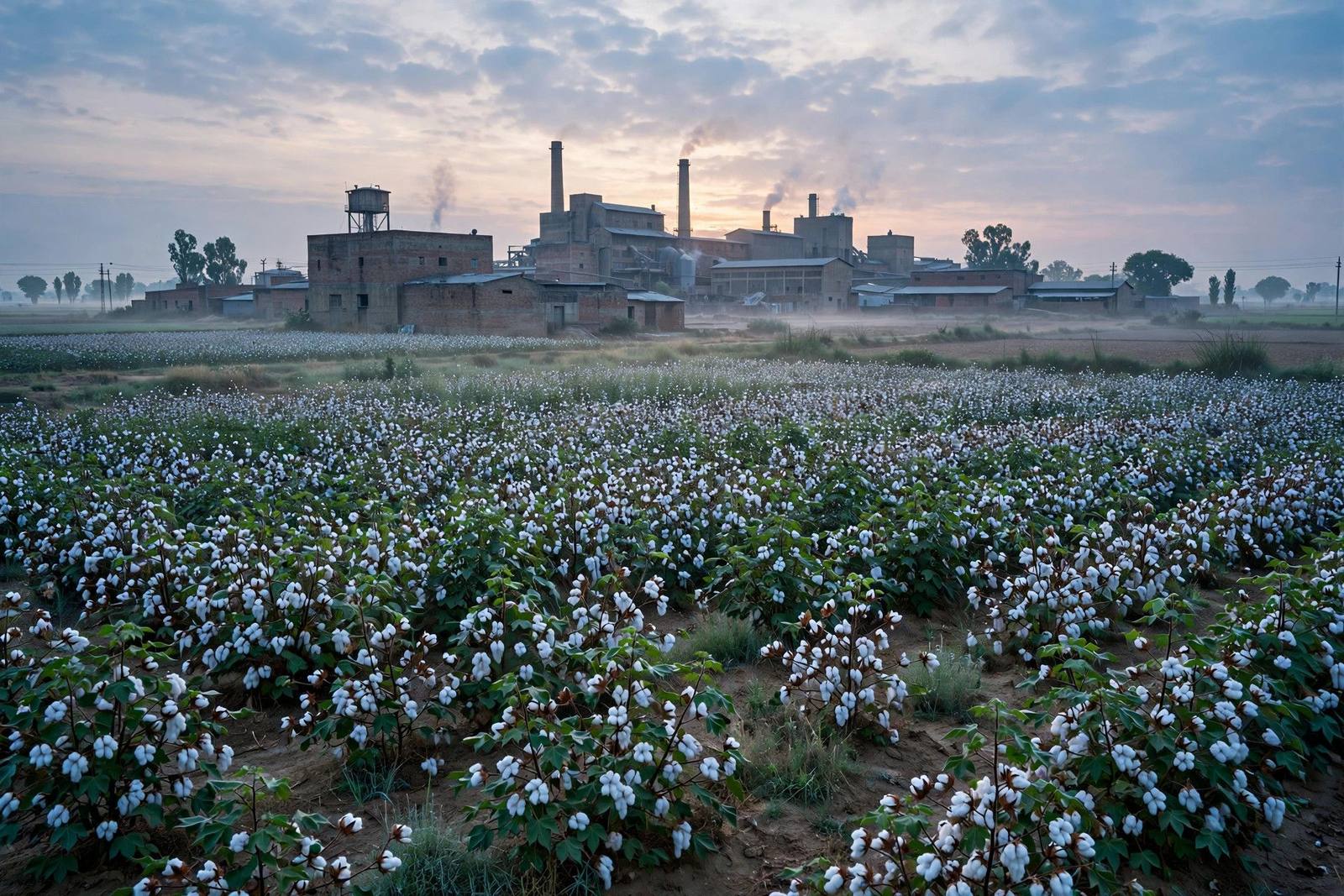
Mahmood — spelled Mehmood in the company's own name — Textile Mills Limited was incorporated in Pakistan on 25 February 1970 as a public company, and its shares were quoted on the Karachi Stock Exchange, one of the predecessor exchanges of today's PSX. The registered office is in Multan, southern Punjab's commercial capital, but the mills themselves stand in District Muzaffargarh, in what was then the Dera Ghazi Khan Division — deep in the cotton-growing belt between the Indus and the Chenab. The geography was the strategy. A composite mill in Muzaffargarh sat amid its raw material, drew labour from an agricultural region with few industrial alternatives, and shipped yarn and grey cloth north to the weaving, processing and export centres of Lahore, Faisalabad and Karachi. Companies of this vintage and location — its near neighbour in the district, the Tata group's mills, is profiled as Tata Textile Mills — formed the industrial skeleton of southern Punjab, and for many local families the mill gate was the district's steadiest source of cash wages.
Composite, in the market's classification, is the key word: Mehmood Textile is listed in the PSX's textile composite sector, meaning it does more than one stage of the chain inside one company. Its own descriptions of its business give the classic three-part shape of the Pakistani composite mill — the manufacture and sale of yarn, of grey cloth, and of electricity, generated on site and sold as well as consumed. Over the decades, garment making joined that list, most visibly in the apparel unit whose separate future the board moved to formalise in 2025. A workforce counted in the thousands runs the Muzaffargarh complex, and the company's longevity through Pakistan's textile cycles — the booms, the energy crisis, the cotton failures — is itself part of the record: mills founded in 1970 that still file audited composite accounts in the 2020s are the survivors of a much larger founding generation.
That survival has a social dimension worth recording. A composite mill in a district like Muzaffargarh is rarely just an employer; it is the anchor around which transporters, cotton traders, repair workshops and whole mohallas organise their incomes, and its gates structure the working day of thousands of households who may never read its annual report. Companies of Mehmood Textile's generation were built in an era when the state expected industry to carry regional development with it, and the mill colonies and long-service workforces of southern Punjab are that era's residue. It does not appear in any valuation model, but it explains the patience — of workers, of the town, and historically of lenders — that has carried such mills through the cycle's worst years.
What the Muzaffargarh complex does
Start, as the product does, with spinning. Cotton and blended fibre enter the Muzaffargarh mills and leave as yarn, sold to weavers across Pakistan and into export channels, and consumed by the company's own next stage. Weaving turns yarn into grey cloth — greige fabric, unfinished by definition, the raw material of the dyeing and processing houses. Power generation stands behind both: the company generates electricity at its mills, uses what the spindles and looms demand, and has historically sold power as a line of business in its own right, a common arrangement for mills that built captive capacity in the shortage years. Apparel is the value-added tip — cut-and-sew garment production that takes fabric closest to the final wearer and to the export buyers who pay for finished goods rather than intermediates.
Each stage has a different customer and a different temperament. Yarn is a near-commodity sold on count, quality and credit terms to a domestic weaving industry that is itself cyclical. Grey cloth is an intermediate with a narrower buyer set. Power is a regulated, contract-flavoured business inside an industrial one. Apparel is a fashion-adjacent business of programmes, compliance audits and delivery dates. Holding all four within one listed company is precisely what "composite" promises investors — a spread of the chain's margins under one roof — and precisely what makes the accounts a small education in the whole industry: read a composite mill's segment discussion carefully and you have read the Pakistani textile economy in miniature, from cotton arrivals to the price of a stitched shirt. The sector-wide map is drawn in our guide to textile stocks on the PSX.
How a composite mill makes money
The composite model's promise is margin capture. A pure spinner keeps only the spinning spread — yarn price minus cotton, energy and labour — and hands the weaving margin to someone else. A composite keeps both spreads and, with apparel, a third, and it can route its own yarn and cloth internally at the qualities each stage needs. The cost of that promise is capital and complexity: spindles, looms, generators and sewing lines all demand investment in the same balance sheet, and each stage's cycle peaks at a different moment. When yarn is dear and cloth cheap, the spinning division subsidises the weaving division's pain; when export garment demand booms, the apparel end earns while commodity yarn merely ticks over. Energy sits across everything — Muzaffargarh's generators turn fuel into the power that decides whether the other three stages run at all — and cotton sits underneath everything, since a Punjab composite still begins, every season, with the same crop risk as the smallest spinner in the district. Our explainer on Pakistan's cotton economy follows that risk to its source.
Working capital is the quiet fourth business. A composite holds cotton stocks, yarn stocks, cloth in process, finished garments and receivables from buyers at home and abroad simultaneously, and finances the pile at Pakistani interest rates. That is why composite results can look paradoxical to a beginner — healthy operating margins and a heavy finance cost in the same year — and why the cash-flow statement, not the profit headline, is where experienced readers of MEHT start. It is also why power matters beyond its own segment profit: every unit generated on site is a unit whose cost the mill controls, in a country where the grid alternative has at times been neither cheap nor certain.
The KSE-100 chapter: in in 2024, out in 2026
The index episode deserves a plain explanation, because it is widely misunderstood. The KSE-100 is recomposed periodically under published rules, broadly selecting companies by sector representation and market capitalisation, with buffers designed to limit churn. In the recomposition for the March–August 2024 review period, announced that September and effective 1 October 2024, Mehmood Textile entered the index — the exchange's notice recorded its arrival under the market-capitalisation rule, in a reshuffle that also brought in several other names and removed, among others, Kohinoor Textile Mills. Two years later, in the recomposition for the March–August 2026 review period, announced on 15 September 2026 and effective 1 October 2026, MEHT was among four companies removed, again on the market-capitalisation rule, with Thatta Cement taking the seat tracked against it in the exchange's summary. The mechanism behind such moves is explained in our guide to KSE-100 index rebalancing.
What did membership change? Practically, index funds and benchmarked portfolios that track the KSE-100 mechanically hold constituents, so entry tends to bring a class of ownership — and exit tends to remove it — quite apart from any view about the business. Symbolically, membership is a size certificate: for two years, the market's own arithmetic counted a Muzaffargarh mill among the hundred companies that define Pakistan's benchmark. What exit does not mean is failure, delisting or distress: the company remains listed, traded and audited, in the large population of substantial PSX companies outside the hundred. Readers who treat index exit as a verdict on a factory misunderstand both the index and the factory; the rules measure the market's valuation of the shares against other companies at a review date, not the quality of the yarn.
Restructuring, strengths and risks
The clearest recent signal of management's own thinking came in May 2025, when the board approved the demerger of the company's apparel unit into MG Apparel Limited, a wholly owned subsidiary, together with certain leasehold properties in the Multan Industrial Estate, to be executed through a scheme of arrangement under the Companies Act, 2017, with the Lahore High Court's Multan Bench petitioned as the law requires. The stated logic, as reported from the company's exchange filing, was operational focus: apparel performance made visible on its own, a dedicated vehicle able to claim the incentives statutory authorities offer value-added exporters, and cleaner lines between the commodity stages and the garment business. Demergers of this kind are a recognisable Pakistani pattern — the fashion-facing end of a composite is chronically undervalued inside a yarn-weighted whole, and separating it is an attempt to let each part be judged on its own economics. Whether it delivers is an execution question, and the honest reader will follow the subsidiary's development in future filings rather than assume the answer.
The strengths, meanwhile, are those of a survivor composite: five decades of operating history, an integrated chain from yarn to garments, captive power, a cotton-belt location, and scale sufficient to have stood in the benchmark index. The risks are the composite's standing list — cotton supply and price, energy cost, the domestic weaving industry's own cycles pressing on yarn and cloth demand, export apparel competition, and the finance cost of a large working-capital machine in a high-rate economy. Add one specific to this company: the attention effect of index exit, which can thin trading interest in the short run regardless of the underlying mills. None of it alters the daily reality at Muzaffargarh, where the spindles run on cotton, power and orders, in that order.
The name on the PSX
MEHT remains what it was before, during and after its index stay: a mid-cap textile composite whose register and liquidity reflect its size and its sector. Its payout history has followed the textile pattern — distributions a function of the year's earnings and cash, not an entitlement — and its results will continue to be read, as composites are, stage by stage: spinning margins, weaving utilisation, power economics, apparel orders. For the student of the market, the company now offers a unusually complete teaching file: an old mill, a full chain, a demerger in progress, and a documented ride into and out of the KSE-100 that demonstrates exactly how the benchmark's calculation and recomposition machinery treats a borderline constituent.
The investor who studies Mehmood Textile is generally studying the composite idea itself — whether owning the whole chain in one southern Punjab company beats owning its stages separately — with a side interest in how the apparel separation develops. That is a legitimate, old-fashioned industrial question, and Muzaffargarh is a good place to ask it. This profile is educational content, not financial advice.
Key takeaway: Mehmood Textile Mills, incorporated in 1970 and milling at Muzaffargarh, is a yarn-to-apparel composite with captive power that entered the KSE-100 in October 2024, left it in the October 2026 recomposition, and is separating its apparel unit into MG Apparel.