KARACHI: In the villages and dense neighbourhoods where most Pakistanis live, the formal banking system historically arrived late or not at all — no branch, no collateral, no payslip, no loan. Microfinance was built to fill that gap: very small loans, made to people the banks considered unbankable, for a buffalo, a sewing machine, stock for a corner shop or seed for a field, on the theory that the poor repay reliably when lending is designed around their lives. Over three decades Pakistan has built one of the developing world's more complete microfinance sectors, with specialised banks, rural support programmes, foundations and one famous interest-free charity, reaching millions of active borrowers whose individual loans would be rounding errors on a corporate balance sheet. It has also produced hard arguments — about interest rates that look extortionate to outsiders, about how much difference small loans really make, and about what happens when a social mission meets commercial funding. This guide explains how microfinance in Pakistan is structured and regulated, how the lending model actually works, who the main players are, and what little of the sector an investor on the PSX can actually touch.
Two regulators, three kinds of institution
Pakistani microfinance grew up in layers. The oldest layer is the rural support programmes — the Aga Khan Rural Support Programme in the northern areas in the 1980s, and the National Rural Support Programme and its provincial siblings in the 1990s — which organised villages into community organisations and lent through them, bundling credit with training and collective savings. The second layer is the specialist non-government lenders: foundations and non-profit companies that lend without taking deposits. The third layer, created deliberately by the state, is the microfinance bank: a licensed, deposit-taking bank built only for this market, beginning with Khushhali Bank in 2000 under a dedicated Microfinance Institutions Ordinance, with the sector's framework later folded into the State Bank's prudential regime.
That history explains today's regulatory split, which confuses many first-time readers. Microfinance banks are licensed and supervised by the State Bank of Pakistan, take deposits, and appear in its published statistics. Non-bank microfinance providers — the foundations and rural support programmes when they lend on their own account — were brought under a licensing framework administered by the Securities and Exchange Commission of Pakistan as non-banking finance companies for investment finance services, after years in which the largest NGO lenders operated in a grey zone as societies and trusts. Industry coordination and data run through the Pakistan Microfinance Network, whose quarterly reviews are the standard source for sector numbers — borrower counts, portfolio size, average loan size — and which should be the first stop for anyone quoting figures, since this article deliberately quotes none as current.
How you lend to someone with no collateral
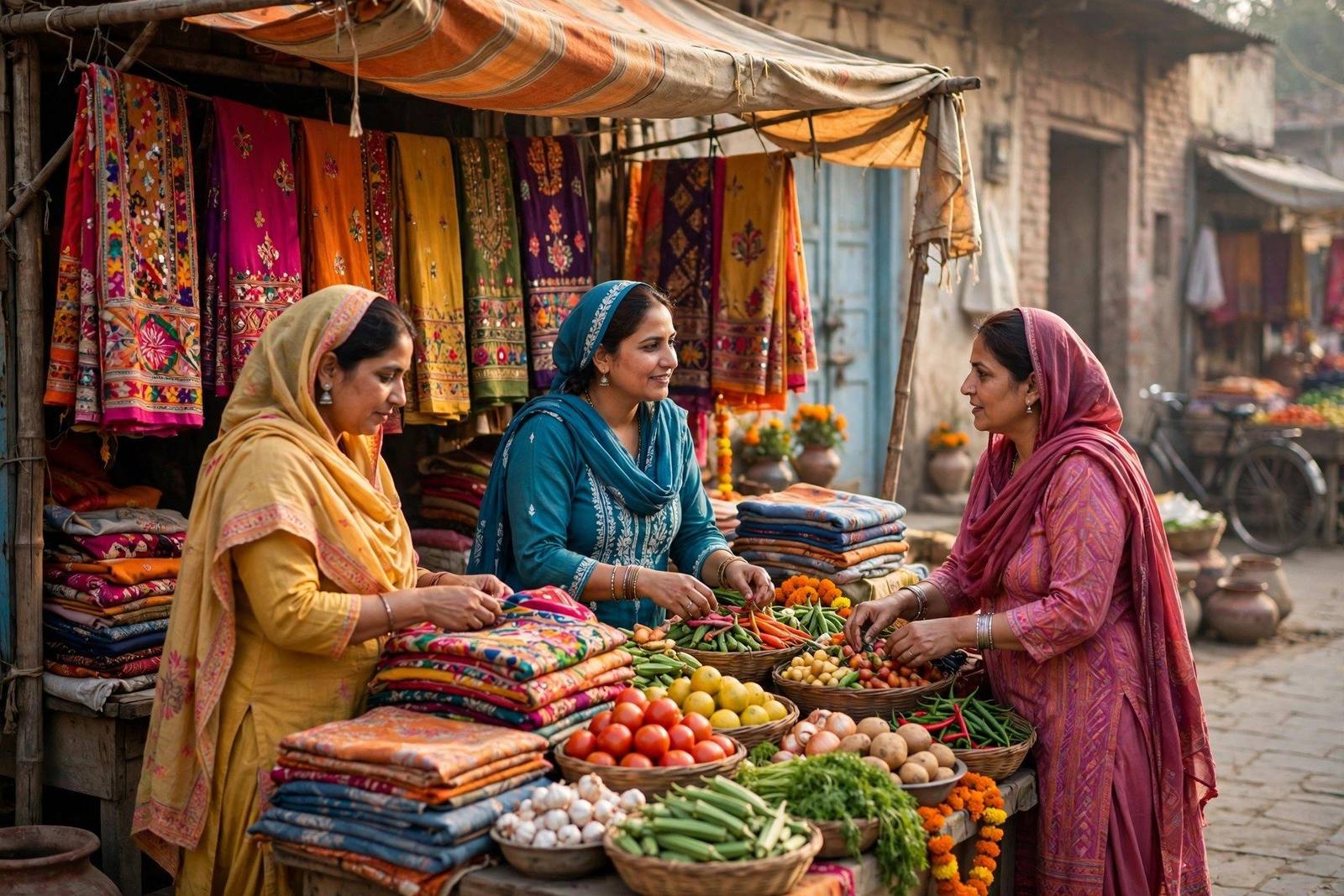
The classic microfinance toolkit replaces the missing collateral with social and mechanical substitutes. Group lending makes a small circle of borrowers — often women from the same street or village — jointly responsible: if one defaults, the others feel it, so the group screens its own members with local knowledge no credit officer could buy. Progressive lending starts deliberately tiny and grows the limit loan by loan, so the borrower's track record becomes the collateral. Loans are short, repayments frequent — weekly or monthly, matched to cash coming in from a shop's till or a milk sale — and loan officers work in the field, visiting clients rather than waiting behind desks. Character references, guarantors within the community, and the borrower's own savings history with the institution complete a system that, at its best, achieves repayment rates conventional bankers once insisted were impossible for this clientele.
Digital rails are rewriting the mechanics. The two giant mobile-money platforms built by telecom-linked microfinance banks — the Easypaisa and JazzCash ecosystems — turned the phone into a branch, and nano-loans scored from mobile usage data now reach borrowers no field officer ever visited. Our batch guide to Pakistan's gig economy meets many of the same customers from the income side. The gains are real — cost per loan collapses, women can transact without travelling — and so are the new risks, because instant, invisible credit makes over-borrowing easier and the community screening of the old model disappears. The State Bank's branchless-banking and digital-banking frameworks are the rules this frontier operates under, and they evolve constantly.
The names a reader will meet
Among microfinance banks, Khushhali remains the sector's founding name, created under the 2000 ordinance with public and donor backing and a nationwide mandate. The telecom-linked banks built the largest customer franchises through mobile money. Akhuwat, founded in Lahore in 2001 under Dr Amjad Saqib, is the sector's moral counterweight: it lends interest-free — qard-e-hasan — through mosques, churches and community spaces, funded by donations and recycling of repayments, and has grown into one of the world's largest interest-free micro-lenders while also branching into education and other social programmes. Kashf Foundation, founded in the 1990s by Roshaneh Zafar after studying the Grameen model, pioneered women-focused microfinance in Pakistan and later anchored a microfinance bank of its own. The rural support programmes remain giants in the northern and rural districts, and a long tail of foundations and non-bank lenders serves particular provinces, trades and communities.
For the PSX reader, the honest headline is how little of this is listed. The standout listed name is Apna Microfinance Bank, whose profile in this batch — Apna Microfinance Bank (AMBL) — shows what a small listed micro-lender's accounts look like. Most large players are unlisted banks, foundations or telecom subsidiaries, so exposure to the sector through the exchange is thin and indirect: through banks that wholesale-lend to microfinance institutions, through the telecom groups, or through listed companies selling the motorcycles, fertiliser and consumer goods that micro-borrowers buy. Anyone studying the sector seriously reads the Pakistan Microfinance Network's data and the State Bank's financial-stability reviews rather than ticker pages.
The pricing argument, conducted honestly
No guide should dodge the sector's central controversy: micro-loans are expensive. Effective charges that would be scandalous on a mortgage are routine in microfinance, and critics periodically ask whether the industry helps the poor or farms them. The lenders' arithmetic is real, up to a point. A loan officer's salary, travel and paperwork cost roughly the same whether the loan is for thirty thousand rupees or thirty million, so small loans carry huge cost ratios; the money itself is often borrowed wholesale at commercial rates; and unsecured lending to volatile incomes produces genuine losses that the price must absorb. Pakistani regulation has at times capped or guided pricing, and disclosure rules require the effective cost to be stated — rules the State Bank and SECP publish and revise, and which borrowers should insist on seeing in writing.
The development evidence is the second half of the argument. Rigorous studies internationally — randomised evaluations of microcredit expansions in several countries — generally find modest average effects: some businesses grow, consumption smooths, dignity and options improve, but the dramatic poverty exits of the founding mythology are rare. Pakistan's own experience adds a darker chapter in the form of localised over-indebtedness crises, where multiple lenders chased the same borrowers and repayment discipline collapsed — the reason credit-bureau coverage through the sector's dedicated reporting arrangements matters so much. The mature view, now common inside the sector itself, is that microcredit is a useful financial tool among several — savings, payments, insurance and housing micro-loans may matter as much — rather than a poverty cure on its own. Our guide to housing finance in Pakistan shows the room-and-roof end of that wider toolkit.
A word, too, about who borrows. Women form a large share — in many institutions the clear majority — of microfinance clients, a design choice inherited from the Grameen tradition rather than an accident. The reasoning was practical as much as idealistic: women's repayment discipline in group settings proved strong, and money routed through mothers showed a reliable tendency to reach children's food, schooling and health. The honest complications are also documented by researchers: loans taken in a woman's name are sometimes controlled by male relatives, and the burden of weekly repayment discipline falls on the borrower whatever the loan's actual use. Institutions answer with financial-literacy training, business-skills programmes and, increasingly, products designed for women entrepreneurs specifically. The sector's own reporting tracks the female share of borrowers precisely because the mission is judged on it.
Savings, insurance and the wider toolkit
Credit was the founding product, but the sector's own veterans argue the quieter products may matter more. Micro-savings — small, safe deposits that a street vendor can add to daily — turn the microfinance bank into the neighbourhood's vault, and deposit-taking is precisely what separates the licensed banks from the lending-only foundations. Micro-insurance, often bundled with loans as credit-life cover and sold in health and livestock variants, pays out at the moments that otherwise force a family to sell assets or borrow from a moneylender. Remittance payouts through branchless agents connect the Gulf wage to the village household without a day's travel. Housing micro-loans — too small for the mortgage market, large enough for a roof or an added room — sit between microfinance and the housing-finance world, and specialist lenders and charities have built dedicated products around them. A household using all four tools is financially included in a way a single celebrated loan never achieved.
There is a graduation story too, and it cuts both ways. Successful micro-borrowers grow into customers for the small-and-medium-enterprise desks of commercial banks, and Pakistan's SME finance agenda leans on microfinance track records as informal credit histories. But the ladder has missing rungs: a borrower can be too big for a micro-loan and still too undocumented for a bank, a gap that specialised SME and leasing products fill only patchily. Watching whether the sector builds that bridge — or keeps recycling the same small loans to the same households — is a fair test of whether microfinance is a staircase or a waiting room.
One more structural force deserves note: the donors and the state keep re-entering the model. Concessional wholesale funds, government poverty programmes that channel subsidised loans through microfinance partners, and pandemic- and flood-era relief routed through the sector's branch networks all blur the line between a commercial lender and a delivery arm of social policy. The blurring is mostly honourable — no other network reaches those villages — but it complicates the accounts an analyst reads, since a portfolio swollen with a government scheme's subsidised loans is not the same asset as one built loan officer by loan officer. Separating the scheme business from the institution's own book is a first-order question in any serious reading of a microfinance balance sheet.
Funding, shocks and what to watch
Microfinance portfolios live close to Pakistan's weather, literally. The 2022 floods devastated exactly the districts where micro-borrowers concentrate, destroying the livestock and stock their loans had bought, and the sector responded with rescheduling and write-offs under State Bank guidance — a live demonstration that this loan book is a climate-exposed asset. Inflation squeezes from the other side, shrinking the real size of loans while raising borrowers' costs. The sector's funders — the State Bank's refinance windows, the Pakistan Poverty Alleviation Fund's wholesale lending built with donor money, commercial banks meeting priority-sector expectations, and international impact investors — all watch the same core indicators: portfolio at risk, write-off ratios, the average loan size drifting up (a sign of mission drift toward richer clients, or of inflation, or both), and the share of women borrowers, historically a headline measure of the sector's founding mission.
For a beginner, the way to hold the whole story is simple. Microfinance is Pakistan's proof that lending is a technology, not just a balance sheet: with the right design, the customers banks ignored repaid for decades. It is also a warning that good intentions do not repeal arithmetic — small loans cost a lot to make, and someone always pays. This article is educational content, not financial advice.
Key takeaway: Microfinance lends to Pakistan's smallest borrowers by replacing collateral with groups, track records and field officers — a proven technology with real costs, modest proven effects, and almost no direct presence on the PSX.