KARACHI: Ask a Pakistani factory owner of a certain generation how they bought their first serious machine, and there is a fair chance the answer involves a lease — and the lessor was ORIX. OLP Financial Services Pakistan Limited, ticker OLPL, was incorporated on 1 July 1986 as ORIX Leasing Pakistan, a joint venture between Japan's ORIX Corporation and local investors, converted to a public company in December 1987, and for thirty-five years it was the name that defined equipment leasing in Pakistan. In January 2022 it took its present name, shedding the ORIX brand while ORIX Corporation kept its large shareholding. The renaming marked a broadening: from leasing company to multi-product financial house for small and medium enterprises. This profile tells that story — how leasing reached Pakistan's workshops and fleets, how a lessor actually makes money, and what changed when the pioneer widened its licence.
1986: leasing arrives as an idea for the underserved
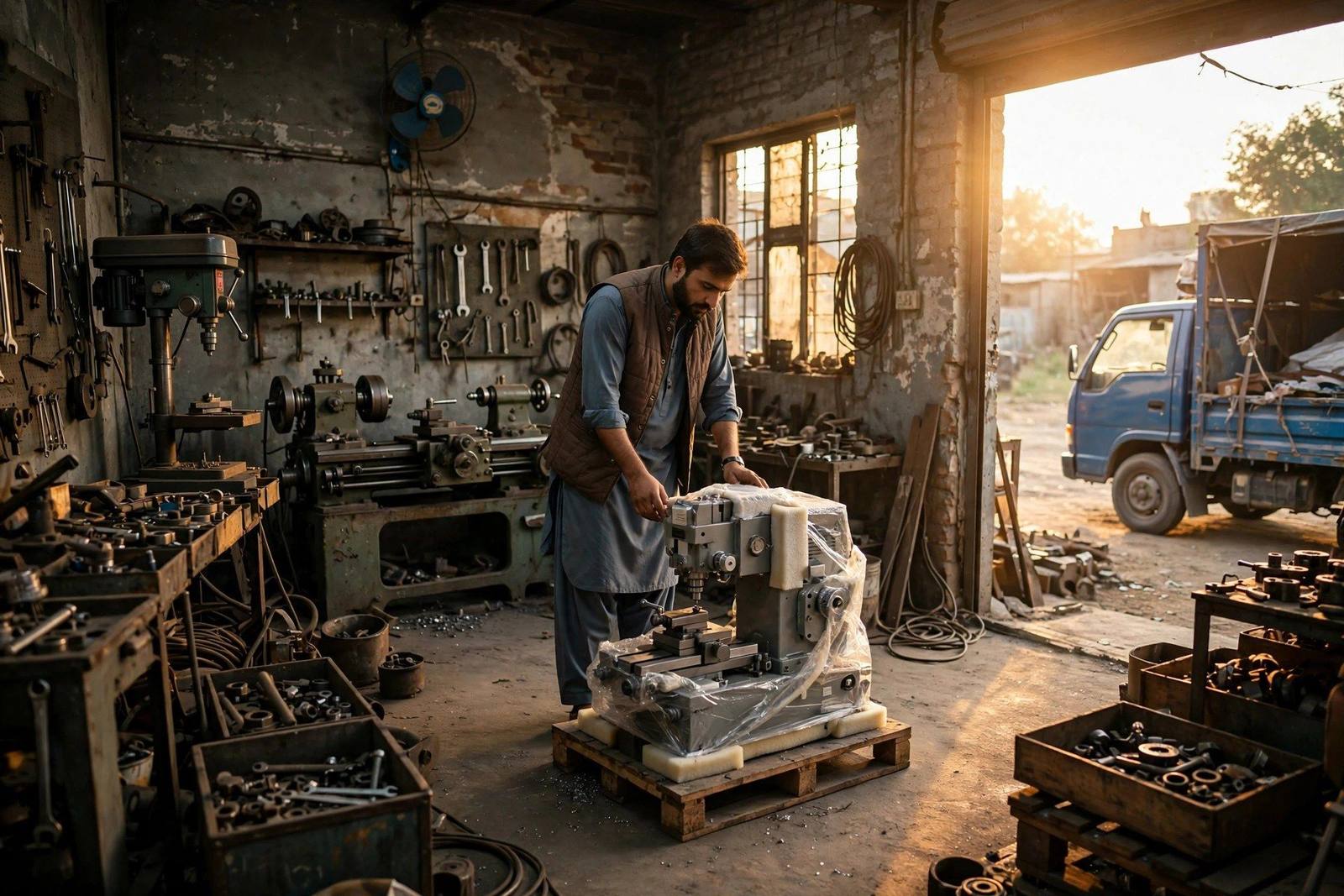
To understand OLP's founding, start with the problem it solved. In 1980s Pakistan, a small manufacturer wanting a generator, a printing press or a delivery fleet faced a banking system geared to large, collateral-rich borrowers. Banks lent against property and balance sheets; a growing business whose wealth was its order book and its machines struggled to borrow against the very asset it needed. Leasing inverted the logic. The finance company bought the asset and leased it to the business for a fixed term of rentals; the asset itself was the security, and at the end of the lease the customer could typically acquire it. Credit judgement shifted from "what do you own?" to "what will this machine earn?" — a subtle change that opened formal finance to thousands of small and medium enterprises.
ORIX Corporation was a natural sponsor for the experiment. Founded in Japan in 1964, ORIX had itself pioneered leasing in its home market before carrying the model across Asia. Its Pakistan venture, established in July 1986, paired Japanese leasing know-how with local partners who understood Pakistani business. The company commenced operations that year as a private company and converted to public status at the end of 1987, listing on the country's exchanges in that era. Through the following decades it described itself, in industry reporting, as the country's largest leasing player, and its name became near-generic for the product: businesses spoke of "taking an ORIX" the way households name a category by its first brand.
What OLP actually finances
The company's segments, as set out in its reporting, organise around three activities: finance leases, loans and finances, and other services. The traditional core is corporate leasing of productive assets — plant and machinery for factories, commercial vehicles from prime movers and trucks to buses and light commercials, and office automation equipment. Around it sit vehicle products for individuals and smaller businesses, including consumer auto leasing and loans for cars, and term and agricultural finance for customers whose needs do not fit a lease's shape.
Two features of the modern range deserve attention. The first is Islamic finance: alongside conventional products the company offers Ijarah — the Shariah-compliant lease structure in which the financier owns the asset and rents its use — and Diminishing Musharakah, the co-ownership structure common in Islamic asset finance, both explained in our guide to Islamic finance modes. The second is funding the public: like other non-bank finance companies, OLP raises part of its money by issuing certificates of deposit to savers, giving households a deposit-like instrument from a leasing house — a product whose risks and protections differ from a bank deposit and deserve the careful reading our investor-protection guides recommend. The company has also acted, across its history, as a regional base for the wider ORIX group's leasing ventures elsewhere in the Middle East and North Africa, supplying management and technical support to sister ventures — an unusual export of Pakistani financial expertise.
The 2022 renaming: what actually changed
In September 2021 the board announced the rebrand, and the name OLP Financial Services Pakistan Limited took effect in January 2022, with the ticker OLPL unchanged. Two things were happening at once. Globally, ORIX had decided to withdraw its name from listed associates outside Japan in which it did not hold control, citing differing governance and regulatory regimes — the shareholding — just under half the company — stayed exactly where it was. Locally, the company had upgraded its regulatory licence from leasing to Investment Finance Services under the SECP's non-banking finance company rules, which materially widens what it may offer: more lending products, more services, less dependence on a single product whose tax and regulatory treatment had shifted over the years. The new name was chosen to say precisely that — a multi-product, SME-focused financial institution rather than simply a leasing company. ORIX's own announcement of the change stressed continuity of commitment; the sponsor remained the largest shareholder, and the business kept its Karachi headquarters, by then in its own building in the Korangi Industrial Area.
How a leasing company makes money
A lessor's economics resemble a bank's, with machinery in place of a loan book's abstractions. OLP raises funds — from banks, from its certificates of deposit, from its own capital — at one cost, and deploys them into leases and loans at a higher yield. The spread between the two, earned over the multi-year life of each contract, is the gross engine. From it the company pays its people and branch network, absorbs the credit losses that inevitably arrive when some customers cannot pay, and funds the tax bill. What survives is profit. Two disciplines decide whether the engine runs well. Funding discipline matters because leases are fixed-rate and multi-year while funding can reprice quickly; when Pakistan's policy rate rockets, a lessor whose borrowings reprice faster than its lease book watches margins compress — the squeeze every Pakistani finance company of the era can describe from memory. Credit discipline matters more: the SME customer is profitable to serve precisely because banks underserve the segment, but defaults are a certainty to be priced, not a surprise to be lamented, and the recovery value of a repossessed truck or machine is the lessor's second line of defence.
The lease structure itself shapes risk in the lessor's favour compared with an unsecured loan. Because the finance company owns the asset until the contract completes, a defaulting customer's equipment can be repossessed and resold; because rentals are matched to the asset's working life, the exposure amortises alongside the machine's value. None of this makes the business safe — a downturn hits transporters, manufacturers and farmers together, and collateral values fall exactly when repossessions rise — but it explains why leasing companies survived cycles that broke less secured lenders, and why the model earned its pioneer a near-forty-year run.
Ownership and the ORIX connection
ORIX Corporation's holding of roughly half the shares makes OLP a genuine joint venture rather than a licensed franchise: a Japanese financial group with operations across dozens of countries, listed in Tokyo and New York, standing behind a Pakistani SME lender with board presence, technical standards and reputational capital. Local investors hold the balance. For minority shareholders, the arrangement has the usual two faces. A committed sponsor with a global leasing playbook brings credit culture, systems and credibility with lenders and rating agencies — PACRA has historically rated the company in the strong double-A range for a non-bank, as older research records. The same structure means the company's strategy, branding and even its name are partly decided in a relationship with a partner whose global policies, as 2022 showed, can redraw the local identity overnight.
Strengths, risks and the NBFC landscape
OLP's strengths begin with incumbency in a niche: decades of SME credit files, a nationwide customer base built since 1986, a product range now spanning conventional and Islamic asset finance, and a sponsor whose name still opens funding doors even after it left the letterhead. Its market — Pakistan's small businesses chronically short of formal credit — is structurally undersupplied, which is why specialists persist despite competition from banks' SME desks and Islamic banks' Ijarah books.
The risks are those of every non-bank lender, sharpened. Funding is wholesale and confidence-sensitive; a leasing company cannot fall back on insured retail deposits the way a bank can. Interest-rate cycles squeeze fixed-rate books. SME credit losses spike in slowdowns, and Pakistan's slowdowns are frequent. Regulation is a live variable — the NBFC framework, tax treatment of leasing, and SECP capital and provisioning rules have each reshaped the industry's economics before, emptying it of weaker players in the 2000s consolidation that left established names like OLP standing. A reader comparing finance models will find the contrast with microfinance in our sector guide to microfinance in Pakistan, and with deposit-funded banking across our bank profiles.
The modaraba sibling and the wider family
One corner of the business beginners often miss is the modaraba connection. Attached to the OLP family is OLP Modaraba, a separately listed Islamic financing vehicle whose management company sits inside the group, with OLP Financial Services as the holding company behind that manager. Under a modaraba, investors pool capital that the management company deploys in Shariah-compliant financing — including the Ijarah and Diminishing Musharakah structures described earlier — and returns are shared under the modaraba contract rather than promised as interest. The arrangement shows how thoroughly the old leasing house rebuilt itself across both conventional and Islamic finance: the same SME credit skills, expressed through two different legal and religious frameworks, each with its own listed security. Our explainer on modarabas in Pakistan sets out how these vehicles work and why their managers matter to their returns. For a reader of OLPL itself, the lesson is simpler: the group's earnings include management remuneration and dividends flowing from this Islamic sibling, a stream that behaves differently from lease spreads and is worth identifying separately in the consolidated picture.
There is also a longer lesson in OLP's survival. Pakistan's non-bank sector has repeatedly thinned itself out: weaker leasing and investment-finance companies failed or were absorbed in past consolidations, deposit-taking by finance companies was tightened by regulators, and banks moved down-market into the SME territory leasing pioneered. That a 1986 venture still operates under its sponsor's eye says something about underwriting conservatism — the unglamorous habit of valuing the asset, knowing the borrower and provisioning early. Students of the stock learn to read its disclosures in that spirit: portfolio growth is only good news if the non-performing book stays contained, and a year of modest disbursements with clean collections can be worth more than a year of aggressive expansion whose losses have simply not arrived yet.The name on the PSX, and who studies it
OLPL sits in the exchange's investment banks, investment companies and securities companies sector — the filing cabinet where the PSX keeps its non-bank financials — with a June year-end. It is a seasoned, mid-sized listing: not an index driver, but a stock with a long public history stretching back to the old Karachi exchange floor, a meaningful free float, and a shareholder proposition built on steady spread income rather than trading excitement. Its dividend character, in evergreen terms, has been that of a mature finance company — willing to distribute when provisioning and capital allow, restrained when credit cycles demand caution.
The investor who studies OLP is studying Pakistani SME credit itself: disbursement growth, the lease and loan book's quality, non-performing exposures and their provisioning, funding mix and cost, and the spread the company defends as rates move. They are also watching a strategic question with a long fuse — whether a leasing pioneer, rebranded and relicensed, can grow from the industry's elder into its broader financial-services future while its founding product remains the core. This article is educational content, not financial advice.
Key takeaway: OLP Financial Services — ORIX Leasing Pakistan from 1986 until its 2022 renaming, with ORIX Corporation still its largest shareholder — makes money on the spread between its funding costs and what SMEs pay to lease and borrow against productive assets.