KARACHI: Start with a paradox. Agriculture contributes roughly a fifth to a quarter of Pakistan's gross domestic product — the share drifts with the weather and the harvest — yet it employs well over a third of the workforce and supports, directly or indirectly, the majority of the population. No other sector touches so many lives with so little margin for error. A failed monsoon or a flooded cotton belt shows up within months in food prices, textile exports, rural incomes and, ultimately, the political temperature of the country.
That is why this guide treats farming not as a rural sideshow but as core economic infrastructure. The same fields supply the cotton that Pakistan's textile mills spin into the country's biggest export, the sugarcane that feeds its sugar mills, and the wheat that decides whether flour — and governments — stay affordable. Understand the farm economy and you understand half of Pakistan's inflation story before it reaches the headlines. The statistics themselves deserve a word of caution, because Pakistani farm data is softer than it looks. Crop estimates pass through provincial reporting services whose field methods vary, livestock numbers are projected from censuses that are years apart, and the informal milk and meat economy barely touches a ledger. Serious readers treat the decimal points as decoration and the directions as information: whether cotton arrivals are running ahead of or behind last season, whether fertiliser off-take is rising, whether reservoir storage entering the rabi season is comfortable. In a sector this large and this loosely measured, the trend is the fact.
Canals: the Indus machine underneath it all
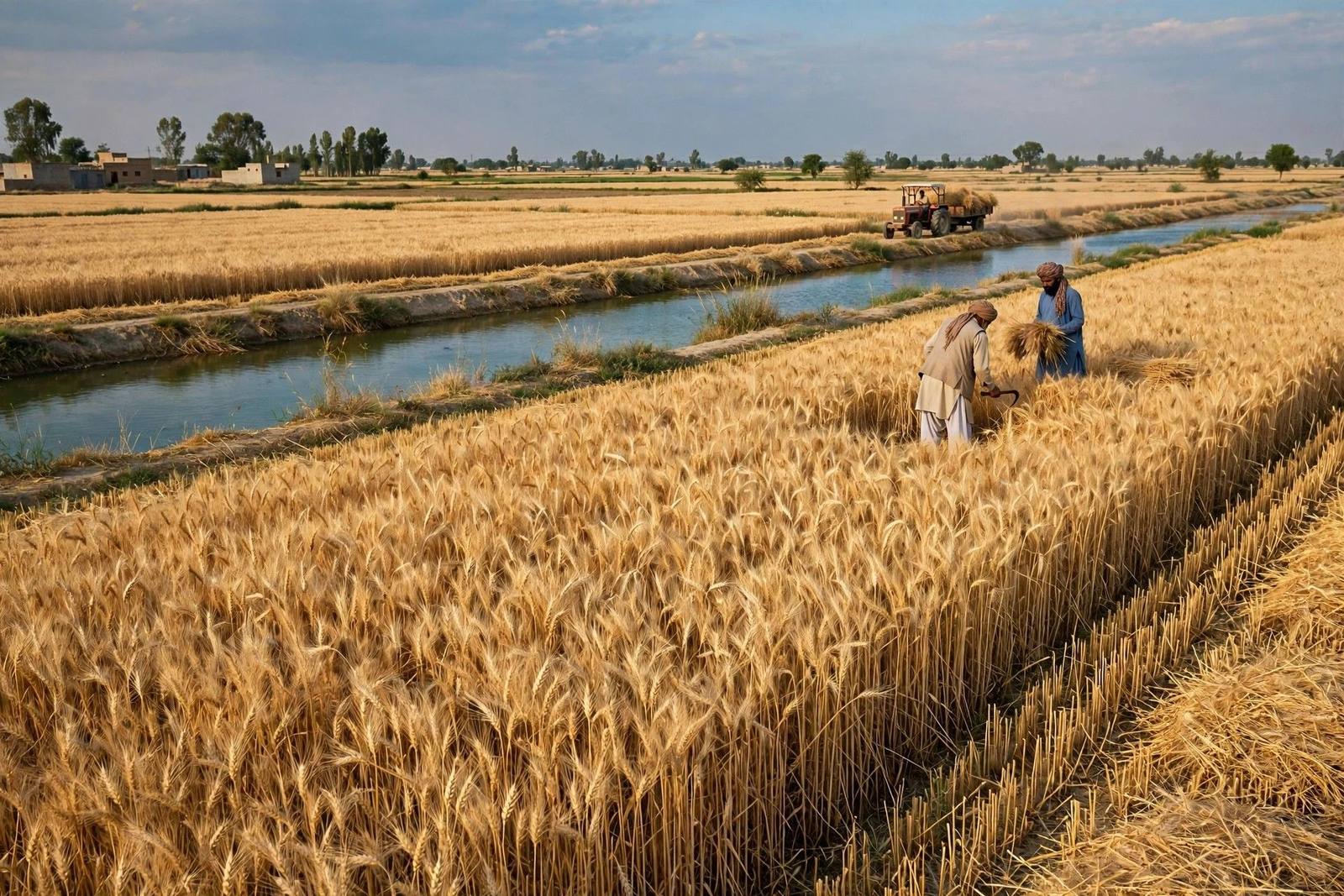
Pakistan farms on one of the largest contiguous irrigation systems on earth, built around the Indus and its tributaries and massively expanded in the British era, then again after independence with the great barrages and the Tarbela and Mangla dams. Most cultivated land is irrigated rather than rain-fed, which makes Pakistani agriculture less a bet on rain than a bet on river flows, snowmelt from the northern mountains and the machinery — canals, distributaries and tube wells — that moves water to the field.
The legal skeleton is the Indus Waters Treaty of 1960, which divided the basin's rivers between Pakistan and India, and the 1991 Water Accord, which divides flows among Pakistan's own provinces. Both are permanent sources of argument, because water is allocated by shares of a river that does not deliver the same amount every year. The mechanics of the system — reservoirs filling in summer, canals running on rotations — explain why a dam announcement or a treaty dispute is an economic story, not just a political one, a theme our guide to Pakistan's water crisis takes up in full.
Water allocation is also where the federation's politics become concrete. Sindh, downstream, watches upstream Punjab's withdrawals with permanent suspicion; the Council of Common Interests arbitrates; IRSA, the Indus River System Authority, operates the accord day to day with provincial representatives looking over its shoulder. Every dry season reopens the argument about whether the 1991 shares still fit a changed climate and changed cropping patterns. For the economy, the implication is that water reform is constitutional politics, not irrigation engineering — which is precisely why it moves at the speed it does.
The big five crops and the livestock giant
Five crops dominate the cropped area. Cotton is the industrial crop: it feeds ginning, spinning and the whole textile chain, and its harvest size moves export earnings. Wheat is the political crop, the staple whose support price and procurement fill committee rooms every spring. Rice — especially basmati — is the earner, one of Pakistan's signature exports. Sugarcane is the thirsty crop, grown in water-stressed regions and processed by politically connected mills. Maize is the quiet climber, pulled upward by demand from poultry and livestock feed.
Yet the largest single part of agricultural value added is not a crop at all: it is livestock — milk, meat and hides from the buffaloes, cattle, goats and sheep kept by millions of smallholders. Pakistan is among the world's larger milk producers, almost all of it sold fresh through informal channels. Livestock acts as the rural savings account: it produces daily cash, needs no canal turn, and can be sold in an emergency. Any account of farm income that starts and ends with crops misses the animal half of the economy.
Mechanisation sits oddly inside this picture. Pakistan has a substantial tractor industry and widespread use of threshers and tube-well engines, yet harvesting and much field work remains manual, because small plots and cheap seasonal labour make hand work rational at the farm gate even when it looks inefficient from the ministry. The result is a dual economy on the same acre: diesel-powered water and seed, human-powered picking and weeding. Cotton picking, in particular, is women's work across Sindh and southern Punjab — paid by weight, invisible in most statistics, and central to the crop's economics.
How a farm actually makes money
The typical Pakistani farm is small — a few acres, often split among heirs — and its economics are a stack of input costs against one or two harvest payments a year. Seed, fertiliser, diesel or electricity for the tube well, pesticides and hired labour at peak times all have to be paid before the crop is sold. Fertiliser is the swing item: urea and phosphate prices track global gas and commodity markets, which is why the economics of producers like Fauji Fertilizer are wired directly into farm costs across the country.
Between the farmer and the final buyer stands the arthi, the commission agent of the grain market who often also lends the farmer money for inputs. That dual role — creditor and buyer — is the farm economy's informal banking system: fast and relationship-based, but priced into the harvest at rates no bank would advertise. Formal credit through banks and microfinance reaches only part of the sector, and crop insurance remains thin, so a bad season is absorbed by the household, not by an insurer.
The export crops deserve their own footnote, because they behave differently from the food crops. Basmati rice sells into Gulf and Western markets where Pakistani origin commands a premium built over generations, and where geographical-indication disputes with India have commercial stakes. Cotton, by contrast, has slid from reliable export surplus to frequent import need as area shrank and yields stagnated — a strategic reversal for a textile nation. Mango, citrus and meat exports grow from a small base with cold-chain and sanitary-standard constraints. The pattern is consistent: Pakistan sells farm goods well when quality systems work, and defaults to bulk commodities when they do not.
Support prices, procurement and the food-price seesaw
Because wheat and sugar are politically explosive, the state has long intervened: announcing support or indicative prices, procuring wheat through provincial food departments and PASSCO, holding strategic stocks, and periodically restricting exports or imports to calm the home market. The intention is stability; the side effects are fiscal cost, storage losses and distorted planting decisions, as farmers chase whichever crop the state is currently guaranteeing.
For everyone else, the farm economy arrives as food inflation. Food carries a heavy weight in Pakistan's consumer price basket, so a poor harvest or a supply disruption feeds directly into the inflation numbers the State Bank must fight with interest rates — the chain our guide to how inflation works in Pakistan traces in detail. A bumper crop, by contrast, is the cheapest anti-inflation policy a government can get: it lowers food prices, lifts rural demand for everything from motorcycles to cement, and swells the raw material of the export sector.
Credit reform attempts illustrate the system's inertia. Successive schemes — warehouse receipt financing so farmers can store grain and borrow against it rather than selling distress-cheap at harvest, movable-collateral registries, agri-fintech apps offering input loans — all attack the arthi's advantage, which is not price but presence: he is in the village, decides in a day and collects in kind. Formal finance wins only where it matches that convenience, which is why mobile-money-linked products and satellite-based crop monitoring are watched as infrastructure, not novelties. Until borrowing against a crop is as easy as borrowing from the commission agent, the informal stack endures.
Farms to factories: the agro-industrial chain
Agriculture's GDP share understates its reach because so much of Pakistani manufacturing is farming by other means. Textiles begin in the cotton field. Sugar mills, rice mills, flour mills, edible-oil refiners, dairy processors and leather tanneries all convert farm output into industrial output, and the listed end of that chain — mills and food companies on the PSX — reports harvest conditions in its results long before economists summarise them. Tractors are the capital-goods end of the same chain: makers such as Al-Ghazi Tractors sell more machines in years when farm cash is good.
This is also why agricultural shocks become balance-of-payments shocks. When the cotton crop fails, Pakistan imports raw cotton; when wheat falls short, it imports grain; edible oil and pulses are structural imports in most years. Each shortfall is paid for in dollars, linking the farm economy directly to the country's foreign reserves and to the current account. A good harvest is, in effect, an invisible export.
There is also a generational story inside the farm gate. Rural youth increasingly treat farming as one income among several — a plot farmed by parents, a motorcycle rickshaw or a Gulf contract or a shop in the nearest town completing the household portfolio. Remittance money often funds the tube well, the seed and the tractor share, binding the farm economy to labour markets in Riyadh and Dubai. Economists call this livelihood diversification; farmers call it survival. It means agricultural policy aimed only at crop prices misses the household's real balance sheet, which is deliberately spread across farm, wage and migration income.
The structural problems nobody has fixed
Three weaknesses recur in every serious diagnosis. First, productivity: yields per acre for most crops sit well below what comparable climates achieve, held back by seed quality, soil health, extension advice that rarely reaches the field, and research systems starved of funds. Second, water productivity: flood irrigation wastes much of what the canals deliver, and the pricing of canal water — a small flat charge unrelated to volume — gives no signal to conserve. Third, fragmentation: inheritance splits holdings generation by generation, leaving plots too small to mechanise profitably and titles too tangled to mortgage.
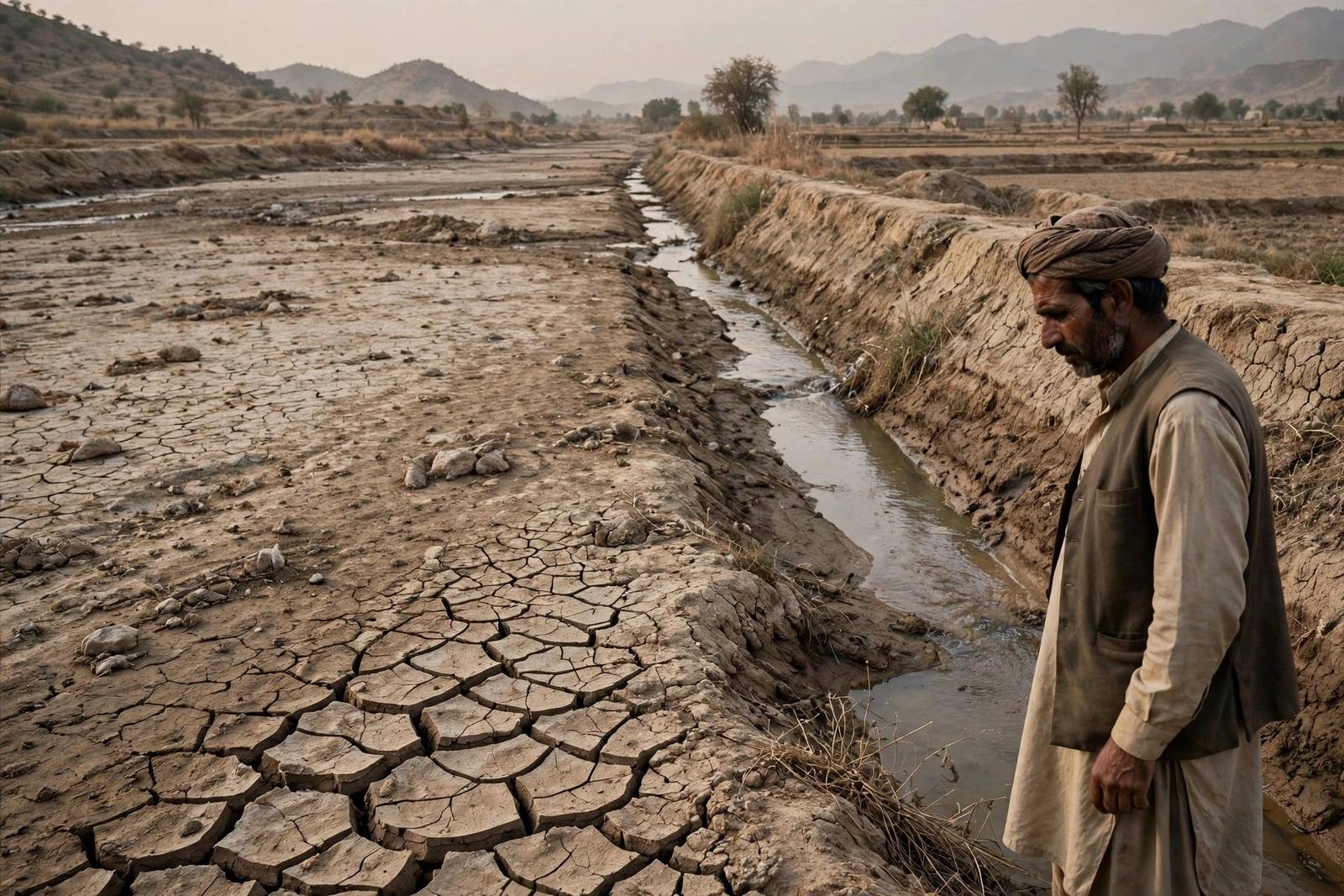
Climate now presses on all three. The 2022 floods drowned crops and livestock across Sindh and Balochistan and demonstrated that a single season can erase a year of rural income — the subject of our companion guide to climate risk and Pakistan's economy. Heat stress on wheat, shifting monsoons and glacier-fed river variability are not environmental footnotes; for a fifth of GDP, they are the business cycle.
Reformers inside the system point to working proofs rather than theories: laser land-levelling spreading through service markets because it visibly saves water and lifts yields in one season; drip and sprinkler adoption where subsidies and water scarcity align; seed companies demonstrating hybrid maize economics district by district. The lesson of each is that Pakistani farmers adopt technology quickly when the payoff is visible within a single crop cycle and the risk is borne by someone else first. Extension policy that understands this — demonstration over instruction, services over ownership — travels further than the subsidy announcements that dominate the headlines.
What kind of investor studies the farm economy
Few investors buy 'agriculture' directly on the PSX — there is no big listed pure farmer — but almost every portfolio owns it indirectly: fertiliser producers, tractor makers, sugar and textile mills, food companies and the banks that lend against crops. The farm-literate investor watches the crop estimates published by the Pakistan Bureau of Statistics and provincial crop reporting services, the cotton arrival figures during ginning season, reservoir levels at Tarbela and Mangla, and the fertiliser off-take data that reveal what farmers are actually spending. This article is educational content, not financial advice; its point is simpler — in Pakistan, the harvest is a macroeconomic release, and the investor who reads it early reads everything else a little earlier too.
Key takeaway: Pakistan's farm economy is a fifth of GDP, a third of jobs and the first domino in food prices, textile exports and dollar outflows — which is why a canal, a crop and a monsoon belong on every investor's reading list.