KARACHI: Pakistan's interest in electric vehicles begins not with climate romance but with arithmetic. Transport runs overwhelmingly on imported petroleum — the single largest complex in the import bill, as our guide to the oil import bill shows — and every litre burned in a Karachi traffic jam is dollars gone and urban air poisoned. An electric vehicle substitutes domestic electricity for imported fuel, and electricity, whatever its problems, is increasingly generated from local coal, hydro, nuclear and sun. Add the world's worst urban air in the smog season and a vast two-wheeler fleet ripe for cheap electrification, and the policy case writes itself.
The counterweight is equally material: a strained grid, scarce charging infrastructure, high vehicle prices in a poor market, and consumers whose trust must be earned on resale and reliability. Pakistan's EV policy — and this guide — is the story of those two ledgers negotiating. The numbers discipline applies here as everywhere in this library. Pakistan's vehicle fleet is counted in tens of millions, overwhelmingly two-wheelers; annual new-vehicle sales swing violently with the economy and import restrictions — cars from a few hundred thousand in boom years to a fraction of that in busts. Any EV market-share claim should be read against that volatile denominator, and any 'sales doubled' headline against its tiny base. The transition will be real when electric two-wheelers hold a visible share of monthly registrations in ordinary months, not when a launch event trends on social media.
The policy stack: NEVP, auto policy and the duty lever
The framework's foundation is the National Electric Vehicle Policy approved in 2019, which set headline targets — shares of new vehicle sales to be electric by 2030, steepest for two- and three-wheelers and buses, more modest for cars — and blessed the instrument Pakistan actually uses for industrial policy: the customs tariff. Successive budgets and the Automotive Development and Export Policy layered the detail: sharply lower duties on EV-specific parts and completely built units for a period, concessional treatment for local assembly kits, reduced sales tax and registration costs in various rounds, and incentives for charging-equipment imports.
Read Pakistani EV policy the way you read all Pakistani industrial policy: the Federal Board of Revenue's tariff notifications are the real text, and they change with budgets and lobbying. The protection structure of the legacy auto industry — dissected in our guide to auto policy — means every EV concession is also a negotiation with incumbents who assemble petrol cars under high tariff walls. Whether EVs get a genuine cost bridge or a token one is decided in those schedules, not in policy speeches.
Battery economics is the technical heart of the matter. The battery is the vehicle's costliest component, its degradation curve decides resale value, and its supply chain runs through a concentrated global industry in cells and materials that Pakistan does not control. Local value addition therefore realistically starts with pack assembly, battery management systems, swapping cabinets and recycling — the same ladder the solar market climbed from panels to local mounting, cabling and services. Policy that demands deep localisation on day one kills the market; policy that never demands it builds an import channel with flags on it. The schedule between those errors is the whole art.
Two and three wheelers: the real revolution
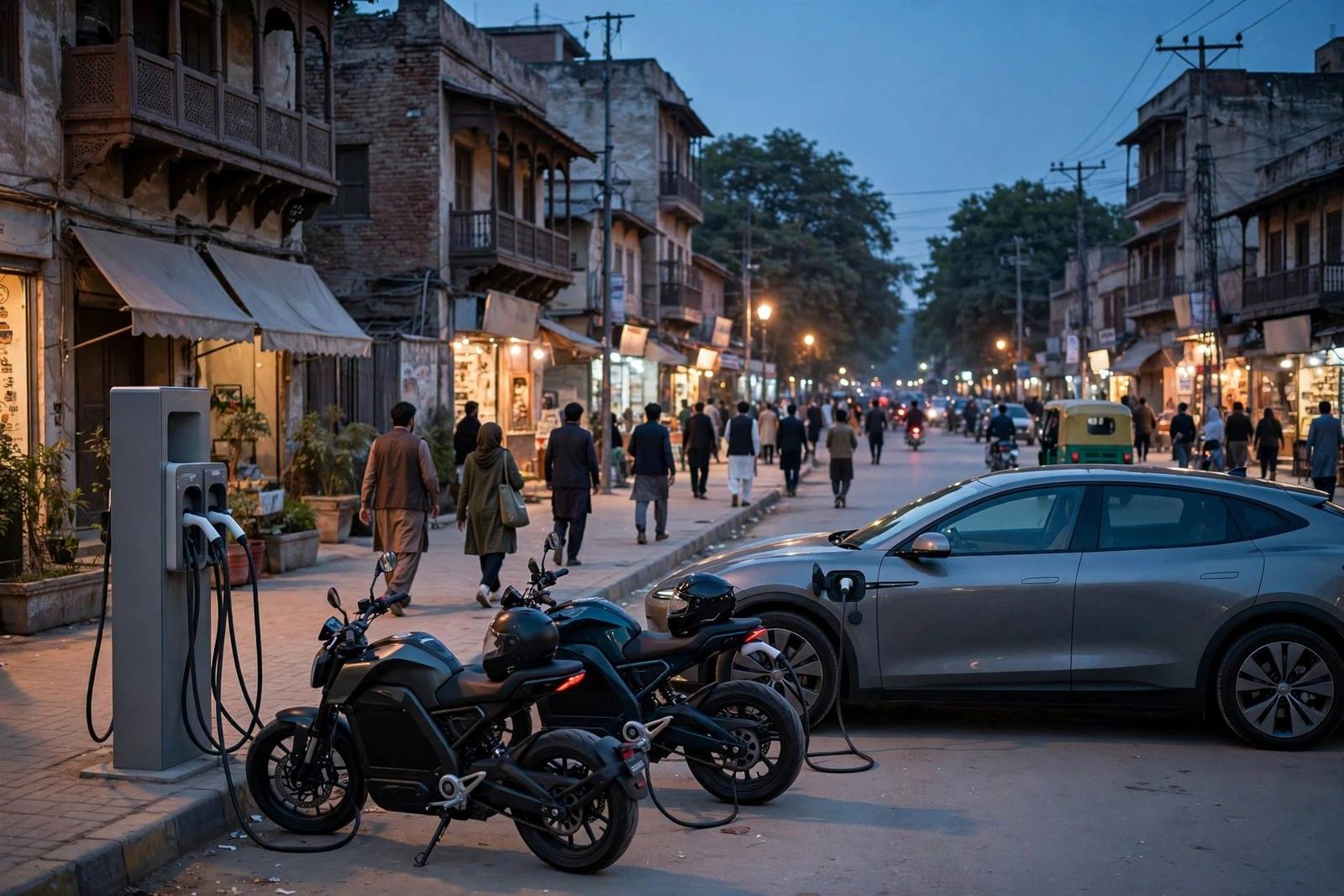
If Pakistan electrifies, it will be on two wheels first. Motorcycles and rickshaws dominate the vehicle fleet by an overwhelming margin, run the highest daily mileages in delivery and commuting service — where fuel savings pay back fastest — and need small batteries that local industry can plausibly assemble. Electric two-wheeler startups and established assemblers alike have launched models; battery-swapping and rickshaw retrofits populate the informal frontier; and the fuel-saving arithmetic for a rider covering long daily distances is compelling even at current electricity prices — provided the bike, the battery and the financing hold up.
Financing is the hinge. A petrol motorcycle is bought with dealer credit and family pooling; an electric one asks more upfront for savings delivered monthly. Concessional green financing windows, including State Bank renewable-energy refinance schemes under which EV-related lending has been discussed and partially channelled, aim at exactly this gap, as do manufacturer instalment plans. The two-wheeler transition is therefore a credit story as much as a technology story — and the segment where Pakistan's EV targets will first be proven honest or imaginary.
Three-wheelers and commercial fleets may be the sleeper segment. Rickshaws — petrol and increasingly LPG — run extreme daily mileages in defined urban territories, return to base nightly, and are maintained by an informal mechanic ecosystem that adapts fast; electrification economics per kilometre are the best in the fleet, and several local makers already sell electric loaders and rickshaws into it. Delivery fleets are the corporate version: e-commerce and courier riders on electric bikes convert fuel cost into predictable electricity cost and have begun appearing in Lahore and Karachi fleets. Watch the working vehicles, not the showroom ones, for the transition's true speedometer.
Cars: imports, assembly announcements and the BYD question
The car story is glossier and thinner. Early EV cars arrived as expensive completely-built imports for enthusiasts; the volume question is local assembly, where global — especially Chinese — manufacturers have been circling Pakistan's protected market. Announcements have included major Chinese brands establishing assembly partnerships, most prominently BYD's entry with a local partner to build a plant for new-energy vehicles, alongside hybrid models from Japanese and Korean incumbents hedging their petrol franchises. Hybrids, note, are the industry's bridge product: no charging anxiety, meaningful fuel savings, and policy treatment that has at times been nearly as kind as for pure EVs.
The investor's discipline is to separate the four stages — memorandum, plant, production, sales — which press releases deliberately blur, and to watch the deletion and localisation schedules that decide whether 'assembly' means manufacturing depth or a screwdriver operation on imported kits. Pakistan's auto history, from Pak Suzuki onward, contains both. The BYD question matters because a serious Chinese entrant reprices the whole market: product, parts, resale expectations and the incumbents' tariff arguments all move at once.
Standards are the boring policy that prevents expensive chaos. Connector types, battery safety certification, testing capacity at the standards bodies, and rules for imported used EVs — which will arrive, as used petrol cars did, whatever policy prefers — decide whether the fleet that forms is safe and serviceable or a scrap problem with wheels. The used-import question is genuinely two-sided: cheap used EVs could democratise access years early, and could equally dump degraded batteries into a country with no recycling regime. A serious policy names its choice; Pakistan's is still being improvised at the ports.
Charging: the infrastructure that decides the map
An EV fleet is only as mobile as its chargers, and Pakistan's network is embryonic: a scattering of DC fast chargers along motorways and in big-city malls and fuel stations, policy documents promising corridors, and tariff questions — what electricity price a commercial charging station pays and may charge — settled slowly by the regulator. For two-wheelers, home and workplace charging largely suffices, which is another reason that segment leads. For intercity car travel, the motorway network needs dependable fast charging at intervals the current fleet's range respects, plus the grid connections to feed it.
The economics are chicken-and-egg in the classic form: chargers are unprofitable at low fleet volumes, and fleets stay small without chargers. Other markets broke the loop with mandates on fuel retailers, public co-investment and standardised connectors; Pakistan's version is being improvised by oil marketing companies adding chargers as marketing, startups leasing space, and policy incentives for charging-equipment imports. Watch installed, working, publicly listed chargers — not announcements — as the metric; the same discipline as counting factories applies to counting plugs.
Oil marketing companies face the transition as a property question. Their forecourts are the natural charging network — prime urban land, power connections, retail footfall — and their fuel margins are what charging would cannibalise; their strategies worldwide have been to own the charger before someone else does. In Pakistan the same logic is visible in embryo: chargers as flagship-site marketing while the fuel business pays. The listed-energy reader should track which OMC builds a real network position, because forecourt land plus charging is one of the few credible second lives available to a petrol retailer in an electrifying fleet.
The grid question: can the system take the load?
Every EV debate ends at the grid, and Pakistan's grid has famous problems — but the EV arithmetic is kinder than intuition suggests. Two-wheelers sip electricity; even large numbers add modest total demand, mostly chargeable at night when the system has slack. Cars add more, and unmanaged evening charging could sharpen peaks the system serves expensively. The deeper issue is the one from our solar guide: Pakistan has surplus installed generation capacity it pays for through capacity charges, so additional well-timed demand can actually improve system economics by spreading fixed costs — EVs as a customer the power sector needs, not a burden it fears.
Distribution is the binding constraint: neighbourhood transformers and feeders sized for yesterday's load, in the same DISCOs whose finances and losses limit investment. Time-of-use tariffs that make night charging cheap are the standard tool, aligning the driver's wallet with the grid's needs. The honest summary: generation can take the EVs of the next decade; local networks and tariff design must be rebuilt to deliver them, which is an argument for starting the rebuild while the fleet is small.
There is a fiscal shadow to success that budgets must pre-fund. Petrol and diesel carry heavy taxation — the petroleum levy is a pillar of federal revenue — and every electric kilometre erases a little of it. Countries further along are already designing road-user charging and electricity-levy replacements; Pakistan, whose levy dependence is acute, will face the gap sooner than its EV fleet size suggests, because the levy base is also squeezed by smuggling and demand weakness. A mature EV policy therefore includes its own revenue succession plan; one that does not is borrowing from a future finance minister who will, predictably, tax the EVs instead.
Air, oil and industry: what success would look like
Price the prize properly. Transport electrification attacks the import bill at its largest line, cuts the urban air pollution that closes schools in Lahore each winter, and gives Pakistan a manufacturing ladder — batteries are the summit, but motors, controllers, harnesses, chargers and two-wheeler frames are climbable rungs — adjacent to its existing auto-parts base, whose listed makers supply today's assemblers. It also converts fuel demand from a dollar outflow into electricity demand partly met by rooftop solar, compounding the energy transition's external benefits described in our guide to reserves.
The failure mode is equally visible in other markets: incentives captured by luxury imports, assembly without localisation, a charging map that ends at the rich districts, and targets quietly buried at the first budget squeeze. The difference between the two futures is not technology — Chinese supply chains have made the vehicles cheap and available — but the unglamorous consistency of tariffs, standards, financing and grid investment over a decade. Pakistan's EV policy has had its announcement decade; the delivery decade is the test.
Finally, the consumer's verdict is delivered in the resale market, years after the policy. Pakistani buyers price a vehicle by what the next buyer will pay, and EVs will have crossed over when a three-year-old electric commands confident money in the used listings — when batteries carry transferable warranties, when mechanics outside the dealership can service them, when parts sit in Shah Alam and Plaza markets. That ecosystem is the real infrastructure, and it is built by fleet volume and time rather than by notification. Policy can shorten the wait; it cannot substitute for it.
What kind of investor studies EV policy
EV policy reprices the listed auto chain — assemblers' product plans, parts makers' order books, oil marketing companies' forecourt futures, tyre and battery names — and, at the macro level, the slope of the oil import bill itself. The EV-literate investor reads tariff notifications rather than launches, tracks two-wheeler sales data as the transition's true leading indicator, separates assembly stages rigorously, and counts working chargers. This article is educational content, not financial advice. Pakistan will not electrify because a policy says so; it will electrify rider by rider and route by route, wherever the monthly arithmetic beats petrol — and policy's job is simply, and difficultly, to widen the ground where that is true.
Key takeaway: Pakistan's EV policy is an import-bill strategy wearing a green badge: duties and financing try to push two-wheelers first, local assembly second and charging infrastructure always — against a grid and a tariff system that decide how fast any of it can go.