KARACHI: Pakistan builds cars behind some of the highest protective walls in its economy, and the result is an industry everyone has an opinion about: a handful of assemblers, prices that climb with every budget, waiting lists and 'own money' premiums in boom years, and a slow procession of new Korean, Chinese and local entrants promising to break the pattern. Auto policy — the shifting bundle of tariffs, taxes, localisation rules and incentive packages through which the state shapes this market — is where those outcomes are decided. This guide explains how the protection system works, why it produces the prices it does, what the reform era of the last decade actually changed, and how to judge the next policy announcement when it lands.
The structure protection built
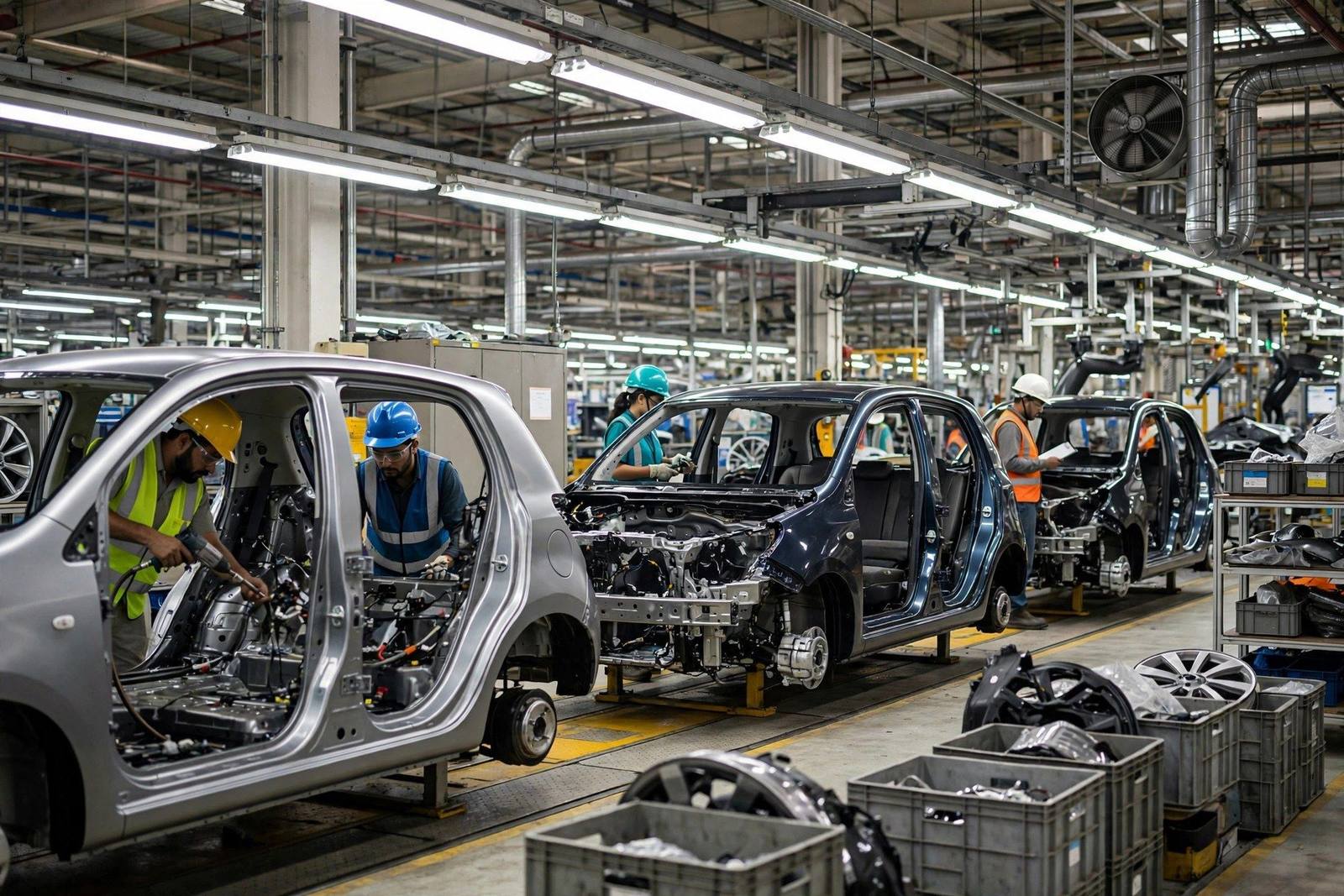
Start with the market's shape. For decades, passenger cars were dominated by three Japanese-linked assemblers — Suzuki's local arm, and the Toyota and Honda ventures — operating plants that assemble vehicles from imported kits and locally made parts, alongside a tractor industry of real scale, a motorcycle industry that is among the world's largest and substantially localised, and truck and bus assemblers serving a thin commercial market. The listed universe mirrors this: Indus Motor, Honda Atlas Cars and, in the current batch of profiles, Pak Suzuki — plus parts makers such as the battery, tyre and component companies whose fortunes are the assemblers' order books at one remove. Our sector overview of PSX automobile stocks maps the full listed field.
The assemblers' defence of the structure is not nothing: they and their vendors employ large numbers, localise a substantial share of parts by value in high-volume models, pay significant taxes, and build to a price point in a market where most households' first 'car' is a motorcycle and the true mass product is the small hatchback. The critics' case is equally concrete: effective protection has historically been high, competition narrow, model cycles long, safety and emissions standards years behind the export markets of the same parent companies, and prices — adjusted for income — among the region's steepest. Auto policy is the arena where these two cases meet every five years, dressed as tariff tables.
How the protection actually works: CKD, CBU and the tariff staircase
The mechanics matter more than the speeches. Vehicles can be imported completely built up (CBU) — finished cars paying high customs duty — or completely knocked down (CKD) — kits of parts for local assembly, paying far lower duty, with further concessions for parts that are localised and higher rates for parts the policy wants made in Pakistan. Around this staircase sit regulatory duties, additional customs duties, sales tax, federal excise on some categories, and withholding taxes collected at registration — a cumulative stack that means the state's take and the protection margin are the same number viewed from two sides. Used-car imports, the consumer's escape valve, are confined mainly to overseas Pakistanis' baggage and gift schemes with age limits that policy periodically tightens to protect assemblers or loosens under consumer pressure; the periodic flood and throttling of used imports is one of the sector's oldest political cycles.
Localisation — historically the 'deletion programme' — is the policy's industrial ambition: requiring or incentivising assemblers to source rising shares of parts domestically, building the vendor industry of seats, glass, radiators, wiring and plastics that employs far more people than the assembly lines themselves. Its honest record is mixed: genuine depth in mature, high-volume components; persistent import dependence in engines, transmissions, electronics and the high-technology core, where Pakistani volumes are simply too small to interest global suppliers. Every policy since has promised to fix this with scale — exports of parts, regional value chains — and every policy has discovered that scale is the thing protection was supposed to create and, on its own, did not.
The 2016 opening and the new entrants
The Automotive Development Policy of 2016–21 was the most deliberate attempt to break the three-player structure: it offered new investors — defined to exclude the incumbents — a package of duty concessions on imported machinery and non-localised parts for a set period, in exchange for building plants and bringing competition. It worked as designed at the level of entry: Kia returned through a local partner, Hyundai re-entered in a joint venture, Master and Sazgar expanded from commercial vehicles and rickshaws into cars and SUVs, Chinese brands arrived in growing numbers, and the market's product range — crossovers especially — widened beyond recognition; Sazgar Engineering is the listed face of that wave. What entry did not deliver, at least not yet, is the promised price discipline at the mass end: entrants priced against the protected incumbents rather than against world prices, 'own money' premiums reappeared in the demand surge after the pandemic, and the consumer's gains arrived as choice and features more than as cheapness. That outcome is itself a policy lesson — concessions lower an entrant's costs, but only competition at scale, sustained through a full demand cycle, turns lower costs into lower prices.
Boom, bust and the policy whiplash problem
No Pakistani industry rides the macro cycle harder. Car demand is credit-sensitive — auto financing expands and contracts with the State Bank's policy rate and bank prudential limits — income-sensitive, and hostage to the import restrictions that arrive in every balance-of-payments crisis, when CKD kits join the long list of letters of credit the banking system cannot open. The result is a sawtooth: record sales and premiums in the cheap-money years, plant shutdown days counted in the news during the squeezes, and an investor experience in auto stocks that is a leveraged bet on macroeconomic stability. Policy has often amplified rather than damped the cycle — incentives announced in booms, duties raised for revenue in crises, localisation deadlines extended under pressure — giving the industry its defining complaint, echoed in every sector study in this series: investors can price risk, but they cannot price reversals. The demand side of the cycle is traced in car financing in Pakistan, a companion guide in this series, and the macro frame in Pakistan's current account.
Safety, emissions and the standards gap
The quiet scandal of the protected decades was specification: models sold in Pakistan long lacked airbags, stability control and emissions equipment standard in the same nameplates abroad, because no regulation required them and no competitor forced them. The newer policy era has begun closing the gap through adopted WP.29-style regulations and type-approval requirements phased across categories, pushed by a consumer and media environment less willing to accept 'Pakistan-spec' as an answer. Progress is real but uneven, enforcement capacity is thin, and the two-wheeler fleet — the vehicle most Pakistanis actually ride — remains the least regulated of all. For policy assessment, standards are the cheapest test of seriousness: unlike tariff bargains, a safety regulation costs the exchequer nothing and its beneficiaries are the buyers the protection system claims to serve.
Electric vehicles: policy's second front
Layered over the conventional framework is the electric transition, treated in full in Pakistan's EV policy explained: duty concessions for EV kits and parts, targets for electrifying two- and three-wheelers first — the rational sequence for a country whose oil bill is a motorcycle fleet's fuel — and a procession of local EV assembly announcements of varying substance. The auto incumbents' incentive is to electrify slowly enough to sweat their conventional investments; the state's incentive, set by the import bill and city air, is the opposite. Which incentive the tariff tables end up serving, category by category, is the most consequential auto-policy question of the coming decade.
How to judge the next auto policy
Read the annexes, not the launch. The duty rates on CKD versus CBU by engine class, the length and conditionality of entrant concessions, the treatment of used imports, the localisation schedule's enforcement teeth, the standards timetable, and the EV categories' precise definitions — those six details determine prices, entry and safety for the policy's life. Then watch volumes and vendor investment a year later: policy in this sector is what survives its first crisis budget. This article is educational content, not financial advice.
Tractors, trucks and the two-wheeler republic
Car policy monopolises attention, but the industry's centre of gravity lies elsewhere. Motorcycles are Pakistan's true mass motorisation — annual sales in the millions in good years, deep localisation, fierce price competition among dozens of assemblers anchored by the Japanese brands and a long tail of local names — and the segment where policy's light touch produced the market's most competitive corner, as the listed makers covered in our motorcycle and parts coverage attest. Tractors are the second pillar: two historic assemblers building Fiat- and Massey Ferguson-derived machines, a vendor base of genuine depth, and demand that tracks farm incomes, harvests and the state's periodic sales-tax and subsidy experiments — a market important enough that tractor policy is effectively agricultural policy. Trucks and buses, by contrast, remain the industry's unfinished business: low volumes, an ageing fleet kept alive by extraordinary local rebuilding skill, dependence on imported kits and used imports, and a freight economy whose inefficiency taxes every other sector in this series. A policy that judged itself by the whole fleet — renewal of the truck stock, safety of the bus fleet, emissions of the two-stroke legacy — would look quite different from one judged by hatchback prices in Karachi showrooms.
The vendor industry: where the jobs actually are.
For every worker on an assembler's line, several more work in the vendor tier — the foundries, forges, plastic moulders, glass and rubber plants, seat and harness makers, many of them family firms in Lahore, Karachi, Gujranwala and Sialkot's industrial belts, several of them listed in their own right. The vendors live the policy cycle most intensely: localisation schedules create their order books, assemblers' shutdown days become their idle weeks, and the quality ladder — supplying a local assembler, then an assembler's export programme, then an unrelated foreign customer — is the realistic escalator by which Pakistani auto engineering could enter world supply chains, as a small number of parts exporters have already shown. Policy's most productive instinct has always been the one aimed here: technology funds, testing facilities, tooling support and export facilitation for vendors, whose capabilities outlast any single assembler's model cycle. Its least productive instinct is the tariff tweak announced for one budget's revenue and reversed in the next, which vendors — investing on five-year horizons — experience simply as weather.
The test of the coming policy cycle will be whether any of this reaches the buyer in a downturn as well as a boom. Pakistan has now run the experiment of protection with three incumbents and protection with a dozen entrants; the second produced better cars and wider choice, and only in the segments where volumes justified real rivalry did it produce visibly keener prices. That is not an argument against entry — it is the specification for what entry policy must do next: keep the door open long enough, and the macroeconomic floor stable enough, for rivalry to reach the small-car buyer who has waited longest for it.
Key takeaway: Pakistan's auto policy protects assembly through a CKD–CBU tariff staircase — producing real vendor industry and employment, entrenched high prices, and periodic new-entrant waves whose benefits depend on competition surviving the next macro bust.