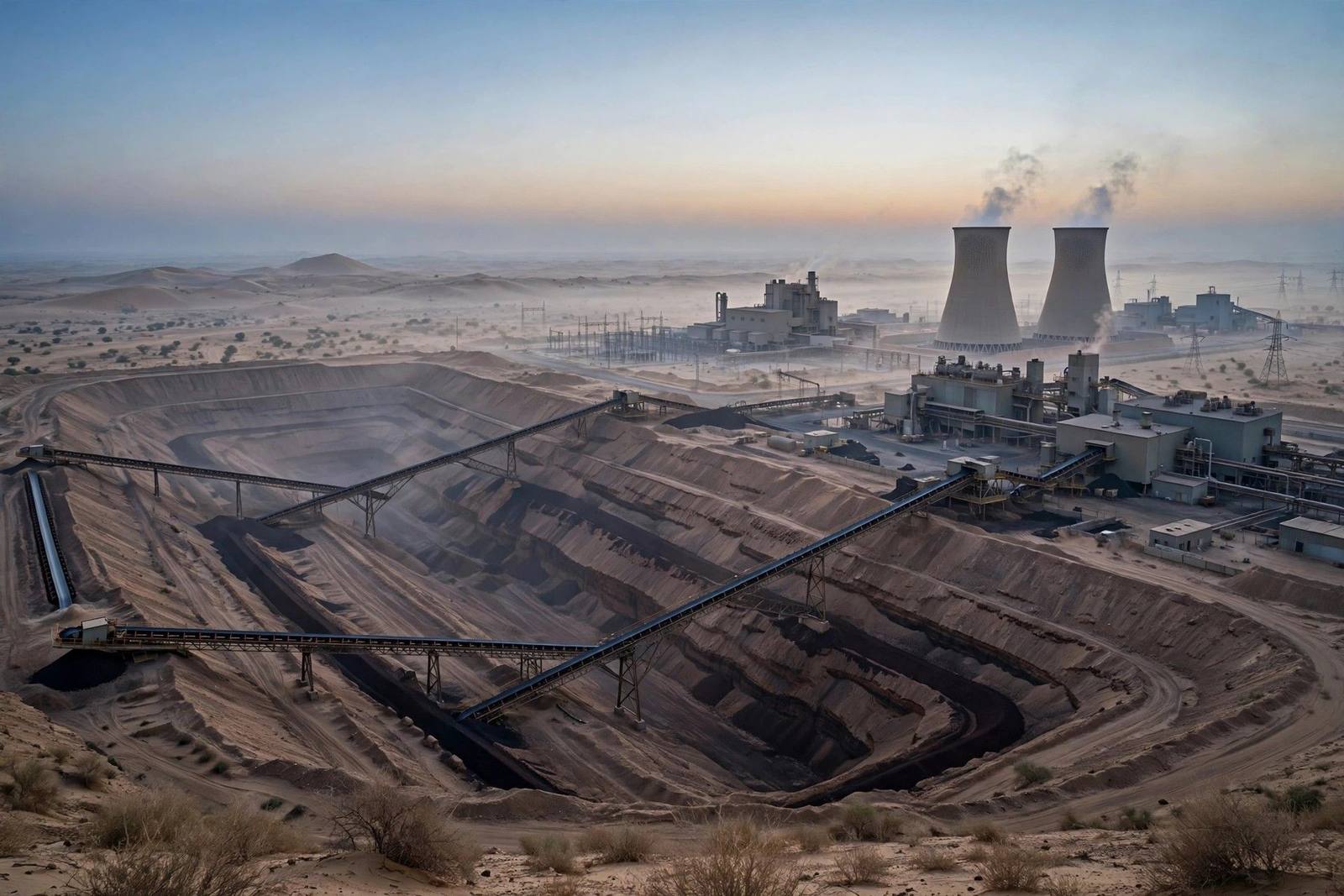
KARACHI: Under the Thar desert in south-eastern Sindh lies one of the largest coal deposits on earth — a sea of brown lignite laid down in an ancient lake bed, known to geologists for decades and dismissed for just as long as too wet, too low-grade and too remote to matter. In the space of a decade, Thar coal went from punchline to power station: open-pit mines at Block II, rows of mine-mouth generating plants, a transmission line marching across Sindh, and a place in Pakistan's electricity mix that no planner in the 1990s would have predicted. This guide explains what Thar coal is, how the mining and power model works, why it divides opinion so sharply, and what its rise tells you about the way Pakistan builds energy projects when it decides to finish them.
The resource: lignite in the desert
Thar coal is lignite, the youngest and softest rank of coal — high in moisture, low in energy per tonne, and expensive to transport because so much of every truckload is effectively water. Those properties dictated the entire development model: Thar coal cannot sensibly travel, so the power stations must come to the coal. The deposit, centred on the Islamkot area of Tharparkar district, is vast in extent and shallow enough in its developed blocks to be mined by open pit — stripping sand and overburden to expose seams that are then dug, crushed and fed by conveyor to adjacent plants. The Pakistan Geological Survey's drilling established the broad shape of the field long before commercial mining; what changed in the 2010s was not the geology but the alignment of a provincial sponsor, Chinese financing under CPEC, and a national electricity shortage severe enough to make desert lignite worth the engineering.
Tharparkar itself frames the social story. It is among Pakistan's poorest districts — a pastoral and rain-fed farming economy of extraordinary cultural richness and chronic vulnerability to drought, with some of the country's weakest health and education indicators. Into this landscape the projects brought roads, an airport, hospitals and thousands of jobs, alongside resettlement, dust, aquifer questions and a transformation of land use that locals judge in mixed terms. Any account of Thar that omits either half of that sentence is advertising, not analysis.
The model: mine-mouth power, block by block
Development is organised in numbered mining blocks, each pairing a mine with power plants. Block II led: its miner, Sindh Engro Coal Mining Company — a joint venture between the Government of Sindh, Engro and partners — supplies the adjacent Engro Powergen Thar plant and other Block II generators, several of them sponsored by listed groups including Hub Power, whose Thar Energy and ThalNova ventures extended the model. Other blocks have followed their own sponsor and financing paths. The electricity travels to the national grid over a dedicated high-voltage line built for the purpose, which for years was the project's most anxious dependency: coal without evacuation is a hole in the ground, and Thar's plants earn only when the grid takes their power.
The commercial logic is a swap. Pakistan historically burned imported coal and furnace oil whose prices arrive in dollars and swing with world markets; Thar lignite is priced in rupees under regulated mining and generation tariffs, insulating a slice of the power system from both commodity and currency shocks — the same exposure that drives Pakistan's oil import bill. In exchange, the country accepts the costs of a carbon-heavy fuel, capacity payments to plants that must recover a large fixed investment, and the operational reality that mine and plant are a single point of failure for each other. The tariff machinery through which all of this is paid is the one whose shortfalls produce circular debt; Thar plants are creditors in that chain like every other generator.
Why Thar took thirty years to happen
The deposit's long sleep is a case study in how projects fail by default. Early studies in the 1990s confirmed the coal and even attracted foreign interest, but the package never closed: lignite's low value demanded huge upfront spending on mines, plants, water and transmission simultaneously; Pakistan's power-sector finances were too weak to sign credible purchase agreements; water for cooling and processing in a desert required its own infrastructure; and successive governments treated Thar as a provincial aspiration rather than a national programme. What finally moved it was the combination of CPEC financing channels, a Sindh government willing to hold equity and political risk through the mining company, tariff determinations that recognised the project's real costs, and an anchor technology partner with Chinese equipment and contractors able to build at the required pace.
There is a quieter lesson in the sequence: the mine came first, deliberately. Establishing the pit, the dewatering and the coal supply before the full plant fleet meant the fuel risk — the question that had killed earlier attempts on paper — was retired physically, seam by seam, in public view.
Water, air and the people of Tharparkar
The environmental ledger has three main entries. Water: mines must be dewatered to be dug, plants need cooling and process water in a district where drinking water is scarce, and project water infrastructure — including supply lines from the Indus system and treated-water schemes — has been both a genuine local benefit and a continuing controversy about whose water is used for what. Air and carbon: lignite is the most carbon-intensive mainstream fuel per unit of electricity; Thar's plants use modern boilers and emissions controls for local pollutants, but their carbon dioxide output is intrinsic to the fuel, and each new block adds decades of it to Pakistan's inventory — the tension at the centre of Pakistan's energy mix. Land and livelihoods: villages inside mining areas have been resettled under project frameworks that independent observers have assessed in sharply differing terms; grazing land, graveyards and the desert ecology of the region carry meanings that compensation arithmetic does not settle.
Balanced against this are documented gains that district residents themselves cite: wage employment at unprecedented local scale, women's employment programmes attached to the projects, hospitals, schools and drinking-water plants run by project foundations, and the simple fact of a metalled road and a grid connection reaching villages the state had barely touched. The honest summary is that Thar industrialised a district that development had skipped, with the usual distribution of industrialisation's benefits and harms compressed into a single decade.
Thar in the power system — and what could strand it
Within a few years of first power, Thar plants were supplying a meaningful share of national generation at fuel costs that, in the merit order, generally undercut imported-fuel plants — a structural benefit whenever global coal and oil prices spike. Expansion phases have repeatedly been proposed: more blocks, larger pits, and at times talk of coal-to-liquids or gasification schemes that remain, for now, talk. The counter-scenario has grown more credible with time. Solar and wind costs have fallen below new coal almost everywhere; Pakistan's own rooftop solar surge is hollowing out daytime grid demand; international climate finance has largely closed to coal; and each Thar plant carries dollar-linked debt service and equity returns inside its rupee tariff, so the insulation story is partial, not total. Investors in the listed sponsors therefore read Thar two ways at once — as contracted, regulated cash flow today, and as an asset whose later decades must survive a grid that is changing underneath it.
What to watch
Follow the physical numbers the sponsors disclose: coal production and pit expansion milestones, plant availability and dispatch, receivables from the power purchaser, and any new block reaching financial close. Follow, too, the district story — water schemes, resettlement phases and Sindh's budget receipts from its mining stake — because Thar's licence to expand is renewed politically, not just commercially. This article is educational content, not financial advice.
The economics Sindh sees
For the Government of Sindh, Thar is not only an energy project but the province's largest industrial asset. The provincial government holds its stake in the Block II mining company directly, earns royalties and taxes on extraction, and points to project employment and infrastructure as development delivered to its most deprived district — a political asset no Sindh government will lightly allow to fail. That alignment of host-province interest with project success is the same design principle visible, in equity form, at Reko Diq, and its absence helps explain older Pakistani resource projects that died between Islamabad and a resentful province. The alignment has a fiscal shadow: provincial receipts and plant tariffs alike ultimately depend on the national power purchaser paying its bills, so Thar's cash story is chained to the same payment discipline as every other generator's.
Could Thar coal do more than make electricity?
Almost since the deposit was proved, engineers have asked whether lignite's highest use is really burning it in place. Coal gasification — converting coal underground or at surface into gas for fertiliser, chemicals or liquid fuels — has been studied for Thar repeatedly, and pilot ambitions surface in policy documents with some regularity. The obstacles are consistent: gasification at commercial scale is capital-hungry, water-hungry and technologically unforgiving, and its products must compete with imported LNG and urea economics that shift with world prices. For now, the honest position is that Thar's proven role is electricity, its possible chemical future is an option rather than a plan, and proposals should be judged by whether they reach financed pilot scale rather than by the enthusiasm of their launch events. A parallel question is whether future blocks should be developed at all as solar-plus-storage costs keep falling — a decision that will be made block by block, government by government, against the security of a fuel that is already in the ground in Sindh and a grid that still runs short on still, hot evenings.
Reading the listed companies' Thar story.
Investors meet Thar through sponsors whose annual reports separate, with varying clarity, the mining and generation legs: coal production tonnages and stripping ratios on one side; plant availability, capacity payments and receivables on the other. The two legs fail differently — a mine can flood or a conveyor can stop; a plant can trip or the purchaser can delay payment — and the reports reward readers who track both rather than the consolidated dividend alone. What the dividends themselves demonstrate, when they flow, is the model's core claim: that a rupee fuel, regulated and contracted, can throw off cash in an economy chronically short of the dollars that imported fuel demands.
One further test of maturity will be how the Thar projects handle their second decade: pits deepen, equipment fleets need renewal, resettled communities judge whether promised services endured, and the first generation of local employees looks for promotion into the supervisory grades that expatriate and Karachi staff dominated at start-up. Mines and power stations are judged, in the end, less by their inauguration than by whether they become ordinary, well-run local institutions — and Thar's sponsors have laid enough social and technical foundation that ordinariness, paradoxically, would be the project's greatest achievement.
Key takeaway: Thar coal turned remote, low-grade lignite into working power by pairing open-pit mines with mine-mouth plants — cutting imported-fuel exposure at the price of carbon, water strain and a transformed Tharparkar, whose people carry both the gains and the costs.