KARACHI: Officially, a little over a third of Pakistanis live in cities. Unofficially, demographers argue the true share is far higher — Pakistani definitions of 'urban' are restrictive, and vast peri-urban settlements function as city in every way except the census form. Either way, the direction is unambiguous: Pakistan adds the equivalent of a mid-sized city to its urban population every year, through natural growth and through migration from countryside to town in search of work, schooling and safety.
Karachi is the extreme case — one of the world's largest megacities, Pakistan's port, financial capital and manufacturing hub in one congested package — but Lahore, Faisalabad, Rawalpindi-Islamabad, Hyderabad, Multan, Peshawar and Quetta are all growing faster than their infrastructure. This guide explains the economics of that growth: the housing shortage it creates, the informal city that fills the gap, and why land — not labour or capital — is the asset Pakistani households trust most, a preference our comparison of property versus stocks explores. The census itself is part of the story. Pakistan's population counts are politically charged — seats, fiscal transfers and provincial shares ride on them — and the urban numbers are the most contested of all, with Karachi's true population a standing argument between demographers and officials. Undercounting cities is not a victimless statistical sin: transfers, water quotas, policing and infrastructure budgets all key off the official figures, so a city counted small is funded small, and the gap is paid by its residents in services that never arrive. When you read that a Pakistani city's infrastructure is 'overwhelmed', check first whether it was ever funded for its real size.
The housing shortage, counted in millions
Estimates of Pakistan's housing shortfall vary by method, but they agree on scale: a backlog commonly put in the vicinity of ten million units, growing by several hundred thousand a year as household formation outruns construction. The shortage is not uniform. Luxury apartments and gated schemes are built readily; the deficit sits at the bottom — small, serviced, legally titled homes and rental units that low- and middle-income families can actually afford, near the jobs the cities offer.
The arithmetic of unaffordability is simple. Formal construction costs, land prices inflated by speculation, and a near-absent mortgage market — housing finance is a tiny fraction of GDP compared with peer economies, as our guide to housing finance details — mean a salaried family buys housing the way it buys everything large: slowly, informally and through family networks. Government programmes periodically promise millions of low-cost homes; delivery is consistently throttled by land title, utility connections and financing rather than by any shortage of bricks.
Rental is the invisible half of urban housing. Policy and conversation fixate on ownership — plots, files, societies — while a large share of urban Pakistan rents: rooms in shared houses, floors of subdivided homes, informal tenancies in settlements, and a thin formal apartment market in the big cities. Renters are younger, poorer and more mobile than owners, and almost entirely unprotected by enforced tenancy law. The shortage expresses itself for them not as an unbuyable house but as a rising share of income for a worsening room — which is why urban cost-of-living politics in Pakistan is so often, underneath, housing politics.
The informal city: katchi abadis and the real housing market
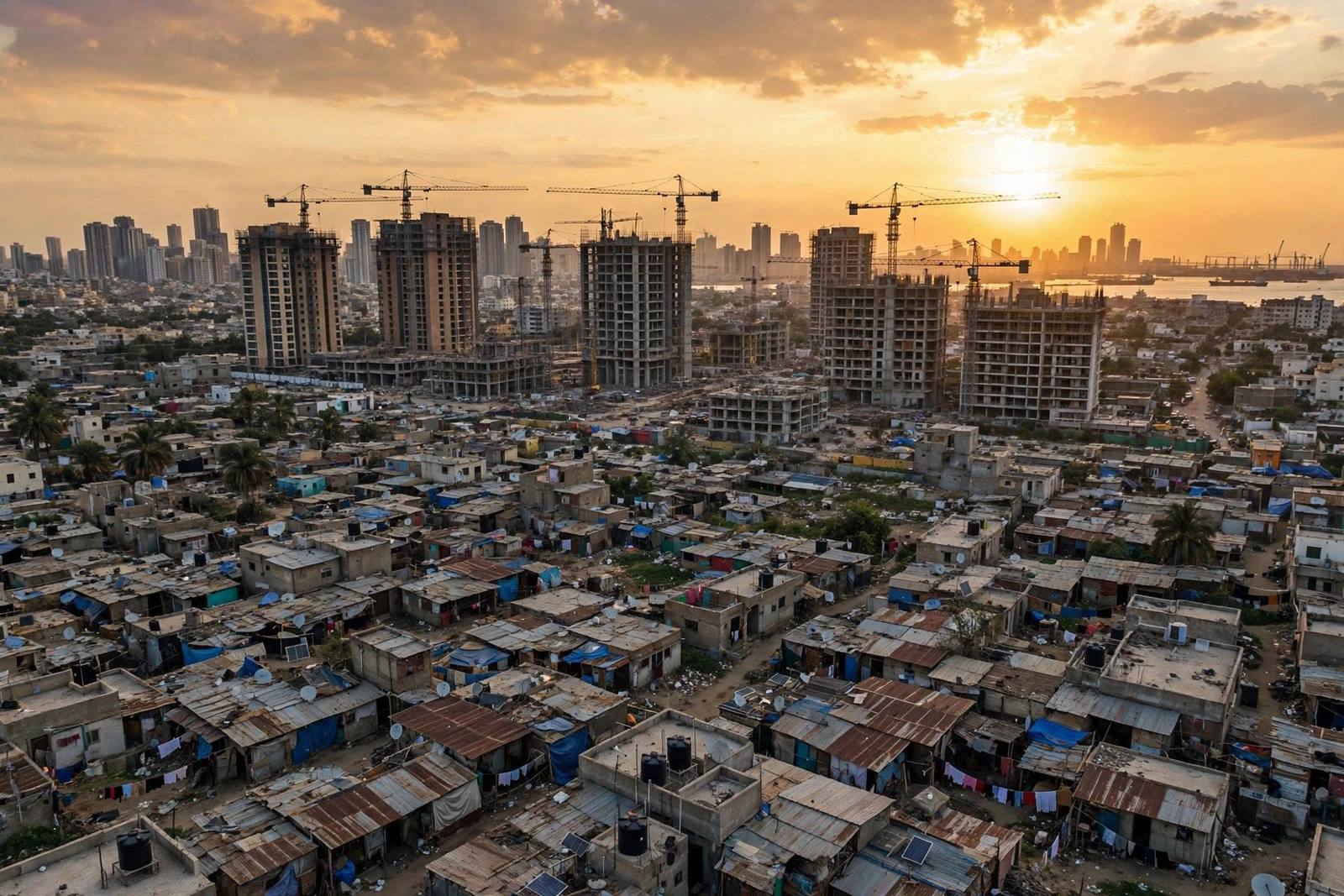
Where the formal city fails, the informal city builds. Katchi abadis — informal settlements on occupied or subdivided land — house a large share of Karachi's and other cities' populations, often for decades, with incremental self-built housing, informal water and electricity arrangements, and tenure regularised only partially and slowly. Economists once treated these settlements as pure pathology; the better view is that they are the working-class housing market, supplying shelter at price points the formal sector refuses to serve, at the cost of legal insecurity and absent services.
Around them sits the grey economy of plot files and speculative subdivisions — the parallel property market demystified in our guide to plot files — in which claims on future plots trade like securities, sometimes for years before a road exists. Urban land in Pakistan thus serves two masters: shelter and savings. The savings function bids prices away from the shelter function, which is one reason a country with a housing shortage can simultaneously have vast tracts of plotted, serviced and entirely unbuilt land on its urban edges.
Transport is housing policy by other means. Where a city offers no credible public transport, the effective housing market shrinks to what a motorcycle or an expensive commute can reach, and land near employment carries a premium that prices out the workers the employment needs. Karachi's circular railway revival efforts, Lahore's metro and bus corridors and the BRT systems in Peshawar and Karachi are therefore housing interventions as much as transport ones: each credible line expands the map of land a low-income family can actually live on. Cities that build transit before the sprawl hardens buy cheaper housing with concrete; Pakistan is mostly buying it afterwards, at retail prices.
Why households trust land more than finance
Ask why Pakistanis pour savings into plots and the answers are empirical: land held its value through inflations that destroyed bank deposits' real returns; it needs no documentation of income; it can be bought with informal and overseas money alike; and its taxation has historically been light relative to its gains. Remittances from the diaspora — the flow explained in our guide to remittances — pour disproportionately into property, because a plot in a housing society is the diaspora's most legible asset back home.
The macroeconomic cost is opportunity foregone. Savings locked in unbuilt plots do not fund factories, startups or the stock market; construction that does occur skews to low-density sprawl that is expensive to service with roads, water and transport; and the financial system loses the deposits and the mortgage assets that, in other economies, anchor banking depth. Urbanisation done this way makes households individually prudent and the economy collectively poorer — a signature Pakistani paradox.
The property-tax failure is the fiscal root under much of this. Urban property is Pakistan's most visible wealth and its least taxed: valuations lag market prices by years, coverage is patchy, and rates are low, leaving municipalities dependent on provincial transfers and unable to fund the water, roads and drainage that make land valuable in the first place. Reform is perpetually proposed and perpetually localised into harmlessness, because the taxed class and the deciding class overlap. Until cities can tax the land values they create, the infrastructure deficit is not a mystery of engineering but a choice of fiscal politics — repeated annually, in every budget, by default.
Construction: the economy's great employer of last resort
When governments want jobs quickly, they reach for construction, and Pakistan's structure explains why. Building is labour-intensive, import-light compared with other industries, and pulls a long domestic supply chain behind it: cement and steel, bricks and sanitary ware, glass, paint, cables, tiles and a hundred trades. Listed beneficiaries — cement makers, steel producers, cable and tile companies such as Shabbir Tiles — report urban demand in their volumes within a quarter or two, making construction data a coincident indicator of the whole urban economy.
Policy has repeatedly tried to formalise the lever: construction packages and amnesties for undocumented investment in building, developer incentives, and foreclosure-law reforms meant to unlock mortgage lending. Each episode lifts activity; none has yet changed the underlying split between speculative land-holding and productive housing supply. The investor reading a construction boom should therefore ask which kind it is — plots changing hands at rising prices, or roofs going over families — because only the second kind shows up in cement bags for long.
Developers, for their part, respond rationally to the system as built. Gated schemes on urban peripheries offer what municipalities cannot: internal water, power backup, security and maintained roads — privatised urban services bundled into the plot price. The model works for its buyers and fragments the city for everyone else, consuming agricultural land at the edges while the dense core decays. Bahria, DHA and their peers are thus best read not as villains or visionaries but as market verdicts on municipal failure: where the state will not supply a functioning city, the market sells one by the phase, to those who can pay.
Cities as economic machines — and their failing parts
Cities exist because proximity is productive: Karachi's port and finance, Lahore's commerce and industry, Faisalabad's textiles, Sialkot's export clusters all run on dense labour markets and shared infrastructure. Pakistan's tragedy is that its cities capture the congestion of urbanisation faster than its productivity — transport systems overwhelmed, water and sewerage covering fractions of the population, air quality among the world's worst in the Punjab smog season, and municipal governments too fiscally weak to respond, dependent on provincial transfers rather than their own property-tax base.
The water dimension alone, detailed in our guide to the water crisis, caps what cities can become: a megacity that cannot supply its residents' water cannot formalise its housing or its industry either. Urban reform — empowered local governments, real property taxation, serviced-land supply, mass transit — is therefore not municipal housekeeping. It is the productivity agenda of an economy whose future output will be produced overwhelmingly in cities.
Gentrification's Pakistani dialect deserves a sentence, because it differs from the Western script. The pressure on old-city and inner-settlement land comes less from returning professionals than from commercial conversion — warehouses, wedding halls, wholesale markets — and from infrastructure projects whose compensation and resettlement terms decide whether upgrading a neighbourhood exports its poor. Anti-encroachment drives periodically demolish the informal city in the name of the formal one, without expanding the formal supply that would make the demolition anything but displacement. A housing policy can be judged by a single test: does the city contain more legal, serviced, affordable homes after it than before?
The demographic clock inside the city
Urbanisation interacts with Pakistan's age structure — the subject of our guide to demographics — in one decisive way: the cities must absorb a youth bulge into jobs, housing and services at a pace no previous generation required. Young urban households form later, rent longer, marry later and crowd multigenerational homes in the meantime, all of which suppresses the housing demand that incomes would otherwise express and stores up frustration that periodically becomes politics.
It also creates the market: hundreds of thousands of new urban households a year needing furniture, appliances, motorcycles, schooling, healthcare and connectivity. Consumer-facing listed companies live off exactly this formation curve. The investor who maps where the young households are forming — which districts, which price points — is reading the demand pipeline of the consumer economy several years before it reaches a results presentation.
The long view is oddly hopeful, because the economics are so lopsided. A serviced-plot and small-unit industry building at the shortage's true price points would employ millions, deepen the mortgage market, pull savings from speculation into construction and give the young urban majority a stake in the formal city. Countries at Pakistan's income level have built exactly that industry when land title, utilities and finance were aligned. The shortage, in other words, is not a resource problem — the land, labour and materials are all present — but a coordination problem, and coordination problems, unlike rivers, can actually be solved by policy.
What kind of investor studies urbanisation
Urbanisation is the slow variable that explains fast ones: land and cement cycles, consumer demand, bank branch economics, even the political calendar. The urbanisation-literate investor tracks census and survey data on city growth, watches housing-finance reforms for substance over slogans, distinguishes speculative plot inflation from construction reality, and remembers that Pakistan's savings are quite literally concreted into its cities' edges. This article is educational content, not financial advice. Its closing point is the shortage itself: a deficit of millions of homes is a humanitarian fact, but it is also the largest unbuilt order book in the economy — and whoever learns to build for it profitably changes the country.
Key takeaway: Pakistan's cities grow by a city's worth of people a year into a housing system short by millions of units — so land became the national savings account, construction the national employer, and the shortage the economy's biggest unbuilt order book.