KARACHI: Pakistan Refinery Limited has been "about to be upgraded" for most of living memory — and yet it still matters every single day. From its plant on Korangi Creek Road, Karachi, PRL processes roughly 50,000 barrels of crude a day into the petrol, diesel, kerosene, jet fuel and furnace oil that keep the country's largest city and its armed forces moving. It was incorporated in May 1960, built by a consortium of four of the world's great oil companies after Pakistan declined a Soviet offer to build the refinery instead, and it has been listed since its founding generation. Today it is a subsidiary of Pakistan State Oil, the state-controlled marketing giant, and the standard-bearer for the question that hangs over all Pakistani refining: can a 1960s hydroskimming plant be rebuilt into a modern refinery before economics and fuel standards leave it behind? This profile traces PRL's unusual birth, its long middle age, and the upgrade saga by which the stock is now judged.
A refinery born of the Cold War
The founding story deserves the space it gets in the company's histories. In the late 1950s the Soviet Union offered to help young Pakistan build an oil refinery — on condition that it process only Soviet crude. Rather than accept, the government turned to the Western oil companies already operating in the country and proposed a joint venture. In September 1959 it signed an agreement with a consortium of four: Burmah Oil, California Texas Oil Corporation (Caltex), the Shell Petroleum Company and Standard Vacuum Oil Company. Pakistan Refinery Limited was incorporated as a public limited company in May 1960, the construction contract went to the M. W. Kellogg group at a cost of about $35 million, and the equity was split in a pattern that foreshadowed the company's whole life — the four oil companies subscribed 60 per cent between them, and Pakistani private investors took 40 per cent through an initial public offering on the Karachi Stock Exchange. The refinery at Korangi, with crude berthing and storage at Keamari across the harbour, began operations in the early 1960s — company sources date the start to October 1962, with formal inauguration by President Ayub Khan following in 1964 — at an initial design capacity of one million tonnes of crude a year, later expanded to 2.1 million tonnes, or roughly 47,000–50,000 barrels a day.
One thread from that founding is worth following, because it ties this profile to another in this series. The marketer formed by two of the same parents, Burmah-Shell, grew into today's Wafi Energy Pakistan; the refinery consortium's members included the ancestors of half the Karachi oil trade. In 1960, refining and marketing were being built by the same hands, in the same city, in the same years — the Korangi-Keamari complex was Pakistan's first integrated oil district, and PRL was its foundation stone.
Six decades of the hydroskimming life
PRL is a hydroskimming refinery, and the term explains its economics. A hydroskimming plant distils crude into its natural fractions and treats them — a crude distillation unit, a hydrotreater to strip sulphur, a platformer to raise petrol octane — but it cannot fundamentally convert the heavy bottom of the barrel into light products. What comes out therefore mirrors what went in: a substantial share of furnace oil, for which demand has been collapsing as power generation moves to gas, coal and renewables, and not quite enough of the petrol and diesel whose demand grows every year. For decades this mismatch was tolerable. Furnace oil had a guaranteed home in power stations, the defence services took their jet fuel and diesel, and Karachi's market absorbed the rest. PRL settled into the role of a dependable, unglamorous utility of the oil economy — and, as its consortium parents merged, exited and were nationalised around it, its shareholding drifted steadily toward the state.
The decisive change came in June 2015, when Pakistan State Oil acquired Shell's stake in PRL, taking PSO's holding to the controlling level — about 63.6 per cent in recent disclosures — and making the refinery a subsidiary of the country's largest oil marketer. The logic is vertical integration: PSO sells more petroleum products than any other company in Pakistan, and owning the refinery that makes a share of them secures supply and keeps a slice of the chain's margin inside one group. It also means PRL's fate is set by a state-controlled parent whose own finances and governance move with government policy — a strength when Islamabad wants the refinery funded, a complication when it does not. The one significant modernisation of the plant's recent life, a Penex isomerisation unit supplied by Honeywell UOP and commissioned in 2016, doubled output of high-quality petrol to about 24,000 tonnes a month by converting naphtha into higher-octane blending stock — proof that targeted investment works, and a measure of how much of the plant still awaits its turn.
How PRL makes money
The mechanics are those of every Pakistani refinery, set out in more detail in the National Refinery profile: buy crude at international prices, sell the product basket at regulated import-parity prices, and keep the spread — the gross refining margin — after energy, maintenance and overheads. For PRL three features of that formula dominate. First, product mix: a hydroskimming slate heavy in furnace oil earns less than the slate of a complex refinery, and as furnace-oil demand has shrunk, PRL has periodically had to throttle runs or find export and storage outlets for a product nobody upcountry wants. Second, inventory: weeks of crude and product stock mean sharp oil-price falls produce accounting losses on holdings bought dear, while rising prices flatter results — the same see-saw that moves its Karachi neighbour. Third, the pricing formula's historical furniture, notably the deemed-duty arrangements meant to fund upgrades, which have been revised repeatedly and on which any serious modernisation financing ultimately depends. Defence sales — the company has long supplied the armed forces alongside the domestic market — provide a steadier thread of demand through the cycle, but they do not change the fundamental truth: PRL earns what a simple refinery earns, in a formula not of its choosing.
Costs tell the same story of age. A plant whose core dates to the 1960s, expanded in stages and maintained with care by a workforce of only a few hundred, spends its capital budget disproportionately on integrity — keeping old steel safe — rather than on yield. That is precisely the gap the upgrade is meant to close, and precisely why the upgrade is so hard to finance: lenders are asked to bet on a pricing regime, a parent and a project plan all at once. Our explainer on Pakistan's oil import bill sets out the national stakes: every tonne of crude refined at home into usable products is preferable to importing finished fuel, but only a modern refinery captures the full benefit.
Two sites, one system: Keamari to Korangi
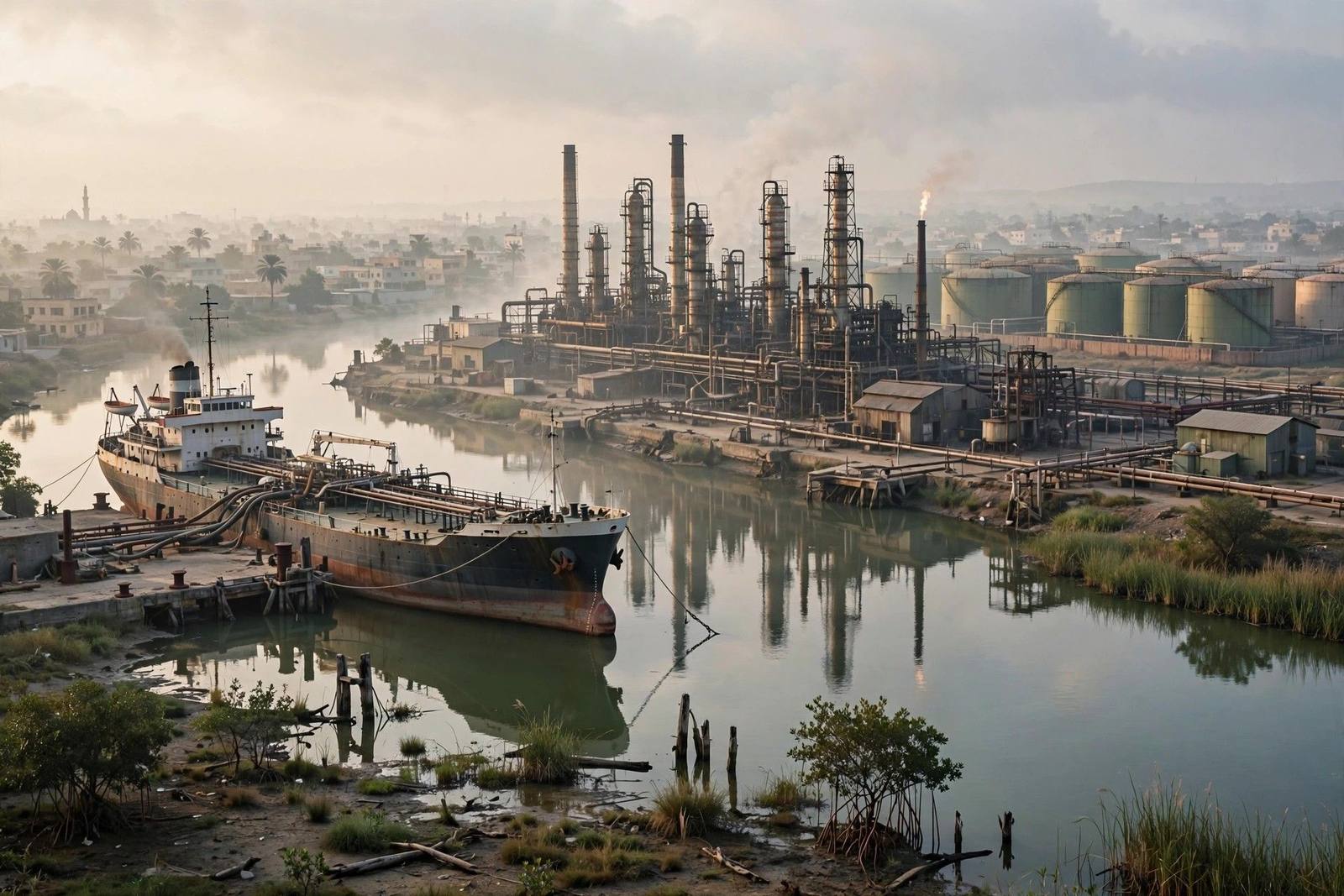
The refinery's physical split tells its own story of the Karachi oil economy. Crude arrives by sea and is berthed and stored at Keamari, the old oil pier district by the port, then moves to the processing plant on Korangi Creek Road, on the city's south-eastern edge, where the distillation, hydrotreating, platformer and isomerisation units stand. Around that axis — port, pipeline, plant — the rest of Karachi's downstream industry arranged itself over the decades: the marketers' terminals, National Refinery's complex across the industrial district, and the storage from which tankers fan out to Sindh and Balochistan. PRL is thus not merely located in Karachi; it is one of the reasons Karachi's fuel geography looks the way it does. Its defence supplies add a further strand: the company has long counted the armed services among its customers, a relationship that predates most of the market's memory and that anchors a baseline of jet fuel and diesel demand through commercial cycles.
Through the long middle decades the founding consortium quietly unwound around the plant. The global parents merged, sold and retreated from downstream positions across Asia; governments came and went with their own claims on the oil sector; and the state's share of the industry — through PSO's marketing dominance and, eventually, its control of the refinery itself — grew by accumulation rather than by any single nationalising act. The workforce that runs the plant today numbers only a few hundred, lean even by refinery standards, which is itself a comment on the asset: a hydroskimming plant's units are few, its routines settled over sixty years, and its knowledge concentrated in people who have maintained the same steel for whole careers. That leanness is an efficiency and a fragility at once — and it is part of what any upgrade must reckon with, since a deep-conversion PRL would need skills and staffing the present plant has never had to carry.
The upgrade: REUP and the long promise
PRL's answer, pursued in various forms for years and unveiled in its current shape at the company's "PRL Connect 2024" event, is the Refinery Expansion and Upgrade Project — REUP. As announced, it is a brownfield expansion of roughly $1.7 billion intended to about double throughput toward 100,000 barrels a day and, more importantly, to convert the plant from hydroskimming to a deep-conversion configuration, so that furnace oil largely disappears into petrol and diesel and the products meet modern Euro-V standards. The enabling framework is the federal brownfield refinery policy, which offers existing refineries fiscal incentives — funded through the pricing system — to sign implementation agreements and modernise. PRL has courted banks and partners publicly for the project, with its chairman and chief executive presenting it as the foundation of a self-sufficient fuel economy: more domestic product, less import dependence, foreign exchange saved.
The honest analyst's caveat is timing. Versions of a PRL upgrade have been announced, studied and re-announced across decades, and the project's scale relative to the company's balance sheet means it can only proceed with policy support, sponsor commitment and syndicated debt all aligned at once. Between announcement and financial close lie front-end engineering, environmental approvals, lender due diligence and the small matter of a national pricing formula that has changed before and can change again. None of this makes the project unreal — the isomerisation unit shows PRL can execute — but it does mean the stock's story is a call option on execution, and options decay. Set against that, the downside of doing nothing is visible in the furnace-oil market every month: a hydroskimming refinery in a market that no longer wants its heaviest product is a wasting asset, however storied.
PRL on the PSX: the investor who prices a promise
PRL's shares have traded since the company's founding generation — the 40 per cent public tranche of 1960 was among the Karachi exchange's early industrial listings — and today the register is dominated by PSO's controlling stake, with the public float trading in the space left over. The stock behaves as Pakistan's purest listed play on refinery-upgrade policy: it stirs on brownfield-policy news, implementation-agreement milestones, engineering-contract awards and any sign of financing, and it drifts when the saga pauses, while its underlying fuel earnings follow the same refining cycle as Hascol and the other oil names in reverse — refiners and marketers rarely feast in the same year. Dividends have never been the story here; capital retention for the upgrade is the board's standing argument. Followers therefore watch a distinctive dashboard: REUP milestones and their dates; crude throughput and any month in which the furnace-oil outlet forced a cut; inventory effects after big oil-price moves; PSO's own position, since the parent's strength is the refinery's credit; and, in every federal budget, the treatment of the pricing formula on which the whole expansion case rests. Readers new to the exchange can ground themselves in how to buy shares on the PSX before wading into a story this policy-laden.
Who studies PRL, then? The special-situations investor who thinks a $1.7 billion project, if financed, transforms a wasting asset into a modern one and is willing to underwrite Pakistani policy risk to own that transformation early; and the sector historian who knows that Karachi's oil age began on this site in 1962. This article is educational content, not financial advice. What is certain is narrower than the promise and sadder than the potential: until the upgrade is financed and built, PRL remains what it has been for sixty years — an essential, ageing refinery, running a Cold War plant at the heart of a fuel system that has outgrown it.
Key takeaway: Pakistan Refinery is PSO's 1960 Korangi hydroskimming plant — Cold War-born, state-controlled, and priced by the market largely on whether its long-promised deep-conversion upgrade finally gets financed and built.