KARACHI: Every Pakistani family knows the price of gold — it is quoted on television, discussed at weddings and mourned or celebrated at the jeweller's counter. Silver, the chandi of the bazaar, has usually lived in its shadow: the cheaper metal, the material of utility cutlery, of modest jewellery, of the small gifts and the Quran-stand and the paan box. Yet silver keeps having its moments, and lately it has had a long one, as global prices have surged on a mixture of industrial hunger and investor enthusiasm, dragging Pakistani sarafa rates up with them and filling market columns that gold used to monopolise. Understanding silver in Pakistan requires understanding two different metals wearing one name. There is silver the jewellery and savings metal, priced by the tola in the sarafa markets of Karachi, Lahore and Rawalpindi, bound to tradition and to the gold relationship every family tracks. And there is silver the industrial input — the best electrical conductor of all metals — poured into solar panels, electronics and electric vehicles by the world's factories, whose demand increasingly sets the price that the bazaar must follow. This guide explains how silver is priced and sold in Pakistan, how it differs from gold as a household asset, and where buyers are quietly skinned.
How the Pakistani price is made
The sarafa price is an import price wearing local clothes. Pakistan produces negligible silver of its own, so the bazaar rate for a tola of silver — the tola, at 11.66 grams, remains the unit of the trade alongside the gram — is derived from the international silver price in dollars per troy ounce, converted at the prevailing rupee exchange rate, with the trade's margins and any applicable taxes layered on top. Market associations in the major cities announce daily rates, and television and newspapers quote them beside gold. When the rupee weakens, the local silver price can rise even on a day when the world price has done nothing; when the dollar price leaps — as it does, because silver is famously the more violent mover of the two metals — the sarafa rate follows within the day.
Silver's violence deserves respect. Because its market is far smaller than gold's, and because its demand splits between investors and industry, silver typically rises faster than gold in precious-metal rallies and falls faster in panics; traders describe it as gold on a lever. The gold-silver ratio — how many ounces of silver buy one ounce of gold — is the bazaar intellectual's favourite gauge of which metal is relatively cheap, with long historical swings in both directions. Households do not need the ratio to feel the basic truth: a sum that buys a modest amount of gold buys a heavy, impressive quantity of silver, and that psychological arithmetic — more metal for the money — is precisely what periodically pulls small savers toward chandi when gold runs beyond their reach. Our companion guide to gold versus stocks in Pakistan works through the comparison for the senior metal, and nearly every argument there applies, with wider spreads and wilder swings, to its junior partner.
The forms silver takes in Pakistan
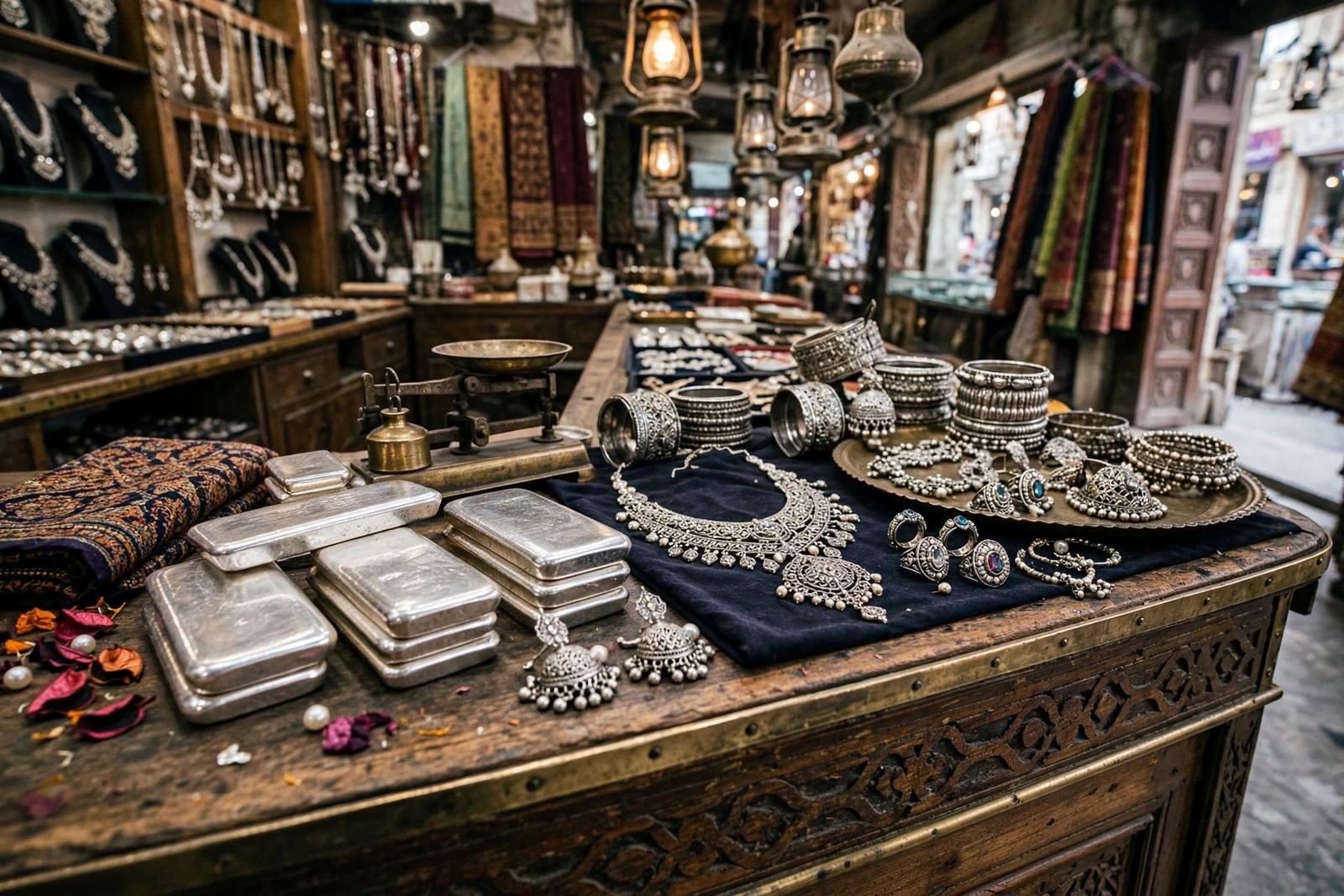
The oldest form is jewellery, worn less flamboyantly than gold and often chosen for everyday pieces, children's items and the white-metal fashions that cycle through the bazaars. Silverware and gift articles — trays, bowls, frames, replicas — form a second traditional market, bought for weddings and corporate gifts and valued by weight with the making charge on top. The investor's forms are bars and coins: minted or stamped bars in standard weights from refiners and larger jewellers, and imported bullion coins whose recognisability helps at resale. A small industrial demand exists too, in electronics, electrical contacts, jewellery manufacture and the mirror and chemical trades, though Pakistan's celebrated new appetite — solar — reaches silver mostly indirectly, embedded in imported panels rather than bought as metal at home.
Each form carries its own trap, and the traps share a name: the spread. A jeweller sells jewellery by weight plus making charges and buys it back by weight minus deductions for solder, alloy and wear — deductions that routinely astonish first-time sellers who imagined their purchase price was the asset's value. Bars from known refiners resell closest to the day's rate; unmarked or decoratively worked silver resells furthest from it. Purity is the second trap: the trade's standard for investment silver is fine silver, while jewellery alloys vary, and an unhallmarked piece is worth only what the buyer's touchstone and acid say it is. Pakistan's hallmarking and consumer-protection frameworks for precious metals remain thinner than the trade's size deserves, so the practical protections are old-fashioned ones — buy from established shops, take a proper invoice stating weight and purity, and know the day's announced rate before walking in.
The industrial metal underneath the jewellery
Silver's modern price story cannot be told without its factory life. It is the most electrically and thermally conductive metal known, which puts it inside solar photovoltaic cells as the conductive paste on the panel's face, inside switches, relays and electric-vehicle power systems in multiplying quantities, inside electronics and medical applications — a demand base tracked by industry bodies such as the Silver Institute, whose annual surveys of supply and demand are the standard reference and should be checked for current balances rather than assumed. Solar is the growth engine: each generation of panel technology tries to thrift — to use less silver per cell — while installations grow fast enough to keep total demand climbing. That tug-of-war between thrifting and volume, fought in Chinese and Western panel factories, increasingly decides whether silver's industrial demand grows into the mine supply or stalls against it.
Supply has its own peculiarity: most silver is not mined for itself. A large share of world production arrives as a by-product of lead, zinc, copper and gold mining, which means silver supply responds sluggishly to silver's own price — a zinc mine does not expand because chandi rallied in Karachi. Years of reported deficits between industrial demand and total supply have been met by drawing down above-ground stocks, and that stock arithmetic is the bulls' favourite chart. The sceptic's reply is equally structural: above-ground silver is enormous precisely because the metal is not consumed the way oil is — much of it sits in vaults, drawers and dining cabinets, available to return to market at a price. Both stories are true, which is why silver can be simultaneously scarce in the industrial sense and abundant in the monetary one.
Silver in the solar age: Pakistan's rooftop connection
Pakistan meets industrial silver most intimately on its own rooftops. The solar boom that swept the country as households and factories fled expensive grid electricity — the phenomenon our batch guide to solar net metering in Pakistan explains — is, panel by panel, a silver story: every photovoltaic cell carries the metal in its conductive paste, and the price and specification of the panels arriving from China embed world silver economics whether the buyer in Lahore knows it or not. Panel makers have responded to expensive silver exactly as industry always does, by redesigning cells to use less of it and by experimenting with copper substitution at the margins — a slow technological leak in silver's fastest-growing demand source that analysts watch as carefully as mine supply. For the household, the practical meaning is modest but real: the metal in the sarafa and the metal on the roof are one market, and a world scrambling for panels is structurally friendlier to silver's price than the world of a generation ago, when demand meant cutlery and film photography.
Silver, gold and the household portfolio
For a Pakistani household, the comparison that matters is practical. Gold wins on value density — a fortune fits in a pouch — on the depth of its resale market, on its role in bridal wealth, and on the narrowness of its spreads. Silver wins on accessibility: the ticket size is small enough for monthly saving, gifts and first purchases by young savers, and its larger swings offer a leverage on the precious-metals cycle that gold cannot. Silver loses, badly, on bulk: serious silver wealth is heavy, tarnishes, demands storage, and tempts theft in proportion to its visibility. It also carries a religious dimension many buyers weigh — zakat obligations apply to silver holdings as to gold, and the classical nisab threshold is itself defined with reference to silver, a point our guide to zakat on shares and savings touches in its wider discussion of zakatable assets.
Paper routes exist for those who want the price without the metal. The Pakistan Mercantile Exchange trades precious-metal contracts under SECP oversight — our explainer on PMEX describes the venue — and international silver funds are accessible to Pakistanis only within the foreign-investment rules that govern residents. Each route trades the sarafa's problems for new ones: contract charges, leverage risk in futures, and the fact that a paper claim is not metal in the hand during the kind of crisis that makes households want metal in the first place. The honest summary is that physical silver suits small, patient, jewellery-adjacent saving; paper silver suits traders who understand they are trading; confusing the two purposes is where losses breed.
One caution belongs in every modern telling, because silver's new fashion brings new sellers with it. Online offers of investment silver at suspiciously convenient prices — unbranded bars shipped by courier, "silver accounts" from unregistered firms, social-media dealers with no premises — reproduce the oldest bazaar frauds in digital dress, and a resident Pakistani's protections are the same as the sarafa's: a verifiable seller, a weighed and stamped article, a real invoice, and a buyback promise from someone who will still exist next year. The regulator's lens on precious metals runs mainly through trade and consumer law rather than securities law, which means the cavalry, if a deal sours, is the police and the courts — a slower cavalry than the SECP's. Fashion is a fine reason to learn about a metal and a poor reason to hurry into it.
Storage and inheritance, the unglamorous end of the subject, deserve their sentence too. Silver kept at home should be listed, photographed and mentioned in the family's papers like any other asset; the metal that heirs do not know about has a way of leaving with the household help or being sold in grief at the first offer. A small safe, a bank locker for larger holdings, and an invoice file that matches the pieces turn a pile of chandi back into wealth that survives its owner — the same estate logic, at kitchen-table scale, that governs every other asset class this site covers.
Buying chandi without being skinned
The bazaar rewards a short checklist. Know the announced rate for the day and the exact weight you are buying — insist the piece is weighed in front of you. For investment purchases, prefer plain, stamped bars or coins of stated purity from established refiners or the largest jewellers, over worked or decorative silver whose making charge will never be recovered. Keep the invoice; a reputable shop's buyback promise lives in that paper. Expect the buyback to be below the selling rate and ask the deduction in advance, in writing if the sum is serious. Store modest quantities discreetly and insured where the value justifies it, remembering that tarnish is cosmetic on fine silver and should not be polished off coins whose buyers may value originality. And size the purchase to silver's character: this is the volatile end of the family vault, a satellite around gold's anchor rather than a replacement for it — a framing our guide to property versus stocks would recognise, since Pakistanis perpetually compare all three stores of value against each other. This article is educational content, not financial advice.
Key takeaway: Silver in Pakistan is priced off world markets and the rupee, driven increasingly by solar and industrial demand, and bought well only when purity, weight and the buyback spread are settled before money changes hands.