KARACHI: Almost everything Pakistan trades with the world arrives or leaves by sea — its fuel, its cooking oil, its wheat and fertiliser, its containers of textiles going out and machinery coming in — yet almost all of it travels on foreign ships. The exception, flying the Pakistani flag, is the Pakistan National Shipping Corporation. PNSC is the state's shipping line: a fleet of oil tankers and bulk carriers headquartered in the PNSC Building on Karachi's Moulvi Tamizuddin Khan Road, majority-owned by the Government of Pakistan, listed on the stock exchange, and descended from a state fleet first organised in 1963 and a wave of nationalised private shipping companies merged into it in 1979. It is the only shipping company on the PSX, which makes it both a genuine operating business — charter rates, bunker fuel and dry-dockings included — and the market's single window into the economics of the sea trade on which the whole economy floats.
Origins: four ships, an ordinance and a national fleet
Pakistan began independence in 1947 with a merchant marine of just four privately owned cargo ships and an urgent need to move the trade of a new country split in two wings separated by a thousand miles of India. Private Pakistani shipping companies grew through the 1950s — names such as Muhammadi, East & West, Trans-Oceanic and Pan Islamic among them — while the state organised its side of the industry through the Mercantile Marine Department and Government Shipping Office. The decisive state step came with the National Shipping Ordinance of 1963, which created the National Shipping Corporation; the NSC procured its first ship, the MV Rupsa, in 1965. By the end of the decade the national fleet, state and private together, had grown to around seventy vessels.
Two shocks then remade it. The separation of East Pakistan in 1971 cost the fleet the ships and trades based in what became Bangladesh. And on 1 January 1974, the Bhutto government's nationalisation programme took over the country's nine private shipping companies — among them the Dinshaw family's Chittagong Steamship and Trans-Oceanic concerns, the Cowasjee family's East & West Steamship, the Valika family's Muhammadi and Gulf Shipping, and Crescent Shipping — transferring some twenty-six ships into state hands alongside the NSC's own fleet.
The present corporation dates from the tidying-up of that era. In 1979 the National Shipping Corporation and the Pakistan Shipping Corporation — the vehicle into which the nationalised lines had been gathered — were merged to form the Pakistan National Shipping Corporation, established under the Pakistan National Shipping Corporation Ordinance, 1979. The PNSC that emerged was, and remains, the country's sole state shipping corporation: national flag carrier at sea, in the same sense that the airline whose restructuring we profile in PIA Holding Company is the flag carrier in the air — though with a notably steadier subsequent history.
What PNSC does today
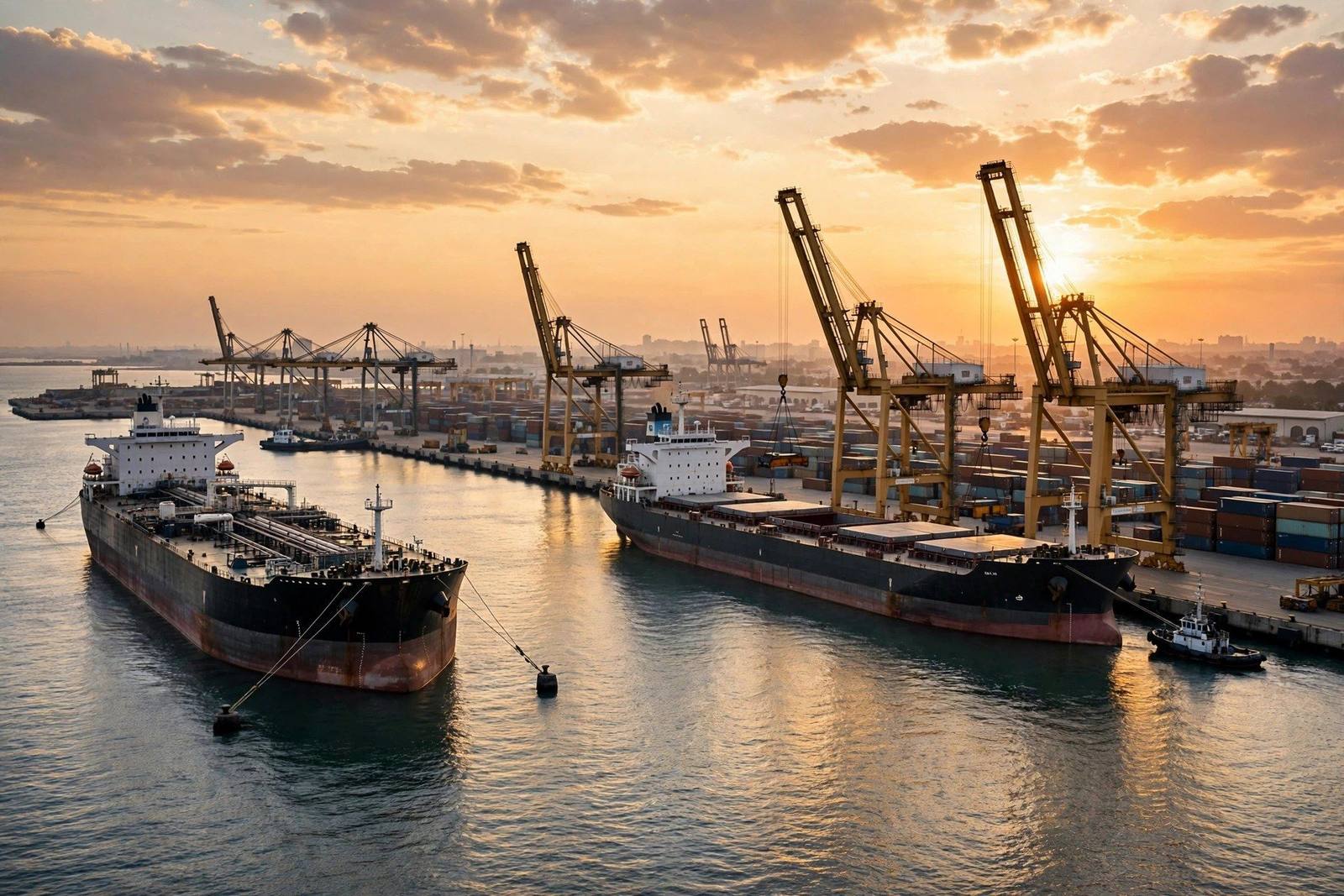
PNSC's business, as its statutory description puts it, is shipping in its full sense: owning and chartering vessels, transporting cargo, and providing the commercial, technical and administrative services that surround a fleet — plus, a Karachi footnote, renting out property, including space in its headquarters tower. The operating fleet divides into two great families. Its tankers carry liquid cargo — above all crude oil and refined products for Pakistan's refineries and oil marketing companies, on routes centred on the Gulf-to-Karachi run that feeds the country's fuel supply. Its bulk carriers carry dry cargoes in bulk — grain, coal, fertiliser and other commodities — trading both for Pakistani cargo interests and, when rates justify it, in the international charter market between third countries.
Customers reflect that mix. The tanker fleet's anchor clients are the state-linked energy chain itself — Pakistan State Oil and the refineries among the names the company has long cited as charterers — giving PNSC a strategic role beyond its profits: in a crisis, a national tanker fleet under national control is a supply-security asset no charter market can guarantee. The bulk fleet works more commercially, fixing voyages and time charters where the freight market pays best. Around the owned fleet, the corporation charters in outside tonnage when demand exceeds its own capacity, manages vessels commercially and technically, and periodically renews the fleet by buying modern second-hand ships — its stated fleet plans over the years have targeted carrying capacity well above a million deadweight tonnes, pursued through acquisitions funded from its own resources and borrowing rather than budget grants.
How a shipping line makes money
Shipping revenue is freight: customers pay to move tonnage across distance, priced either per voyage, per tonne, or per day of the ship's time under a time charter. Rates are set in a global market that swings violently with the balance between the world's cargo and the world's ships — the same tanker that earns a fortune in a tight market can struggle to cover costs when new vessels flood in or trade contracts. PNSC's earnings therefore carry a built-in cycle, softened but not removed by its anchor role carrying Pakistan's own oil imports, where contracts with state-linked charterers provide baseload employment for the tanker fleet at negotiated rates.
The cost side is where shipping fortunes are actually made. A vessel burns bunker fuel priced in dollars; crews must be paid, certified and rotated; insurance — hull, machinery and the protection-and-indemnity cover that stands behind maritime liabilities — is a major fixed charge; and every few years each ship must dry-dock for survey and repair, a lumpy capital event that takes it out of service. Ships themselves are bought and sold in a second-hand market whose prices move with the freight cycle, so the timing of fleet purchases — buying modern tonnage cheaply in a slump rather than dearly in a boom — decides long-run returns as surely as any operating skill. All of it is transacted essentially in dollars while the corporation reports in rupees, which means exchange-rate movements wash through its results in ways readers must separate from operating performance. The corporation's own-accounts pattern across cycles illustrates the species: fat years when tanker rates spike on global disruption, lean years when they normalise, and a balance sheet whose centrepiece is the fleet itself, carried at values the second-hand market re-prices continuously.
Ownership and the state's hand
PNSC is a statutory corporation and a listed company at once: created by ordinance, majority-owned by the Government of Pakistan through the maritime ministry's line of control, with the balance held by public shareholders on the PSX. Its leadership has traditionally mixed professional managers with senior naval and civil-service figures — its chairmen have often been retired flag officers or senior bureaucrats — and its strategy is set inside the state's wider maritime policy, including periodic official ambitions to expand the national fleet's share of Pakistan's own trade and to save the foreign exchange now paid to foreign shipowners. That state parentage brings the usual pairing: strategic patience and an anchor customer base on one side; procurement processes, fleet plans hostage to approvals, and periodic appearances on privatisation lists and in reform debates on the other. Unlike the airline, however, PNSC has generally carried a reputation for operational competence and has frequently been profitable across cycles — one reason it has survived every privatisation programme as a listed-but-state-controlled company rather than a sale candidate of the first rank, a contrast our guide to state-owned enterprises on the PSX explores.
Strengths, risks and honest caveats
The strengths begin with position. PNSC is the national flag carrier with privileged familiarity — and long relationships — with the state energy complex whose imports are Pakistan's largest single cargo stream; it owns a diversified fleet across tanker and bulk segments rather than a single vessel type; its Karachi headquarters property and its decades of accumulated maritime expertise, crewing and technical management are real if unglamorous assets; and as the only listed shipping company, it faces no direct domestic listed competitor for the investor seeking maritime exposure. Its dollar earnings are a natural hedge that most PSX companies lack.
The risks are the industry's own. Freight rates are set globally and can halve faster than any cost base can follow; the fleet ages continuously, and renewal demands large dollar outlays at moments not of the company's choosing; environmental regulation — sulphur limits, efficiency and carbon rules imposed through the International Maritime Organization — steadily raises the technical bar and the cost of older tonnage. Concentration matters too: the tanker book leans on Pakistan's oil-import volumes and on state-linked charterers whose own payment habits and contract renewals shape cash flow. State ownership cuts in as a governance discount whatever the year's results, and the free float is modest, so the share price can move on thin trading. Finally, the strategic paradox shadows everything: Pakistan's seaborne trade is vast and PNSC's share of it small, so the growth story everyone can describe — carrying more of the nation's own cargo — has been promised by maritime policy for decades longer than it has been delivered.
Ships, ports and the state energy chain
PNSC's daily reality is written by Pakistan's ports and refineries. Its tankers discharge at Karachi's oil piers and Port Qasim, feeding the refineries whose products move up-country by pipeline and road; its bulk carriers call with the wheat, coal and fertiliser cargoes that fill the gaps in domestic production. The fleet's structure follows shipping practice worldwide: vessels are commonly held through individual ship-owning subsidiaries under the parent, so that each hull's financing, chartering and liabilities sit in their own compartment — the group structure its annual reports lay out, and a detail worth knowing before reading its consolidated accounts. Crewing is part of the national story too: Pakistani officers and seafarers staff the fleet, and the corporation's training and employment of merchant-navy cadets make it a feeder for the wider maritime workforce that Pakistan supplies to foreign fleets — an export of skilled labour that rarely appears in discussions of the company's value. When officials speak of expanding the national fleet's share of the country's trade, this is the machinery they mean: more hulls under the flag, more of the freight bill retained at home, and a strategic reserve of tanker capacity whose worth is measured in security as much as in rupees.
The name on the PSX
PNSC is quoted in the transport sector, where it sits largely alone, and has been a listed company for decades under its own ordinance-era identity. Its dividend behaviour, by the standards of state-controlled listcos, has been comparatively respectable in profitable phases of the freight cycle — shipping profits, when rates are high, generate cash faster than a prudent fleet plan can absorb it, and the state as majority shareholder has its own appetite for payouts — but followers are careful to treat the payout as cycle-dependent rather than contractual. The share tends to wake when tanker markets, oil-trade disruptions or fleet-expansion announcements put shipping in the headlines, and to drift in the long quiet stretches between, which is the normal rhythm of shipping stocks worldwide.
What kind of investor studies PNSC
PNSC suits the investor who wants to learn a global cyclical industry through a local, readable example: the watchlist is the fleet — its size, age profile and deadweight, acquisitions and disposals and the prices paid — then tanker and dry-bulk rate conditions, the renewal terms of the state energy charters, bunker and dry-docking costs, and the ever-present question of whether expansion capital is being committed at the right point in the cycle. Pair it with the energy chain it serves — the refiners and marketers such as Pakistan State Oil — and the picture completes: the ships, the terminals and the fuel form one system, and PNSC is the part of it that moves. For a market with no other shipping share, it carries an educational value out of proportion to its size. This article is educational content, not financial advice, and nothing in it is a recommendation to buy or sell any security.
Key takeaway: PNSC is Pakistan's flag carrier at sea: a state fleet begun in 1963, swollen by the 1974 nationalisations and formed in its present shape in 1979, it runs tankers for the nation's oil imports and bulk carriers for its dry trade — a dollar-earning, freight-cycle business that remains the PSX's only listed shipping line.