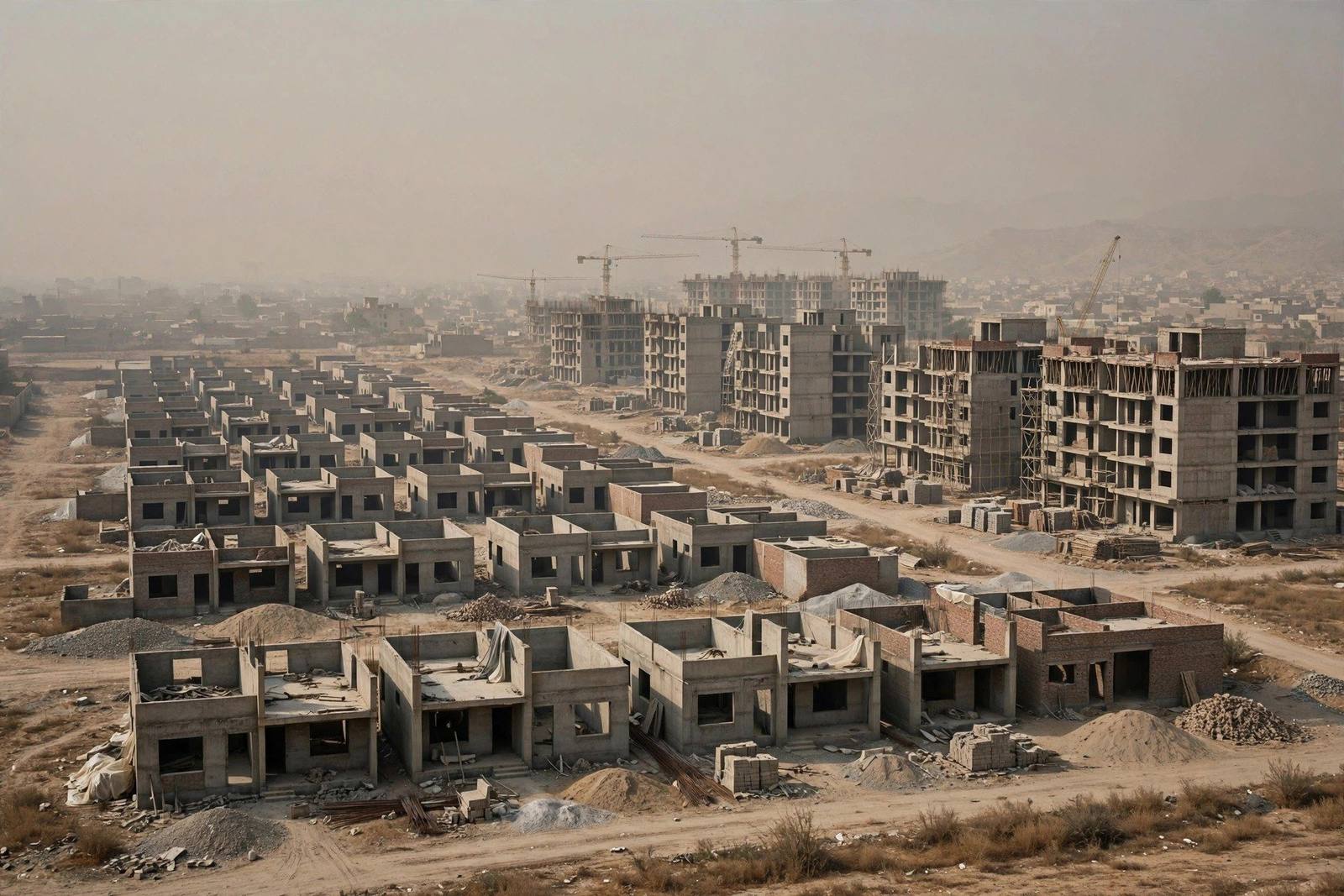
KARACHI: Pakistan needs homes on a scale its formal economy has never financed. Successive official and industry estimates have put the housing backlog in the millions of units and growing every year, in a country where most families still build incrementally — a plot bought slowly, rooms added as money allows, a floor for a married son when savings permit. Against that need sits one of the smallest mortgage markets in the region: housing finance has persistently amounted to well under one per cent of GDP in State Bank reporting, a fraction of the levels seen in neighbouring economies, let alone in developed markets where mortgages are the largest single asset of the banking system. This is not a story about Pakistanis disliking debt — the same households borrow eagerly for cars, motorcycles and weddings. It is a story about land titles that cannot be confidently pledged, courts that make repossession a decade-long project, incomes that exist but cannot be documented, and interest rates that swing so violently that a twenty-year loan is a bet neither side wants to hold. This guide explains how housing finance in Pakistan is structured, who the specialist lenders are, why banks stay away, what the state has tried, and what would have to change for the mortgage to become ordinary.
The cast: banks, HBFC and the refinancers
Formally, housing finance comes from three kinds of institution. Commercial banks offer home loans and Islamic home finance from their branch networks, usually as a small side-line next to their real businesses of government borrowing and corporate lending. The specialist is the House Building Finance Company (HBFC), the state-owned lender founded in the early 1950s that for decades was the only realistic source of a housing loan for salaried families, and which still operates under State Bank supervision with a development mandate. Behind both sits the Pakistan Mortgage Refinance Company (PMRC), created with State Bank and multilateral encouragement to solve a funding problem: banks fund themselves with short-term deposits and fear locking money into twenty-year loans, so the PMRC raises longer-term money — including through bonds and sukuk — and refinances portfolios of housing loans that meet its criteria, giving lenders a reason to write longer loans.
Islamic structures carry a large share of what mortgage business exists. Instead of an interest-bearing loan, the dominant product is diminishing musharaka: bank and customer co-own the house, the customer pays rent on the bank's share and buys that share down in instalments until the house is fully theirs. Our guide to Islamic banking in Pakistan explains the contracts behind such products, and modarabas in Pakistan covers the older non-bank Islamic finance companies, some of which have offered housing schemes of their own. Microfinance institutions and charities touch the bottom of the market — small loans for a room, a roof, a toilet — which the housing-finance statistics barely capture but which is how much of Pakistan actually improves its shelter.
Why the title deed stops the loan
Every mortgage begins with a question a Pakistani bank officer learns to ask early: can this property actually be pledged, and if the borrower stops paying, can it actually be taken and sold? In much of the country the honest answer is uncertain. Land records in the provinces were kept for generations in paper registers maintained by the local revenue official, the patwari, and though Punjab's Land Records Authority has digitised large parts of its rural records and other provinces have followed unevenly, urban property sits in a patchwork of authorities — development authorities, cantonment boards, housing societies, revenue departments — each with its own transfer and mutation process. Properties pass informally between family members without the record ever being updated; plots are sold on files and affidavits rather than registered deeds, a world our guide to plot files in Pakistan unpacks; and whole settlements stand on land whose legal status would not survive a lender's lawyer.
A bank that cannot trust the title cannot lend against the house — it can only lend against the borrower's salary and character, which shrinks the loan, shortens the term and raises the price. This single fact explains more of Pakistan's missing mortgage market than any interest-rate debate. Lenders cluster where titles are cleanest: apartments and houses in established schemes of the big cities, bought from known developers, by salaried borrowers whose employers can be verified. Everyone outside that charmed circle — the self-employed, the informally housed, the rural majority — is rationed out before the conversation starts.
Foreclosure: the law that lenders do not trust
The second lock on the market is enforcement. A mortgage is only as good as the lender's ability to recover the property from a defaulting borrower, and in Pakistan that ability has been contested for a generation. A dedicated recovery law for financial institutions was enacted at the start of the 2000s to allow banks to enforce security without endless litigation, but its housing provisions ran into constitutional challenges and court stays, and the lived experience of lenders — injunctions, adjournments, political pressure when a family home is auctioned — taught the industry that a house is weak collateral in practice. Successive amendments and State Bank frameworks have tried to strengthen foreclosure, and the regulator continues to list it among the structural reforms the market needs. Until recovery becomes routine, lenders price the risk in: larger down payments, shorter tenors and a preference for borrowers whose salaries can be attached more easily than their homes.
High and volatile interest rates complete the trap. Pakistani policy rates have swung across an extraordinary range within single decades, and a long-term fixed-rate mortgage is nearly impossible to offer honestly in such an environment; most products are floating-rate, which transfers the country's macroeconomic storms directly into the family's monthly instalment. When rates spike, instalments jump, demand collapses and banks retreat to government securities — a pattern readers can trace through our explainer on the State Bank policy rate. A mortgage market needs boring money: long-term, predictable funding at rates families can plan around. Pakistan's savers, offered short-term deposits and National Savings products instead, rarely supply it, which is exactly the gap the PMRC and housing sukuk were designed to narrow.
What the state has tried
Governments have repeatedly tried to jump-start the market with subsidy. The best-known attempt was the low-cost housing push launched in 2020, whose Mera Pakistan Mera Ghar markup-subsidy scheme channelled bank lending to first-time and lower-income buyers at subsidised rates for the early years of the loan, with the State Bank setting targets and easing some prudential rules to coax banks in. Applications surged, banks built housing desks, and for a while housing finance grew faster than it ever had — before the scheme was paused amid the fiscal and monetary tightening that followed, leaving a pipeline of approved cases to be worked through. Earlier and parallel efforts include State Bank refinance schemes for low-cost housing, incentives for builders and developers, and repeated announcements of housing authorities and apartment projects by federal and provincial governments.
The honest verdict of housing specialists is that subsidies treat the price of credit while the disease is legal and documentary. A subsidised loan still needs a clean title, a recoverable mortgage and a documented income. Where the schemes did break new ground was in forcing banks to learn the business — standardising appraisals, training credit officers, digitising applications — skills that remain in the system for the next attempt. Meanwhile the private market quietly serves the top slice: salaried professionals buying apartments in Karachi, Lahore and Islamabad, increasingly through Islamic diminishing musharaka, and developers pre-selling units on instalment plans that are really a form of unregulated vendor finance, with all the delivery risk that implies — a risk our guide to Pakistan REITs contrasts with the regulated, listed route into property.
One further actor deserves a paragraph: the apartment developer as accidental banker. Because banks will not lend widely, the large developers of Karachi, Lahore and Islamabad effectively finance their buyers themselves — booking with a fraction down, instalments through construction, possession on completion. The buyer carries the developer's completion risk without a mortgagee bank's monitoring, and the developer carries thousands of small instalment receivables, which is why construction cycles and developer health move together so violently in Pakistan. Regulated escrow arrangements for buyer instalments, of the kind property regulators in the region have adopted, remain the missing piece most often demanded by consumer advocates after each stalled project.
How Pakistan actually houses itself meanwhile
While the formal market stalls, households have not waited for permission to build. The dominant Pakistani housing strategy is incremental construction: buy a small plot in a developing scheme — often through the file and instalment system — hold it as the family's main savings asset, then build in stages over years as remittances, bonuses and committee savings arrive. A ground floor rises, the family moves in, and upper floors follow for married children, turning the house into both pension and inheritance. Alongside it runs a vast informal finance system: rotating committees among relatives and colleagues, advances from employers, loans from shopkeepers and commission agents, gold sold or pledged at the moment of construction, and overseas relatives wiring the decisive instalment. None of this appears in housing-finance statistics, yet by any physical measure — roofs built, rooms added — it dwarfs the mortgage market many times over.
Understanding that parallel system explains the formal market's strange shape. The mortgage is not competing with nothing; it is competing with patience, family pooling and gold. A bank product wins only when it is faster, larger or safer than the informal route — which is why demand concentrates among younger salaried buyers who lack a family plot, cannot wait fifteen years to build in stages, and value moving into a finished apartment now. Developers have learned the same lesson from the other side, which is why the instalment plan sold by the builder, for all its risks, often outsells the bank's cheaper money: it asks for no title archaeology, no income file in triplicate, and no courage at the foreclosure clause. Any housing-finance reform that ignores the informal competitor will keep producing elegant schemes with disappointing uptake.
What would actually change the picture
The reform list is well known to everyone in the sector, and none of it is mysterious. Complete, digitised and legally conclusive land records, so that a title can be verified in days and pledged with confidence. A foreclosure process that is firm, time-bound and fair — protecting borrowers from abuse while making recovery predictable enough to lend against. Longer-term funding through the PMRC, pension money and housing sukuk, so lenders are not financing twenty-year assets with one-year deposits. Appraisal and credit-bureau coverage that can underwrite informal incomes honestly instead of excluding them. And macroeconomic stability durable enough that a family can sign a fifteen-year contract without gambling on the policy rate. Each reform is somebody's hard political problem, which is why progress arrives in pieces.
For the investor reading this on a stock-market site, housing finance matters twice over. Directly, it shapes the earnings of HBFC's successors-in-spirit, the PMRC's bond issues, the banks' loan books and the cement, steel and developer names that feed on construction — the demand logic our guide to property versus stocks in Pakistan sets out. Indirectly, it is a test of the whole financial system's depth: a country that cannot finance a house for its median family will struggle to finance much else long-term either. When State Bank housing-finance statistics show the mortgage stock finally climbing as a share of GDP, something structural will have changed. This article is educational content, not financial advice.
Key takeaway: Pakistan's mortgage market is tiny not for want of housing demand, but because titles, foreclosure and long-term funding are all weak at once — and every serious reform has to fix the law and the records, not just the interest rate.