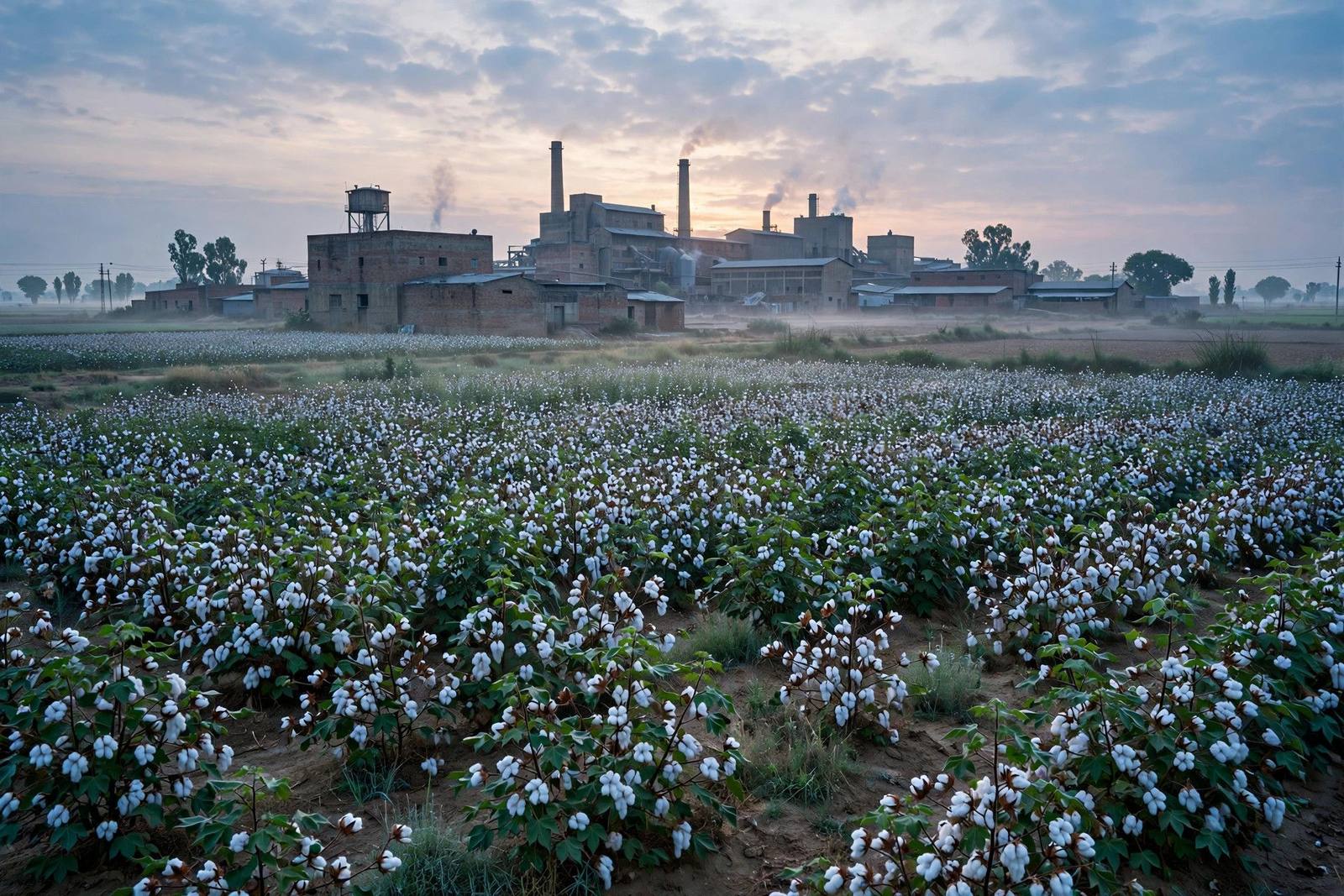
KARACHI: Greige fabric — pronounced "grey", the undyed cloth that comes off a loom — is the least glamorous object in Pakistan's textile trade, and the point at which Kohinoor Mills Limited begins its work. From a small weaving shed set up in the late 1980s with a few dozen looms, the company grew into one of the larger dyeing and finishing operations in the country: hundreds of high-speed air-jet looms weaving the greige, a dye house bleaching, colouring and finishing it for buyers at home and abroad, its own power generation to keep the vats hot and the looms turning, and, most recently, an apparel division turning its finished fabric into garments. Its mills and registered office stand at the eighth kilometre of the Manga Raiwind Road in District Kasur, in Lahore's industrial hinterland, with a marketing office in Karachi. This profile traces how a weaving start-up became a finishing house — and untangles, along the way, one of the PSX's most persistent cases of mistaken identity.
First, which Kohinoor?
Beginners regularly confuse three different companies, and the confusion matters because their shares are entirely separate. Kohinoor Mills Limited — this company, ticker KML — is the Kasur weaving, dyeing and power business incorporated in 1987. Kohinoor Textile Mills, ticker KTML, is a different and much older company, founded in the 1950s, belonging to the Kohinoor Maple Leaf group alongside its cement business; its profile on this site is Kohinoor Textile Mills' own. Kohinoor Energy, meanwhile, is a power company of yet another group. The names overlap because Kohinoor — the famous diamond, and a word long woven into South Asian brand history — has been adopted by several unrelated industrial families. KML's own story needs no borrowed pedigree: nearly four decades of compounding a single site from weaving into dyeing, energy and apparel is achievement enough, and it is the story its accounts actually tell.
What the company is today can be read off its segment reporting. Weaving produces greige fabric from bought-in yarn. Dyeing takes greige — its own and, in the trade's usual pattern, the processing logic applies to fabric generally — and bleaches, dyes, prints and finishes it into the coloured, white and printed fabrics buyers specify. Power generation produces the electricity and steam the first two segments devour, using gas, coal and oil, and apparel — the newest segment — stitches garments from processed fabric. In short: buy yarn, weave cloth, add colour and finish, and increasingly, add the sewing margin too. Our guide to textile stocks on the PSX maps where such a mid-chain specialist sits among the spinners below it and the garment exporters above it.
1987–1988: forty-eight looms
Kohinoor Mills Limited was incorporated on 21 December 1987 as a public limited company. Its first operating asset, Kohinoor Weaving, was set up in 1988 as a small project of 48 looms — the scale of an ambitious workshop rather than an industrial group. The location, on the Manga Raiwind Road in Kasur district, put the young mill inside the Lahore region's emerging textile corridor: close to the city's traders and dye houses, to the Punjab cotton belt, and to the labour of the Kasur and Raiwind towns. The company's shares reached the stock exchange soon after — market records date its initial listing to the beginning of the 1990s — making KML one of the many textile flotations of that era, when Pakistan's exchanges listed mill after mill as the industry industrialised.
The growth that followed was of one deliberate kind: depth on a single site. The weaving shed of 48 looms became, over the following decades, a facility of 272 high-speed air-jet looms, credited in company briefing material with producing more than fifty million metres of greige fabric a year. Air-jet weaving — in which a jet of air carries the weft yarn across the loom — is the fast, modern end of the craft, and the shift from the original looms to a full air-jet hall marks the company's passage from job-weaver to industrial producer. Alongside the looms came the decisive second business: dyeing and finishing capacity on the same premises, so that greige no longer had to leave the gate to become saleable fabric. A workforce that company briefings have put at around two thousand people completed the transformation of the Kasur site from shed to complex.
Dyeing and finishing: where cloth becomes a product
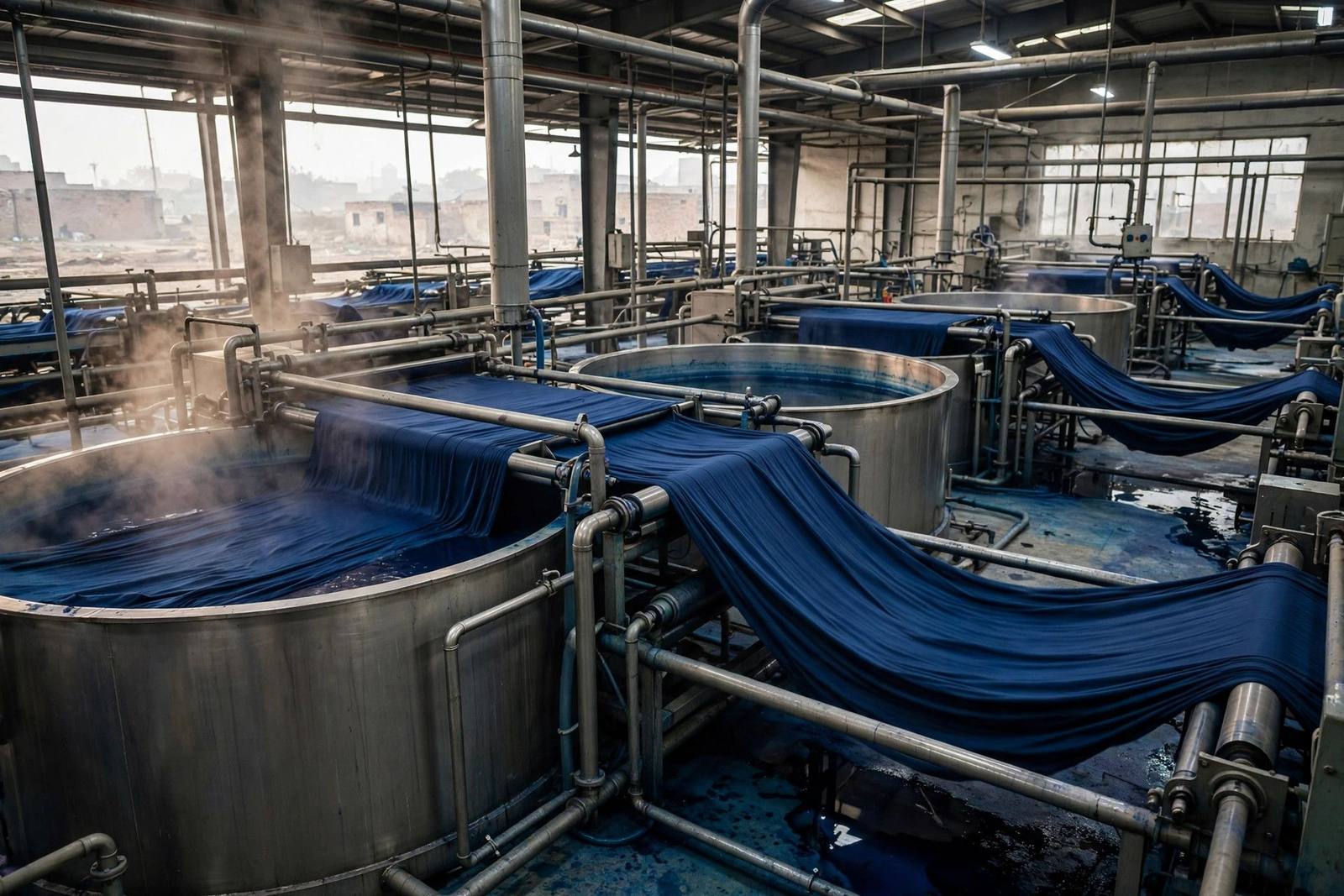
Dyeing is the stage at which fabric stops being a commodity measured in metres and becomes a specification measured in shades, fastness and hand-feel. A buyer's order does not ask for "cloth"; it asks for a colour that must match a standard under shop lighting, survive washing, and feel a particular way between the fingers — and it asks for ten thousand metres of it, identical from first roll to last. KML's dyeing division bleaches, dyes and finishes greige into dyed, white and printed fabrics, with the laboratory and process control that shade consistency demands. Company descriptions emphasise fabric and hand-feel finishes — the softeners, treatments and mechanical processes that decide whether finished cloth feels like a premium shirting or a sack. This is skilled, chemistry-heavy work: dyes, auxiliaries, water and steam are its raw materials, effluent is its unavoidable by-product, and reputation — a dye house that misses shades loses programmes — is its real licence to operate.
Power is the third leg, and it is there for a practical reason. Dyeing is steam-hungry and looms are electricity-hungry, and Pakistani industry learned through the shortage years that a mill depending entirely on the grid is a mill that stops. KML therefore generates and distributes its own power and steam from a mixed fuel base of gas, coal and oil — an arrangement its reporting has described with an installed capacity figure that belongs to the boiler house as much as to the balance sheet. The power segment shows up in the accounts as a separate line, but economically it is best read as insurance the company sells to itself: costly to build, decisive in the weeks when the grid fails or tariffs spike. The newest leg is apparel. In December 2025 the company informed the exchange that commercial production at its apparel division had commenced, in line with its stated strategy of expanding in the apparel industry — the natural final step for a house that already weaves and dyes its own fabric, and the step that moves its product closest to the final customer.
There is a wider significance to that sequence — weaving first, dyeing second, power throughout, garments last — because it is the biography of Pakistan's textile industry written inside one fence. The country began by selling what the loom produced, learned that finishing was where consistency and therefore money were made, discovered in the shortage years that no stage runs without power it controls, and arrived finally at the garment, the stage where the industry meets the consumer it had spent decades supplying at arm's length. KML walked that road a stage at a time, over nearly forty years, without changing its name, its site or its basic craft. Few listed mills illustrate the national progression as cleanly, which is one reason the company repays study beyond its modest place in the market's daily conversation.
How Kohinoor Mills makes money
The economics of the house are a staircase of margins. At the bottom step, weaving converts yarn into greige at a conversion margin — thin, competitive, and hostage to yarn prices and loom utilisation. The dyeing step earns more per metre, because it adds scarce skills and chemistry and because finished fabric has fewer substitute suppliers than greige. The power operation, rather than earning an external margin, defends the first two steps' margins by capping the company's exposure to grid prices and outages; its cost is the fuel bill, which is why the gas-coal-oil mix the plant can swing between is a strategic variable, not a footnote. Apparel, now that production has begun, adds the sewing step's margin and with it direct relationships with garment buyers — the same buyers who previously purchased only fabric. Each step also changes what can go wrong: yarn inflation squeezes the weaver, dye and chemical costs squeeze the finisher, fuel squeezes the power house, and fashion and order risk arrive with the garments.
Demand comes from both sides of the border of the industry. At home, Pakistan's garment and home-textile exporters need finished fabric in volume and on schedule; abroad, the company sells into markets across Asia, Europe, North America, Australia and Africa, as its segment descriptions record. That mix — indirect exports through local garment makers plus direct fabric exports — is typical of the mid-chain, and it makes KML's fortunes a leveraged reading of the whole textile cycle: when Pakistan's apparel exporters are full, its dye house is full first. Working capital follows the same logic, with yarn stocks, fabric in process and buyer receivables absorbing cash long before the final garment reaches a shop in Frankfurt or Chicago. The cotton and yarn end of that chain is introduced by the spinners' stories on this site, including Din Textile Mills.
Ownership, strengths and honest risks
KML is a sponsor-led listed company of the familiar Pakistani pattern: a founding family interest at the centre — its chief executive in recent reporting is Aamir Fayyaz Sheikh — with public shareholders around it and professional managers in the divisions. The credit-rating agency VIS has assessed the company publicly over the years, and its published rationales are a useful independent window: they describe a mid-sized, integrated textile operation of adequate credit quality, with the protections and the sensitivities that description implies. For a minority shareholder, the governance questions are the standard ones for the breed — related-party dealings within the wider family orbit, the pace of reinvestment versus payout, and disclosure depth — best pursued in the annual report's notes rather than assumed in either direction.
The strengths are integration and incumbency. A buyer can place greige, dyeing and now garment orders inside one gate; the site has nearly forty years of accumulated process knowledge; and vertical depth cushions individual stage downturns — a weak greige market hurts less when your own dye house is the customer. The risks are equally concrete. The chain still begins with cotton yarn priced by others. Dyeing is exposed to chemical and energy costs and to tightening environmental expectations around water use and effluent, an area where compliance spending across the industry has only one direction. Finished-fabric demand is a fashion-and-retail derivative, falling quickly when rich-world retailers destock. And the apparel expansion, strategically logical as it is, takes the company into the most labour- and buyer-intensive stage of the chain, where its experience is newest. A reader weighing the company is really weighing execution: looms and vats it knows; garments it is learning.
The name on the PSX
On the exchange, KML trades as a mid-cap textile composite, in the market's textile-composite classification. Its shares carry the sector's usual liquidity character — active in textile rallies and results season, quieter between — and its dividend record has the cyclical signature of the trade, with cash distributions in profitable years decided at rates that reflect the cycle rather than a fixed policy, as the interim and annual filings on the exchange record; readers new to that pattern will find the mechanics in our guide to how PSX dividends work. One further practical note belongs in any KML file: check the ticker, not the name, when reading news. Headlines about "Kohinoor" routinely describe the cement-linked KTML or other namesakes, and acting on the wrong Kohinoor is an error the market's veterans have all seen a beginner make.
The investor who studies Kohinoor Mills is typically interested in the economics of the middle: the unglamorous, indispensable stages where yarn becomes fabric and fabric becomes colour. It is a company for readers who believe value in Pakistan textiles is created less by owning a famous brand than by running vats, looms and boilers a little better than the mill down the road, decade after decade. This profile is educational content, not financial advice.
Key takeaway: Kohinoor Mills (KML), incorporated in 1987 and based at Kasur near Lahore, grew from a 48-loom weaving shed into an integrated weaving, dyeing, power and apparel operation — and is not to be confused with the separate Kohinoor Textile Mills.