KARACHI: Most people who wear Pakistani cotton have worn Din Textile Mills without knowing it. The company sells almost nothing under its own name to the public. Its yarn disappears into other people's garments — into the mottled grey T-shirts made from melange yarn, the stretch denim woven from core-spun Lycra yarn, the knitwear and socks and home textiles that Pakistan ships to the world and sells at home. Din is a spinner's spinner: a Punjab mill group, headquartered improbably in Karachi, that built its reputation on doing the difficult, fashion-sensitive end of a commodity trade. Behind it stands one of Pakistan's great comeback stories. The Din Group's founder, S. M. Muneer, lost a family business, rebuilt from rented tanneries, and in his forties bet on spinning — the bet that became Din Textile Mills, incorporated in 1988 and listed on the stock exchange in the 1990s. This profile tells how that mill was built, what it actually sells, and why a business measured in spindles and kilograms rewards a particular kind of patient reader.
A spinner's name in other people's garments
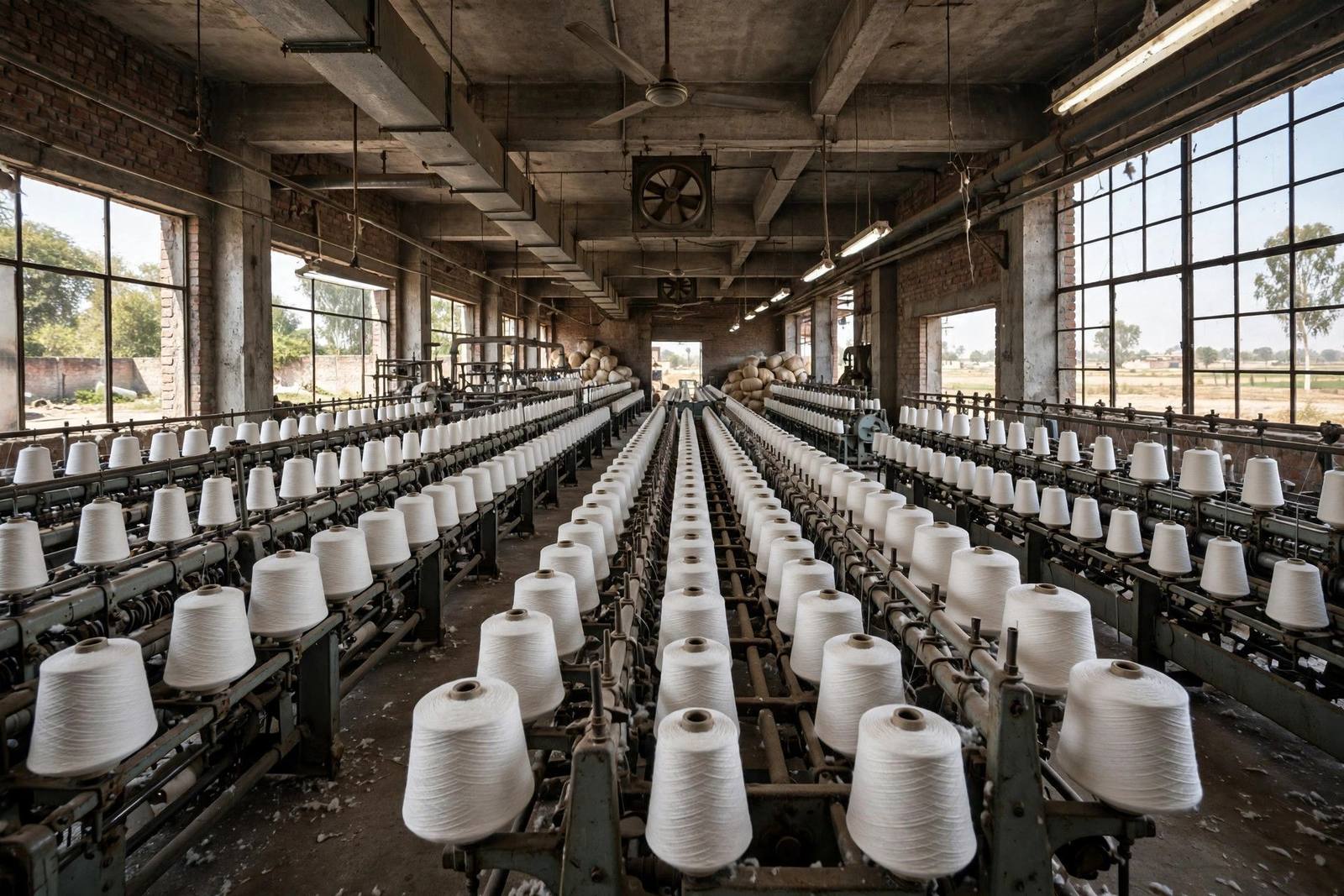
Pakistan's textile chain begins with a cotton crop and ends, several factories later, with a finished garment. In between sits spinning, the stage that turns raw fibre into yarn, and it is the stage where Din has spent its whole life. Spinning is usually described as the commodity end of the industry — thousands of near-identical mills competing on price per kilogram. Din's answer to that description has always been specialisation. Its catalogues lead not with plain yarn but with the varieties buyers cannot source everywhere: combed compact yarn for fine weaving, melange yarns that blend dyed fibres into heather effects, slub yarns with deliberate irregularity for fashion fabrics, core-spun yarns wrapped around Lycra for stretch denim, dyed and gassed and ply yarns for knitters and sock makers. That positioning — part commodity producer, part fashion supplier — is the thread that runs through the company's history, and it is why Din turns up inside the supply chains of brands its own shareholders may never hear named. The wider map of the trade is set out in our guide to textile stocks on the PSX.
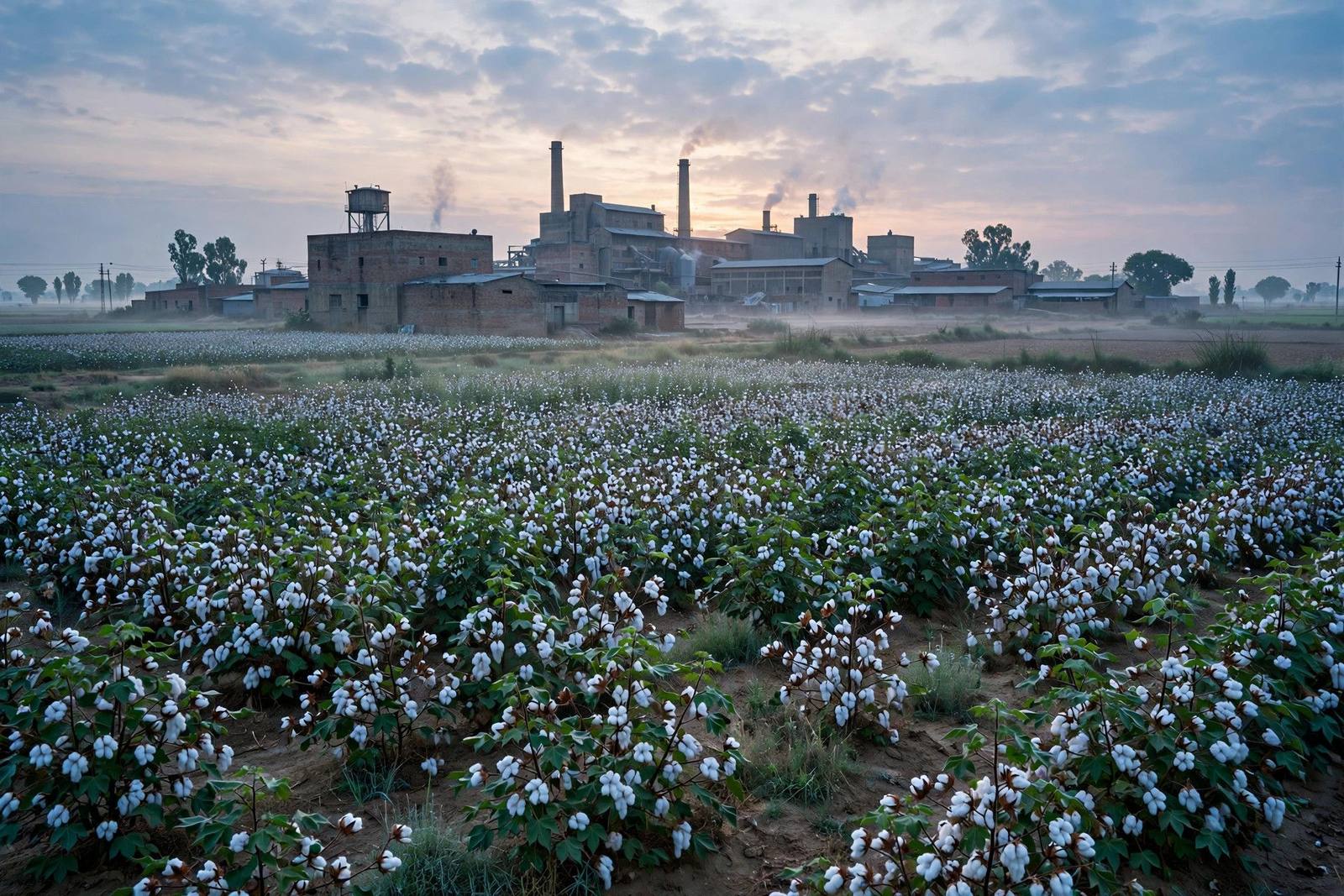
The company the market knows is Din Textile Mills Limited, ticker DINT. Its registered office sits at Din House in Lalazar, Karachi, opposite the Beach Luxury Hotel — a merchant's address, not a mill town one. The mills themselves are hundreds of kilometres away in Punjab, around Pattoki, Raiwind and the Kasur countryside, close to the cotton belt and to Lahore's weaving and knitting buyers. That split geography is typical of older Pakistani textile houses: the selling, financing and family direction in Karachi, the spindles in Punjab. It also makes Din a useful first lesson in reading this sector — the company on the certificate and the factory on the ground are rarely in the same city, and the annual report, not the head office, is where the mills are listed.
From a leather collapse to a second fortune
The Din story does not start with textiles. S. M. Muneer, born in 1945 into a Chinioti business family, began work at eighteen in the family concern, Din Leather. In 1966 that business failed, and the family liquidated personal assets to settle its creditors — an experience that shaped the conservative, asset-backed way the group would later be run. Muneer briefly considered taking a job, was urged by his father to stay an entrepreneur, and restarted by renting leather tanneries in Karachi, establishing his own factory in 1970. Leather made him a substantial Karachi industrialist — he became a fixture of the city's trade politics, patron-in-chief of the Korangi Association of Trade and Industry and a voice of the Federation of Pakistan Chambers of Commerce and Industry — but it was his second act that built the listed company.
In 1987 Muneer founded a spinning factory in Chunian, in the Lahore countryside — the seed from which Din Textile grew, expanding over time, group accounts record, to several spinning units with around a hundred thousand spindles. The timing was not accidental. Pakistan's textile exports were industrialising fast, yarn demand from local weavers and from East Asian buyers was deepening, and a generation of trading families was converting commercial capital into mills. Muneer's own portfolio widened with the era: in the early 1990s he was part of the consortium that acquired Muslim Commercial Bank in Pakistan's first big bank privatisation, and he served as the bank's vice-chairman. The spinning mill, though, was the durable asset. On 13 June 1988 Din Textile Mills Limited was incorporated, taking the Chunian beginning into corporate form.
Incorporation, listing and the Punjab mill map
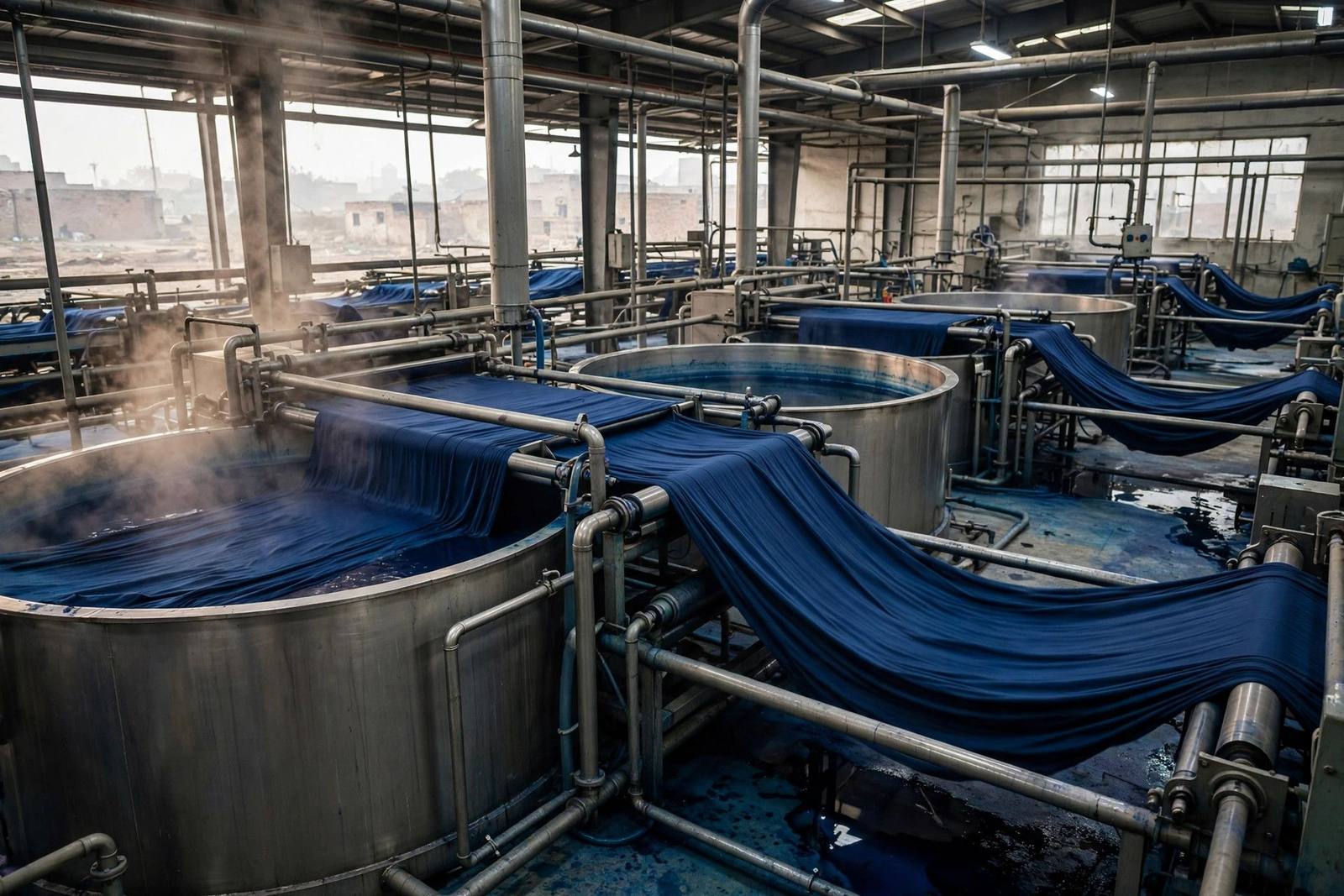
From incorporation, the company's centre of manufacturing gravity settled along the Multan Road corridor south-west of Lahore. Its accounts describe Unit I and Unit II at Kot Akbar Khan, around the 70-kilometre mark of Multan Road in Tehsil Pattoki, District Kasur — the Pattoki mills of this profile's title. A third unit, with weaving attached, followed at Bhai Kot on Raiwind Road, and a fourth unit in the Bachuki Majha area of Kasur district. A dyeing operation has been part of the picture as well, colouring fibre and yarn close to where it is spun, and the group's consolidated capacity has been described in its own reporting at roughly thirty million kilograms of yarn a year when its subsidiary is included.
The public chapter opened in the mid-1990s, when Din Textile's shares were listed — first on the Karachi and Lahore exchanges, which have since been merged into the Pakistan Stock Exchange. Listing gave a family spinning business a public currency and public obligations, but it did not change the family's grip: the Shaikh family — Muneer, and in later years figures such as Shaikh Mohammad Muneer as chairman and Shaikh Mohammad Tanveer as chief executive in company reports — has remained the directing force. The group also grew by acquisition where it could. In 2013 Din Textile acquired the entire share capital of Ihsan Raiwind Mills (Private) Limited, a smaller spinner, folding it in as a wholly owned subsidiary whose results have been consolidated since. An earlier, more experimental step — licensing the use of another company's spinning unit at Bhai Pheru for a monthly fee in the years around 2011 to 2013 — shows the same instinct from the other side: capacity could be rented as well as owned when yarn margins justified the spindles.
What the mills actually spin
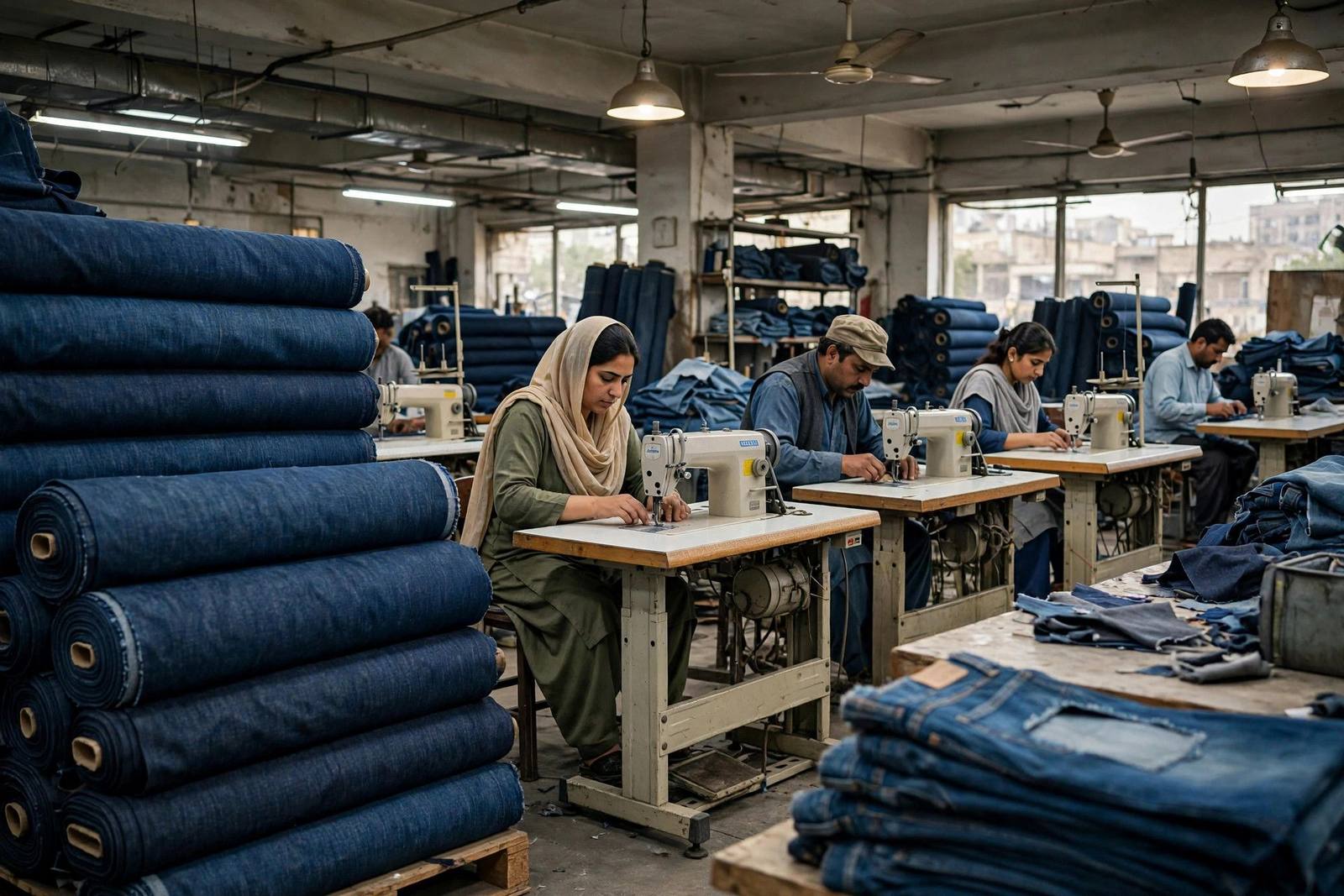
Din's product list reads like a tour of everything yarn can be persuaded to do. There is carded and combed cotton yarn in a wide count range, and compact yarn — spun so the fibres lie tight, giving smoother, stronger thread for quality weaving. There is core-spun yarn, in which a filament of Lycra runs through the middle of a cotton sheath, the ingredient that lets denim and trousers stretch and recover. There are slub yarns, spun with thick-and-thin places on purpose, and melange yarns, in which fibres dyed before spinning are blended to give the heathered look of sports and casual wear. Cone-dyed yarn, gassed yarn with its fuzz burned off for a cleaner finish, bleached cotton web for surgical and cosmetic uses, and ply yarns twisted from multiple strands round out a catalogue aimed squarely at buyers with specifications rather than buyers with only a price. In segment terms the company reports spinning as its core, alongside weaving of greige fabric and other lines that have included towels and bed sheets — downstream steps from its own yarn, but steps it has generally treated as supporting acts rather than the main stage.
Geography completes the commercial picture. Din sells at home to Punjab's weavers and knitters, and it exports, both directly and into the region's garment machine. Trade reporting in the late 2000s described the company opening its own office in Bangladesh — a striking move for a spinner, putting sales staff inside the world's second great garment-exporting economy, whose factories were doing orders for European and American high-street names and needed reliable speciality yarn at short notice. That is the company's logic in miniature: the yarn is Pakistani, the fashion cycle is global, and the margin lives in being specified into a buyer's programme rather than auctioned by the bale. It is a logic it shares, at larger scale and further down the chain, with composite houses such as Kohinoor Mills, where weaving and dyeing rather than spinning carry the story.
How a spinning mill makes money
The arithmetic of spinning is brutally simple to state and hard to execute. A mill buys cotton — its dominant cost, priced off a crop and a world market it does not control — adds labour, energy and machinery time, and sells yarn at a price set by the same world. Profit is the spread between the two, and the spread is not the same for every yarn: a kilogram of compact combed yarn or dyed melange earns more conversion margin than a kilogram of coarse carded yarn, because fewer mills can make it well and buyers pay for consistency. Energy is the second great variable, since spinning halls run around the clock and a tariff change moves the cost of every kilogram; captive arrangements and the fuel mix therefore appear, in one form or another, in every spinner's results discussion. The third variable is the crop itself — a short or rain-damaged cotton harvest forces mills onto imported fibre at dollar prices, which is why the crop that the whole chain stands on gets its own explainer in our guide to Pakistan's cotton economy.
Two quieter levers decide which spinners come through the cycle. One is working capital discipline: cotton is bought in a season and sold as yarn all year, so a mill is permanently financing inventory, and the interest bill on that financing can eat the conversion margin whole in a high-rate year. The other is the product mix flywheel — speciality yarns need development work with each buyer, smaller lots and more shade changes, which costs flexibility but buys loyalty; Din's decades-long emphasis on melange, dyed and core-spun lines is a bet that loyalty outearns volume. Exports add the exchange rate to both sides of the ledger, flattering revenue when the rupee falls while raising the cost of imported fibre, dyes and spares in the same breath.
Strengths, risks and the spinner's cycle
Din's strengths are the classic ones of a surviving specialist. It has been spinning since the late 1980s, through the sanctions-era slumps, the energy crisis years and repeated cotton shocks, and survival in Pakistani spinning is itself a credential — the industry's graveyard of closed and merged mills is long. Its speciality range gives it some shelter from pure price competition, its Punjab locations sit near both fibre and customers, and its place inside a diversified family group has historically meant patient sponsorship. Muneer's own civic and institutional standing — board seats, hospital and education charities in Karachi, Faisalabad and Chiniot, and the bank chapter — made Din a name counterparties knew long before they read a balance sheet. He died in November 2022, and the company's story since is, in part, a succession story: whether the second generation keeps the speciality discipline is the question long-term holders are really asking.
The risks are the sector's risks, unsentimentally. Cotton quality and availability in Pakistan have deteriorated over the long run, pushing spinners toward imports and exposing them to currency and freight. Energy pricing can turn a good yarn market into a loss-making one within a single tariff notification. Export demand is cyclical and fashion-led — a melange programme cancelled by a European buyer is not easily resold. And spinning, for all Din's specialisation, remains a business where the customer's alternative supplier is usually one phone call away, which caps pricing power even for good mills. None of this is hidden: it is the ordinary weather of the segment, and it is why how PSX dividends work matters when judging a cyclical — payouts in spinning tend to follow the good years rather than smooth them.
The name on the PSX
On the exchange, DINT is a mid-sized textile name: established, family-controlled, and traded in the rhythm of the textile cycle rather than the index's daily drama. It has never been one of the market's heavyweight index anchors, and its register has historically combined a substantial sponsor holding with a public float that can be thin by the standards of the big composite mills — a combination that can make the price move in steps when orders concentrate. For the reader of accounts, the useful habits are sector habits: track the cotton-yarn spread through the directors' report, watch energy cost commentary, note how much of sales is export and speciality mix, and treat single spectacular or disastrous quarters as weather unless the capacity or the balance sheet has actually changed.
Din Textile, in the end, suits the investor who likes industrial archaeology: a Chinioti family's recovery from a 1966 failure, a 1987 Chunian spinning shed grown into a multi-unit Punjab operation, and a Karachi boardroom selling heather-grey yarn into wardrobes on three continents. It rewards readers who understand that in textiles the boring stages — spinning, dyeing, finishing — are where the country's export economy is actually decided. This profile is educational content, not financial advice.
Key takeaway: Din Textile Mills, incorporated in 1988 and rooted in S. M. Muneer's Din Group, is a speciality spinner — melange, dyed, compact and core-spun yarns — running mills around Pattoki and Raiwind while its head office sells from Karachi.