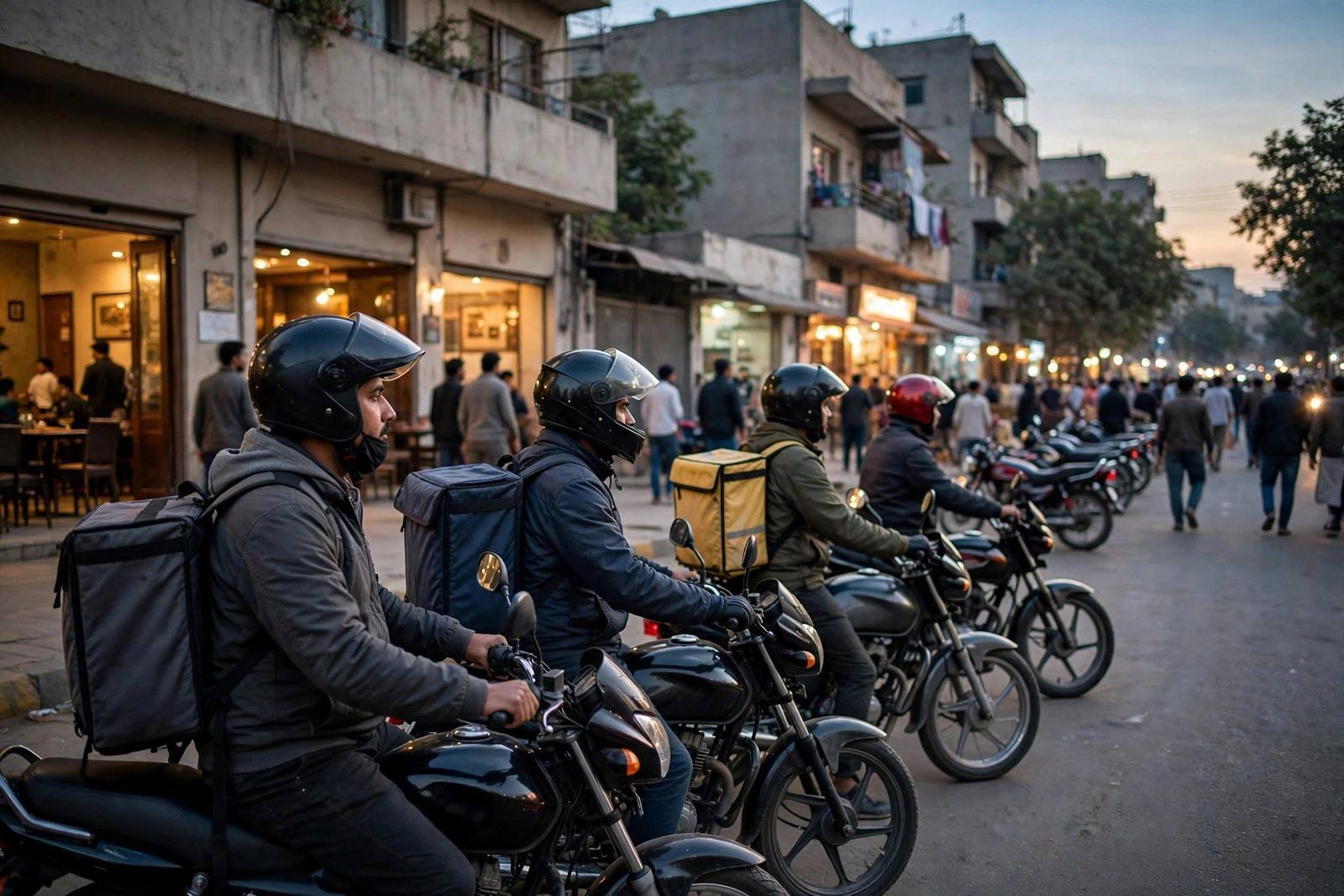
KARACHI: Open any Pakistani city's food-delivery app at lunch hour and you summon an economy: a rider on a financed motorcycle, dispatched by an algorithm, carrying food cooked in a cloud kitchen, paid for through a wallet, rated by a stranger. Add the ride-hailing drivers of Careem, Uber and inDrive, the Bykea partners who carry parcels and people on the same bike, the couriers, the home-based sellers fulfilling orders through platforms, and the freelancers' younger cousins in quick commerce warehouses, and you have the gig economy — platform-mediated, piece-rate, formally self-employed work that has become one of the largest employers of young urban Pakistanis without, in most cases, employing them at all. This guide explains how the model works, what it pays and costs, and why labour law is struggling to describe it.
The model: platforms, piece rates and the algorithm as manager
A gig platform is a marketplace with a foreman built in. The platform owns no motorcycles and few warehouses; its assets are the app, the brand, the payment rails and the dispatch system. Customers order; the algorithm offers the job to nearby workers, sets or discovers the price, tracks the trip by GPS, collects the money, takes its commission, and settles the worker's share — per delivery, per ride, per task. Ratings flow both ways and discipline both sides: a rider whose score falls gets fewer offers; a driver whose acceptance rate drops watches the algorithm route around him. Management decisions that factories once made through supervisors — hiring by sign-up, scheduling by incentive, discipline by deactivation — are made here by software and by the flood of new applicants at the gate.
The main verticals differ in texture. Ride-hailing arrived with Careem's regional expansion in the mid-2010s, was reshaped by Uber's acquisition of Careem and by inDrive's later entry with its bid-your-fare model, and runs on drivers who typically own or finance their cars. Food and grocery delivery, led by Foodpanda and local rivals, runs on motorcycle riders paid per drop with peak and weather incentives. Bike-taxi and courier work, pioneered at scale by Bykea, monetises the motorcycle Pakistan already owns in the tens of millions. Around these anchors orbit smaller platforms for domestic services, beauty, logistics and tasks — and beneath them all, the informal gig work arranged through WhatsApp and Facebook groups that no app mediates and no statistic counts.
Why the supply of riders never runs dry
Gig work's labour supply is Pakistan's demography meeting its formal job market. The country adds young workers far faster than it adds salaried jobs; a large share of employment is already informal, without contracts or protection, as Pakistan's informal economy sets out. Against that baseline, platform work offers real advantages: entry in days rather than after a job search of months, daily or weekly cash settlement instead of monthly arrears, hours that bend around study, family or a second job, and no boss in the room. For migrants to the big cities it is often the first rung — a way to earn while learning the city, sometimes literally by navigating it. Any analysis that treats riders purely as victims of an exploitative model fails its first interview at a delivery hotspot, where the commonest complaint is not the model's existence but its earnings per hour in a slow month — and the commonest fear is deactivation, the loss of the rung itself.
What the work actually pays — and what it costs to earn it
The arithmetic is per-task and ruthlessly transparent to the worker, if not to the public. Gross earnings are the sum of base fares, per-kilometre or per-drop payments, and incentives engineered to pull supply into peak hours and bad weather. From that gross come the costs the platform does not carry: fuel — the expense that links a rider's income statement directly to Pakistan's oil import bill and every fortnightly price notification — motorcycle instalments or rent, maintenance that stop-start city riding accelerates brutally, a smartphone and data, and the unpaid time between tasks that no per-drop rate acknowledges. Net hourly earnings therefore swing with demand density: the same rider earns respectably in a dense, rainy Friday dinner peak and poorly across a thin Tuesday afternoon spent waiting at a kerb he cannot leave. Platforms publish recruitment arithmetic; workers publish screenshots; the truth, as usual, is a distribution — by city, vehicle, hours chosen and season — that neither brochure captures.
The status question: employee, contractor, or a third thing
Pakistani labour law, like most systems built for factories, sorts workers into employees — with minimum wage, social security registration, EOBI old-age benefits and protection against arbitrary dismissal — and everyone else. Platforms classify riders and drivers as independent partners, a description that is genuinely accurate about hours and asset ownership and genuinely incomplete about control: the platform sets prices, standards and the terms of engagement, and can end the relationship by algorithm without the process an employee would receive. Courts and legislators worldwide have split on this question, and Pakistan's own debate follows the global script — provincial labour departments and draft platform-work proposals periodically surface, platforms warn that employment status would raise prices and cut flexible work, rider associations demand insurance, minimum per-task floors and grievance channels that do not end at a chatbot. The pragmatic middle appearing in several markets — portable accident insurance, some social-security contribution, transparent deactivation appeals, without full employee status — is visible in Pakistan mainly as pilot schemes and platform-funded insurance announcements rather than as settled law. For now, an injured rider's safety net is usually his family, his savings and, in the worst cases, a fundraising appeal in the same social feeds that carry his delivery photos.
Risk on the road
The gig economy's ledger must include the road itself. Pakistan's traffic is among the world's most dangerous, and the model concentrates exposure on the workers least able to absorb it: young men on motorcycles, paid in ways that reward speed, riding in all weather to addresses that are often a landmark and a prayer. Accident rates among delivery riders became a public issue as the platforms scaled, prompting company safety programmes, helmet enforcement in bursts, and customer-facing prompts not to pressure riders on time — alongside persistent reporting of incentives whose practical message cuts the other way. A serious accounting of the sector's welfare contribution nets its genuine income opportunity against this transferred risk, and against the absence, for most riders, of the health cover whose Pakistani landscape our health insurance guide describes.
Platforms as infrastructure: payments, data and the formal economy's edge
Whatever the labour verdict, the platforms have built infrastructure the wider economy uses. They normalised digital payment and card-on-delivery at mass scale, created address and demand data for cities that official statistics map poorly, gave small restaurants and home chefs a storefront, and provided an on-ramp — for some workers — into documented income histories usable for microloans and motorcycle financing. The State Bank's instant-payment system and the broader fintech push intersect here: a rider paid instantly into a wallet is, for the first time, visible to the formal financial system, with the credit possibilities and the tax visibility that follow. The gig workforce also shades into the export-facing one — the delivery rider's cousin doing data annotation, design gigs or customer support for foreign clients through global platforms belongs to the story of Pakistan's freelancers, a companion guide in this series — and workers move between the two as English, skills and luck allow.
Where the model goes next
Three pressures will shape Pakistani platform work in the coming years. Consolidation and pricing: the subsidy wars that funded cheap rides and free delivery have thinned; surviving platforms must price nearer true cost, which tests demand and rider supply simultaneously. Electrification: the two-wheeler fleet the model runs on is the natural first target of Pakistan's EV policy, and a rider's fuel bill — his largest variable cost — is the strongest adoption argument any showroom can make. Regulation: some settlement of status, insurance and minimum standards is likelier than either full employment status or permanent laissez-faire, and its design will decide whether platform work matures into a protected occupation or stays a young man's bridge between school and something else.
For investors, the sector is mostly offshore and private — the listed exposure is indirect, through payments, telecoms, fuel retail and the motorcycle assemblers whose sales the riders finance. This article is educational content, not financial advice.
Cities, women and the shape of the workforce
The gig economy is overwhelmingly urban and overwhelmingly male, and both facts are information. Its map is the map of smartphone density, restaurant clusters and disposable income: Karachi, Lahore and Islamabad-Rawalpindi dominate, with Faisalabad, Multan, Peshawar and Hyderabad in a second tier, and the geography of a rider's earnings follows the geography of who can afford delivered food. Women's participation in the visible riding workforce is minimal — a product of vehicle access, family permission, safety and harassment realities that platforms' occasional women-rider programmes have dented rather than changed — while women's gig work concentrates in the less visible layers: home-based food businesses selling through platforms and social media, beauty services booked by app, online freelancing and selling. Any honest headcount of the sector therefore splits it in two: a counted, male, on-road workforce whose numbers platforms can report to the decimal, and an uncounted, substantially female, home-based workforce whose platform income no survey has yet measured properly.
Age is the third shape. Riders and drivers skew young — students riding evenings, school-leavers riding full-time, men in their twenties treating the work as a bridge and men in their thirties discovering the bridge has become the road. That life-cycle matters for policy: protections designed for a teenage side-income will under-serve a thirty-two-year-old whose motorcycle instalment, rent and children's school fees all ride on per-drop rates he does not set. It also matters for the platforms' own future, because a workforce that ages in place eventually organises — and rider associations, WhatsApp-coordinated log-offs at peak hours and city-level protests over rate cuts have already appeared in Pakistan's big cities, the early grammar of a labour politics the platforms' contractor model was designed to avoid and will now have to learn to negotiate with.
The customer's side of the bargain.
None of this survives without the person tapping the screen, and the customer's bargain deserves a paragraph of honesty. Delivered food and cheap rides feel inexpensive because three subsidies converge: investor money that long funded below-cost pricing, the worker's own vehicle and fuel absorbing costs a fleet owner would have to price in, and the public road — congested, accident-prone, unpriced — absorbing the rest. As the first subsidy retreats, prices and delivery fees creep toward the true stack, and the market discovers which of its habits were demand and which were discount. The likely resting point is a smaller, more honestly priced sector that still employs very large numbers — because the underlying facts that built it, urban density, cheap motorcycles, scarce formal jobs and a young population fluent in apps, are not reversing.
Key takeaway: Pakistan's gig economy turns the motorcycle, the smartphone and the algorithm into a vast, flexible labour market — real income and instant entry on one side, piece-rate risk, road danger and no safety net on the other.