KARACHI: Almost every building in Pakistan is wired with something, and for more than seventy years a large share of that wiring has carried one name. Pakistan Cables, founded in Karachi in 1953, is the country's oldest and best-known cable manufacturer — the maker of the copper and aluminium wires, cables and conductors that run through homes, factories, offices and power networks from Karachi to Khyber. It was set up by one of Pakistan's pioneering industrial families with a British partner, it has been listed on the stock exchange since 1955, and it still trades on the Pakistan Stock Exchange under the ticker PCAL. Beginners usually meet the name not on a screen but in an electrical shop, on a coil of wire their electrician insists is the genuine article. This profile explains where that reputation came from, what the company actually makes, who owns it, how it earns its money, and what people who follow the share tend to watch.
Founded in 1953: the Chinoy family and a British partner
Pakistan Cables was incorporated on 22 April 1953 as a private limited company, in a country that was not yet six years old and was industrialising from a very low base. Its founder was Amir Sultan Chinoy, a Karachi businessman whose family went on to build one of Pakistan's respected industrial groups. The venture was established as a joint venture with British Insulated Callender's Cables — BICC — then one of the world's leading cable manufacturers. The logic of the partnership was the classic import-substitution logic of the 1950s: Pakistan was importing finished cable with scarce foreign exchange, demand from construction and electrification was growing, and a local plant with British technology could replace imports while learning the trade from an established maker.
The company converted into a public limited company in 1955 and obtained its listing on the Karachi Stock Exchange in the same year — a remarkably early listing that makes PCAL one of the older continuously traded names on what is now the PSX. That long public history matters. Generations of Karachi investors have held the share, annual reports have been published for decades, and the company's name became shorthand in the trade for a certain standard: in a market where substandard, under-gauged wire is a genuine fire risk, Pakistan Cables built its franchise on the promise that the copper inside the insulation was what the label said it was. Its own corporate motto in recent years — built around being trusted not to compromise — is a direct descendant of that founding bargain.
From BICC to General Cable to the Amir S. Chinoy Group
Foreign partnerships shaped the company's middle decades. The BICC connection gave way over time to other international links, and during 2010 to 2017 Pakistan Cables was an affiliate of General Cable Corporation, an American Fortune 500 cable maker that took a significant equity stake and brought global manufacturing practice into the Karachi plant. When that chapter closed, the company deepened a different kind of partnership: an exclusive technical collaboration with CTC Global of the United States, a specialist in advanced conductors for power transmission lines. The pattern across seventy years is consistent — a Pakistani family company that has repeatedly rented world-class technology through partnerships rather than trying to invent everything at home.
Today Pakistan Cables sits inside the Amir S. Chinoy Group, usually shortened to the ASC Group, alongside two other listed Karachi industrials: International Industries Limited, the steel tube and pipe maker, and International Steels Limited. The three companies share a family heritage, a Karachi base and a reputation for professional management that students of Pakistan's business groups often cite as the quieter, governance-first end of the family-business spectrum. For a minority shareholder in PCAL, that group membership cuts both ways, in the familiar pattern discussed in our guide to family businesses on the PSX: you get sponsor commitment and a long horizon, and you accept that strategic decisions are ultimately the family's to make.
What Pakistan Cables actually makes
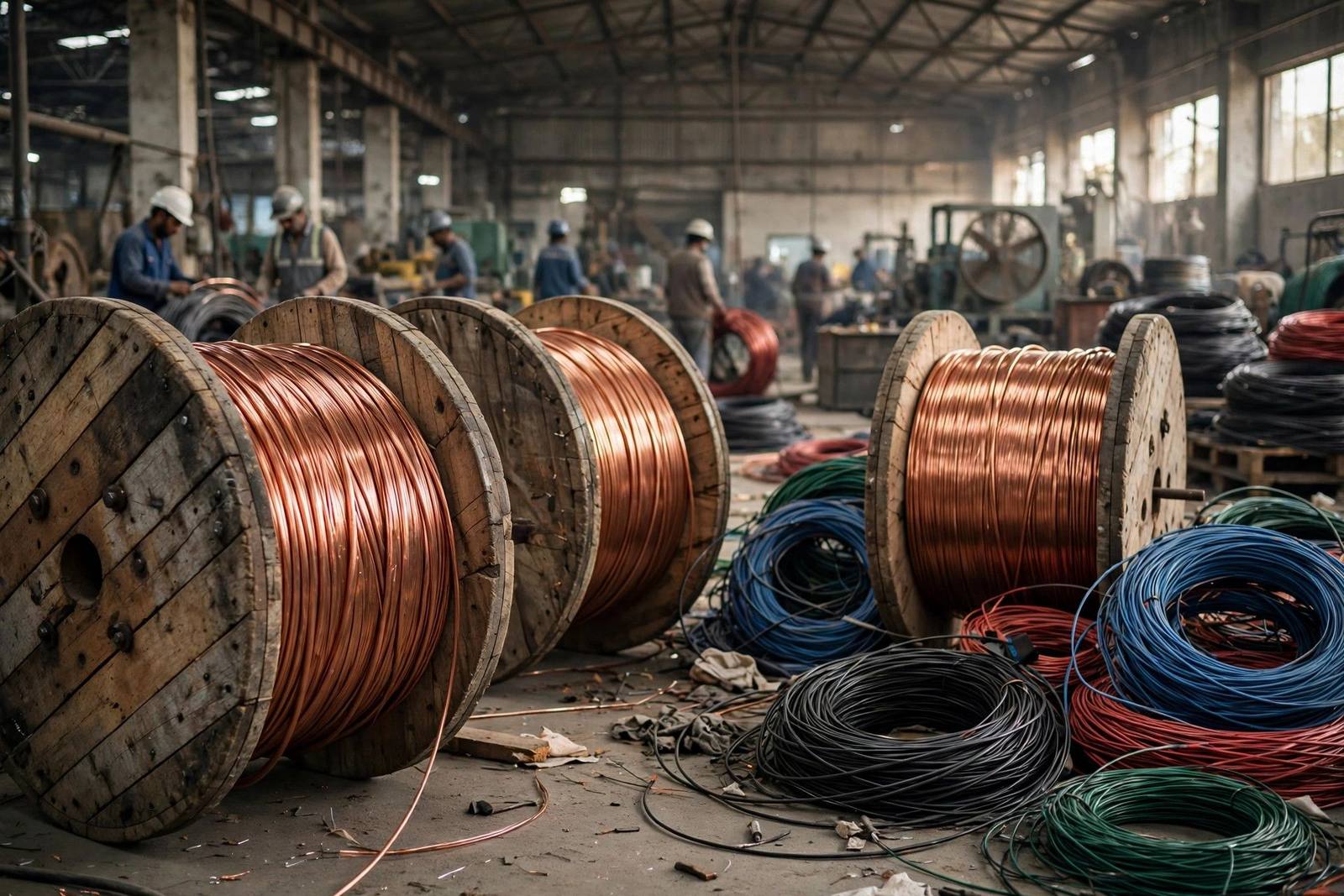
The core business is exactly what the name says, in both copper and aluminium. The product portfolio described in the company's own reporting runs to several families. Wires and cables are the heart of it: general wiring cables for buildings, power cables, control and instrumentation cables, and specialised products such as high-temperature and fire-resistant lines. Copper rod is both an input and a product — the company draws its own rod, the starting point for wire, and sells rod as well. Conductors for overhead power lines connect the company to the national grid business, including the advanced composite-core conductors covered by the CTC Global collaboration, which transmission engineers value because they can carry more power on existing towers.
Around that core sit three diversifying lines that surprise people who assume the company only makes cable. Aluminium extrusion profiles, sold for architectural use — window and door frames, curtain walls and the like — take the company into the building-materials trade under its Alum-Ex branding. PVC compounds, the plastic granules used for cable insulation and by other manufacturers, are produced in-house and sold externally. And wiring accessories extend the brand into the switches-and-fittings end of the electrical counter. Manufacturing has historically been centred on the company's site in the S.I.T.E. industrial area of Karachi, and in recent years the company has assembled a substantial land bank at Nooriabad, the industrial zone on the Karachi–Hyderabad corridor where many Karachi manufacturers have been relocating and expanding — a sign, in bricks and acres, that management sees its future volumes as larger than the old urban site can hold.
How a cable maker earns its money
The revenue mechanics are those of a metal transformer. Pakistan Cables buys copper and aluminium — priced, ultimately, off international metal exchanges and the rupee's exchange rate — draws and strands them into conductors, insulates and armours them, and sells the finished cable at a margin over metal. That structure explains most of what an investor needs to understand about the business. When copper prices rise, the selling price of cable rises with them and reported turnover inflates, but the real question is the conversion margin: how much the company earns for turning metal into a certified, branded, warranted product, over and above the metal's cost. Brand is what protects that margin. A housing contractor or a factory engineer who specifies Pakistan Cables by name is paying for reduced risk of failure, and that willingness to pay a premium over unbranded wire is the company's economic moat in miniature.
Demand, meanwhile, is borrowed from other industries. Building wire follows construction activity — housing, commercial projects and renovation. Power cable and conductors follow investment in generation, transmission and distribution, which in Pakistan means the stop-start capex of the state power sector and industrial expansion. Aluminium extrusions follow the same construction cycle from another angle. So PCAL is best understood as a geared play on Pakistani building and electrification: when construction booms and grid spending flows, volumes and margins expand together; when interest rates spike and building stalls, the same leverage works in reverse. The working-capital cycle adds a further twist — metal inventory is expensive to carry, so high interest rates bite a cable maker twice, once through demand and once through financing costs on stock and receivables from slow-paying institutional customers.
Strengths, risks and the counterfeit problem
The strengths are unusually tangible for a listed company. The brand is genuinely old and genuinely trusted in a product category where failure is dangerous and invisible — few buyers can test the copper content of a wire at the counter, so reputation does the work that inspection cannot. The certifications the company lists, spanning international quality, environmental and safety standards and testing houses, support its position in institutional tenders where unbranded rivals cannot qualify. The ASC Group connection brings professional systems and a balance-sheet culture that has kept the company investing through cycles, including the Nooriabad land purchases. And the product spread — building wire, power cable, conductors, extrusions, compounds — means no single customer or segment decides its fate.
The risks are equally concrete. The first is the informal and counterfeit end of its own market: cheap imported and locally made under-gauge wire, and outright fakes trading on famous brand names, undercut honest manufacturers on price in exactly the retail segment where the brand premium should be safest. The second is metal and currency volatility — a sharp rupee fall raises the landed cost of copper faster than selling prices can always follow, squeezing margins and swelling working capital. The third is the cycle itself: construction downturns in Pakistan can be long, and power-sector spending depends on a financially strained state. Finally there is the generic risk of any family-group mid-cap: the share can be less liquid than the big index names, so prices can move sharply on modest volumes — a point worth understanding through our explainer on market capitalisation and free float before reading too much into any single day's move.
The name on the PSX: PCAL since 1955
PCAL's distinction on the exchange is longevity. Listed in 1955, it is one of the small club of Pakistani companies whose quoted history runs from the old Karachi Stock Exchange — through the era of three separate bourses — into today's unified PSX. It sits outside the very largest index heavyweights, in the broad tier of established industrial names that long-term local investors and smaller funds own for a combination of dividend income and cyclical recovery. Its dividend record, like that of most Pakistani industrials, has followed the cycle and the company's investment programme rather than a fixed promise; readers new to how payouts are declared and timed can use our guide to how PSX dividends work to decode the book-closure notices PCAL files like every listed company. The company's filings and results are followed through the same PSX announcement stream as its ASC siblings — International Industries under INIL and International Steels under ISL — and group-level news in one often explains share moves in the others.
One more long thread runs through the company's prospects: the state of Pakistan's wires-and-cables standards themselves. The cheapest wire in the market is cheap partly because it cheats — less copper than claimed, thinner insulation than safe — and every serious manufacturer in the country has a commercial interest in the enforcement of standards by regulators and testing bodies, and in building codes that specify certified cable for public projects. Each step Pakistan takes toward enforcing those standards transfers demand from the informal end of the market toward certified makers, of which Pakistan Cables is the most established. Set against that is the opportunity in the grid itself: as Pakistan adds renewable generation in places far from its load centres, and debates upgrading transmission to carry it, conductor demand — including the high-capacity composite-core conductors of its American technical collaboration — is one of the few cable segments whose specification sheets, rather than price lists, decide the winner. Followers of PCAL therefore read two documents with equal care: the housing statistics, and the transmission plans.
What kind of investor studies Pakistan Cables
The natural student of PCAL is a patient, cycle-aware investor: someone who follows construction activity, interest rates and metal prices, reads the capacity and land-bank story as a statement about the next decade rather than the next quarter, and is comfortable owning a family-group industrial whose best years arrive with building booms. Followers typically watch copper and aluminium price trends, the pace of power-sector projects, housing and construction indicators, the progress of the Nooriabad expansion, and the dividend declared alongside each annual result. This article is educational content, not financial advice, and nothing in it is a recommendation to buy or sell any security. As Aktzien is being built to make following companies like this simpler for first-time investors, the habit that matters most with a name like PCAL is the oldest one in its own history: check what is actually inside before you trust the label.
Key takeaway: Pakistan Cables has turned copper and aluminium into branded, trusted wiring since 1953 — a Chinoy family company, listed since 1955, whose fortunes rise and fall with Pakistan's construction and power-building cycles.