KARACHI: Walk into a Pakistani home built or renovated in the last forty years and look down: there is a good chance the floor came from Landhi. Shabbir Tiles and Ceramics Limited — STCL on the Pakistan Stock Exchange — is the Karachi manufacturer behind Stile, one of Pakistan's best-known tile brands, making ceramic and porcelain floor and wall tiles and trading in allied building products from its plants at the 15th Milestone of the National Highway. Incorporated in 1978, it describes itself as the first ceramics and porcelain tile manufacturing establishment incorporated in Pakistan, and for decades the Shabbir name has been close to a generic word for locally made tiles. One clarification belongs at the top, because the market confuses it often: Shabbir Tiles has not been renamed Karam Ceramics. Karam Ceramics Limited is a completely separate, separately listed Pakistani ceramics company — a competitor in sanitaryware and tiles, not this company's new identity. STCL still trades, reports and sells as Shabbir Tiles and Ceramics, under its Stile brand. This profile tells the pioneer's story, and where it stands in a market that imports now challenge from every side.
1978: the organised tile industry begins at Landhi
Shabbir Tiles and Ceramics was incorporated in Pakistan on 7 November 1978 as a public limited company under the Companies Act of 1913, and is listed on the Pakistan Stock Exchange. The date matters because of what Pakistan's tile supply looked like before it: at independence there had been essentially no ceramic industry in the country at all, and through the 1950s and 1960s the organised ceramics that emerged — tableware porcelain, then sanitaryware units in the 1970s — still left tiles for floors and walls largely to imports and small local units working with European technology. Shabbir was among the prominent organised tile units established in the mid-1970s wave, and the company itself claims the distinction of being the first ceramics and porcelain tile manufacturing establishment incorporated in Pakistan.
The founding location shaped the business: Landhi, Karachi's eastern industrial belt, on the National Highway — today the registered office and Unit 1 plant stand at the 15th Milestone there, with a second tile plant, Unit 2, at Deh Khanto in Malir's Bin Qasim Town, and smaller building-products operations in Islamabad and Lahore supporting the national trade. Karachi gave the young company the port for its Italian machinery and imported inputs, the country's largest construction market on its doorstep, and a merchant network to carry its crates upcountry. What it sold was partly a product and partly an idea: that a Pakistani factory could make tiles to European standards, in the sizes, colours and finishes that architects were specifying from import catalogues — an import-substitution story told in showrooms rather than in tonnes.
Stile: the brand that carried the factory
Shabbir's masterstroke was branding. The tiles are manufactured and marketed under the name Stile — the name on the boxes, the dealer boards and the company's showrooms and design studios, including its emporium-format outlets in Karachi. In a building-materials market where most products are anonymous commodities bought by contractors, Stile gave homeowners something to ask for by name, and gave the company a consumer franchise unusual in its sector: the person choosing the bathroom wall is not the person who will lay it, but she is the person who will pay for it, and Shabbir learned early to sell to her.
The quality claim behind the brand has been tested in public. Pakistan's Stile porcelain tiles were certified by Centro Ceramico, the Bologna-based ceramics testing laboratory, as meeting European and international standards on dimension and surface quality, physical properties and chemical properties — a certification the company announced with understandable pride, noting it already held ISO certification and used state-of-the-art Italian machinery. In a market where imported tiles arrive with an aura of foreign superiority, a Karachi maker waving an Italian laboratory's certificate was fighting the perception battle with the other side's own weapons. The Shabbir Tiles of the profile's title and the Stile of the showroom are the same company wearing work clothes and showroom clothes — a two-name architecture worth remembering whenever its results are compared with rivals such as the separately listed Tariq Glass in the wider glass-and-ceramics sector, or with the Peshawar tile maker Frontier Ceramics among its direct tile peers.
What Shabbir Tiles actually makes and sells
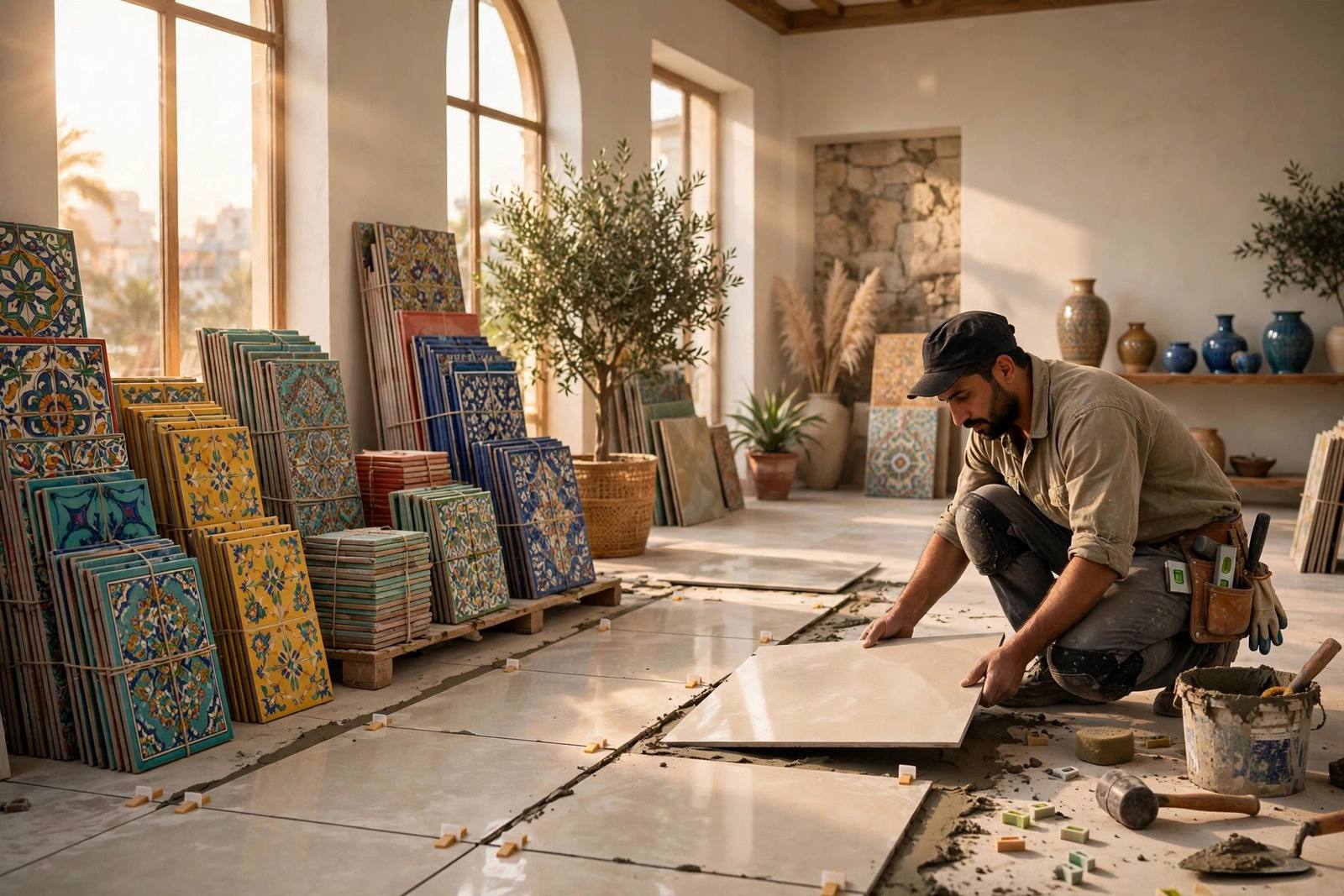
The company's own description of its business is compact: it is primarily engaged in the manufacture and sale of tiles, and the trading of allied building products. Unpack that into a showroom and it becomes: ceramic and porcelain floor and wall tiles in an evolving catalogue of sizes, finishes and designs — glossy, matte, rustic, marble-look and wood-look surfaces chasing the same design cycles as the global industry, produced on Italian lines at the two Karachi plants; and allied building products traded alongside — the complementary fittings and materials sold through its plants and outlets in Islamabad and Lahore and a dealer network across the country, which let a Shabbir outlet dress an entire bathroom or floor project rather than a single SKU. The annual reports add the operational colour: technology and design investment as the stated strategy for meeting shifting consumer taste, in a category where last decade's beige is unsellable and where digital printing has reset what a mid-priced tile can look like.
Distribution is the quiet half of the model. Tiles are heavy, fragile and fashion-sensitive — a punishing combination. They must be made near the clay, gas and port; stocked in depth in every major city against the day a builder's schedule demands them; and displayed properly, because a tile chosen from a stack in a warehouse sells for less than the same tile lit in a design studio. The company's investment in branded emporiums and studios, alongside ordinary dealers, is the visible edge of that logic — the same logic that makes Pakistan Cables' branded wire and Shabbir's branded tile cousins in the building-materials trade: when the product goes inside a wall or under a floor for thirty years, the buyer pays for a name.
How a tile maker makes money
A tile plant is a kiln with a company attached. Clay bodies are prepared, pressed, glazed, printed and fired at temperatures that consume gas in industrial quantities; the finished tiles are sorted, boxed and warehoused. Profit lives in three variables. The first is kiln economics: energy is among the largest costs, so the gas tariff and the efficiency of the firing line can matter more than the selling price list, and a kiln that stops and restarts wastes both fuel and product. The second is mix: larger formats, porcelain bodies and fashionable finishes earn more per square metre than commodity ceramic, which is why the whole industry races upmarket in good times. The third is volume against construction: tiles are ordered late in a building's life, so Shabbir's order book tracks completions — housing schemes, apartment towers, commercial fit-outs and the renovation trade — with the sensitivity to interest rates and construction cycles that our explainer on Pakistan's housing economy maps out.
Imports frame everything. Pakistan's tile demand has long been served partly by imports, above all from China and Iran, and the competitiveness of a Karachi kiln against a landed container depends on the exchange rate, customs duties and anti-dumping measures of the moment as much as on factory skill. When the rupee falls, imports price up and local makers breathe; when trade liberalises or smuggled and under-invoiced supply leaks in, the same makers suffocate. Working capital completes the picture: designs must be stocked before they are fashionable and cleared after they are not, and slow construction years leave beautiful tiles earning nothing in expensive warehouses — the inventory risk our working capital explainer describes in its most literal, breakable form.
Strengths, risks and the Karam confusion, settled
Shabbir's strengths are heritage and brand. It pioneered its industry locally, it owns a consumer brand with decades of recognition, its Karachi base sits beside the port, the gas network and the largest metropolitan market, and its European-standard certifications give architects a defensible specification. Its sponsor family's long stewardship — the Jaffery name has been associated with the company's leadership across its modern history — gives it the continuity typical of Pakistan's durable industrial families.
The risks are energy, imports and fashion, in that order, overlaid on the national construction cycle. Gas pricing and availability in Sindh directly set the cost floor; imported competition sets the price ceiling; and between floor and ceiling the company must keep its designs current against rivals with faster trend cycles. It is worth restating the identity point here, since it is the single most common error in casual writing about this stock: Karam Ceramics Limited (PSX: KCL) is a different company — one of the sanitaryware-and-ceramics units established in Pakistan's 1970s ceramics wave — and no merger, renaming or acquisition has turned Shabbir Tiles into Karam or Karam into Shabbir. If a data source shows one name where you expected the other, it is the source that is confused; the PSX company directory carries both, separately, as it has for years.
The name on the PSX: STCL
STCL trades in the PSX's glass and ceramics sector, a small classification it shares with glass makers and ceramics peers — a materials label, as our market capitalisation explainer would warn, that says nothing about how differently those businesses behave. The share is a small-cap with the trading character of Pakistan's building-materials names: quiet for long stretches, suddenly active when construction sentiment turns or a results surprise lands, with a free float the PSX profile puts at a little over half the shares — enough for a genuine market, thin enough for sharp moves on modest orders. Dividends have followed the industry's cash logic — kiln investment and energy shocks first, payouts when the cycle allows — declared through the ordinary book-closure machinery set out in how PSX dividends work. For reporting discipline, its June year-end results arrive with the late-summer results season alongside the rest of Karachi's industrial old guard.
The category itself keeps moving beneath the kilns. Formats have grown relentlessly — the large porcelain slab that covers a floor in a handful of pieces was a showroom curiosity a generation ago and is now a mainstream specification — and each jump in size demands new presses, new handling and new firing discipline from anyone who wants to sell it, while digital printing keeps shortening the distance between a design seen in Milan or Guangzhou and a crate leaving Landhi. Local makers have also watched the definition of their market widen: tiles now compete with marble, granite, vinyl and polished concrete for the same floor, which makes the showroom experience and the architect relationship as decisive as the kiln. Shabbir's answer, visible across its recent reporting, is the pioneer's standard play — invest in technology and design, lean on the brand's trust, and use the emporium network to sell the room rather than the square metre. It is not a guaranteed answer; imported porcelain sets a hard price reference and local rivals have built larger modern lines. But it is the answer of a company that has already survived the arrival of every previous threat to its trade, from the first European imports it displaced to the Chinese wave it still faces.
What kind of investor studies Shabbir Tiles
STCL is a study in branded building materials: the investor who follows it tracks gas tariffs, construction activity and housing completions, tile import data and trade remedies, rival capacity — including the newer, larger plants that have entered the industry — and the design cycle that decides whose showroom a renovating family walks into. It rewards the same patience as its product: tiles are chosen for decades and should be analysed that way, not quarter to quarter. This article is educational content, not financial advice, and nothing in it is a recommendation to buy or sell any security. As Aktzien is being built to make companies like this easier to follow, Shabbir's file is a good place to practise the first skill of the whole exercise — making sure the name on the share is the company you think it is.
Key takeaway: Shabbir Tiles — still Shabbir, not Karam — pioneered organised tile-making in Pakistan from 1978, built the Stile brand on European-standard quality, and lives on kiln economics, design fashion and the national construction cycle.