KARACHI: First, the clarification every profile of this company owes its reader: Tata Textile Mills Limited, traded on the Pakistan Stock Exchange as TATM, has nothing to do with India's Tata group. The name belongs to a Pakistani business family — the Tata Pakistan group — whose textile company, incorporated in Karachi in 1987, manufactures and sells yarn from three plants at Muzaffargarh in Punjab, Landhi in Karachi and Kotri in Sindh. The present company is itself a consolidation: three sister businesses, Salfi Textile Mills, Island Textile Mills and Tata Energy, were amalgamated into Tata Textile Mills, creating a single listed spinner of well over a hundred thousand spindles. Its story is therefore two stories — a family that built mills mill by mill, and a modern company assembled from those mills into one balance sheet.
Incorporated in 1987, assembled by amalgamation
Tata Textile Mills Limited was incorporated in Pakistan on 15 April 1987 as a public limited company under the Companies Ordinance then in force, and listed on the stock exchange, with its registered office at Textile Plaza on M. A. Jinnah Road in Karachi. Its principal activity, stated plainly in its financial statements, is the manufacture and sale of yarn. That plainness is deceptive: behind the single line sits a group that had developed several spinning businesses in parallel, as Pakistani families commonly did — separate companies for separate plants, financed and incorporated separately as each opportunity arose.
The defining corporate event of the modern company is the amalgamation of Salfi Textile Mills Limited, Island Textile Mills Limited and Tata Energy Limited into Tata Textile Mills. Amalgamations of this kind, sanctioned through the courts, transfer the undertakings, assets and liabilities of the merging companies into the survivor, whose share capital is adjusted for the exchange. For Tata, the merger folded the family's Karachi and Kotri spinning interests — the Salfi and Island mills — together with its energy company into the Muzaffargarh-centred listed vehicle. The industrial logic is straightforward: one listed company instead of several overlapping ones, one cotton-buying desk, one treasury, one register of shareholders, and a spindle base large enough to matter in a consolidating industry.
Leadership has rested with the family whose name the mills carry. The company's annual reports record Shahid Anwar Tata as chief executive and Anwar Ahmed Tata as chairman in its earlier modern period, with family members across the board — the standard sponsor pattern in which ownership, name and management are a single fact. Our guide to family businesses on the PSX sets out what that concentration gives shareholders (continuity, decisiveness, aligned wealth) and what it asks of them (trust, verified mainly through disclosure).
Three plants, one yarn business
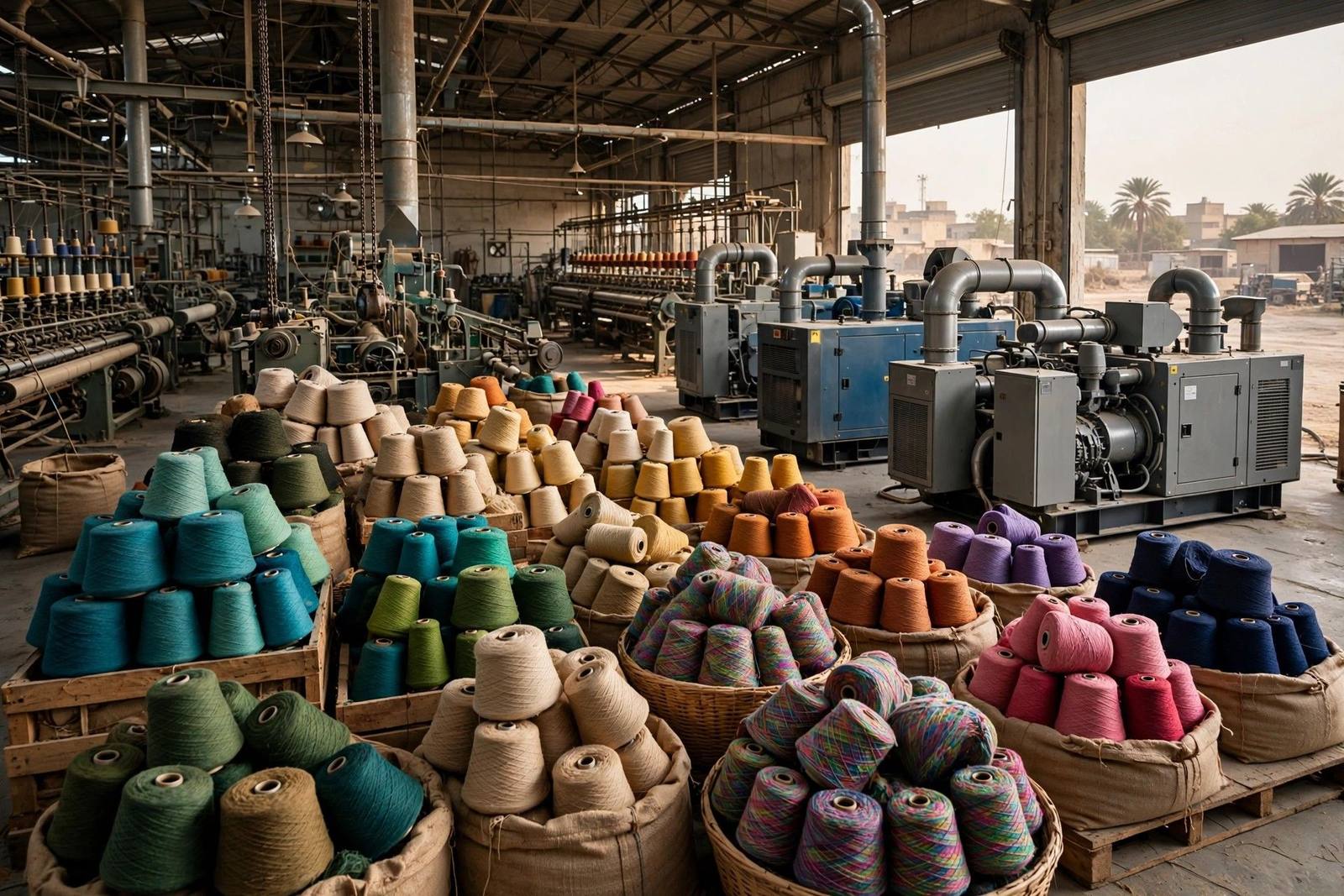
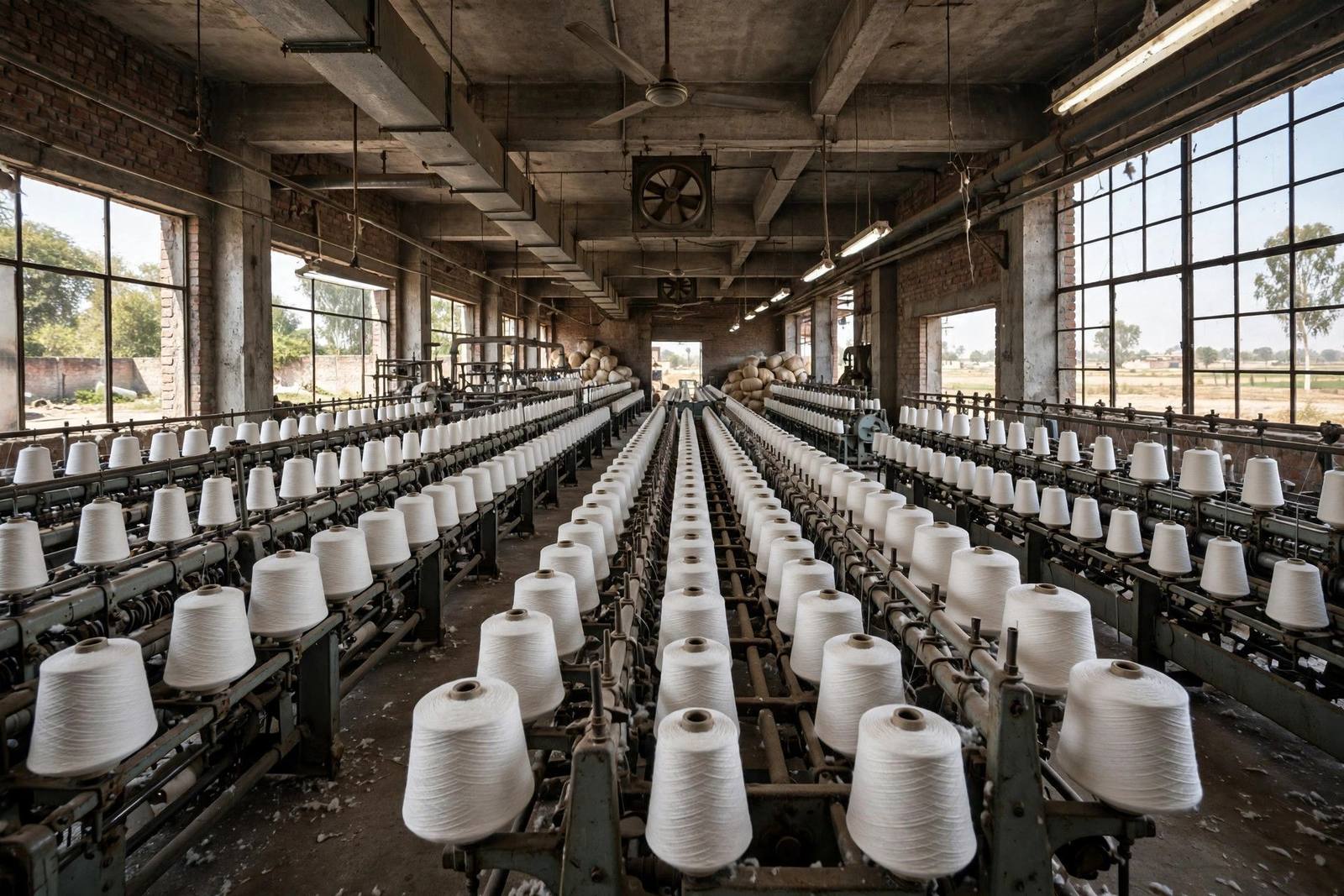
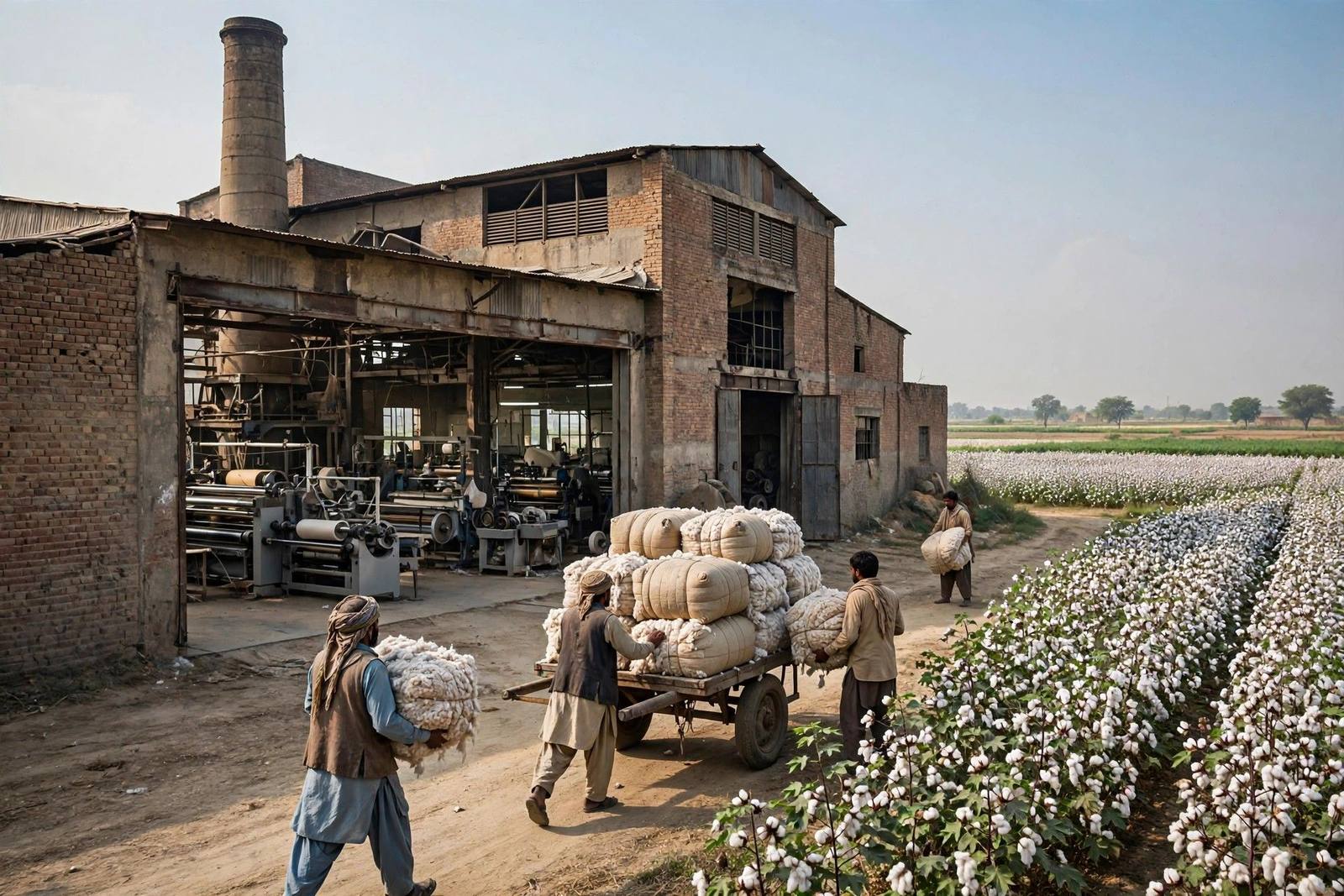
The company's manufacturing geography is set out in its own reporting. The principal plant stands at Khanpur–Baggasher on the M. M. Road in District Muzaffargarh, in the cotton-growing south of Punjab — the mill around which this profile's title is built. The second unit is at Landhi Industrial Area in Karachi, and the third at S.I.T.E. Kotri in District Jamshoro, Sindh. In its corporate briefing for financial year 2024, the company described itself as a leading textile spinning company with those three manufacturing units and a total spindle capacity of 127,092, offering a wide range of cotton and polyester yarn products to domestic and international customers, produced on modern machinery from internationally known makers including Rieter, Trützschler, Toyota and Murata.
That equipment list is not decoration. Spinning margins are made in the preparatory and spinning halls: modern blowroom, carding and spinning machinery from those makers determines yarn evenness, contamination control and energy per kilogram — the difference between yarn a quality weaver reorders and yarn discounted at inspection. A three-plant structure spreads operational risk as well: a breakdown, a labour issue or a local energy fault at one site idles a third of capacity, not all of it, and cotton can be allocated between Punjab and Sindh plants as crop quality and freight dictate.
Investment continues in the same direction. In October 2025 the company disclosed the launch of a balancing, modernisation and replacement project at its Muzaffargarh plant's main unit, replacing an existing 19,200 spindles with 24,288 state-of-the-art spindles, with civil works and machinery replacement expected to complete within about six months. The disclosed aims were the classic BMR trinity — higher output, lower labour and power cost per unit, better efficiency across utilities and maintenance — and the project is a fair emblem of how Pakistani spinners now grow: not by greenfield leaps, but by tearing out a generation of machinery and earning more from the same shed.
How a pure yarn maker makes money
TATM is close to a pure spinner, so its economics are the cleanest in this batch: the spread in PSX textile stocks with nothing downstream to hide behind. Cotton and polyester fibre come in — the domestic crop when quality and price allow, imports when they do not, in the pattern Pakistan's cotton economy describes — and yarn goes out to weavers, knitters and exporters at home and abroad. Between the two prices sit conversion costs, of which energy and labour dominate, finance cost on the cotton inventory, and depreciation on a plant base that must be renewed every generation to stay competitive, as the Muzaffargarh BMR shows.
Product mix is the spinner's main lever. Cotton yarns serve the traditional weaving and denim trades; polyester and blended yarns serve the growing man-made segment, whose fibre prices follow petrochemicals rather than harvests and whose demand is less seasonal. Finer counts and cleaner, contamination-controlled yarns earn premiums; coarse commodity counts earn the market price and nothing more. A 127,000-spindle base run at high utilisation across the right mix is a good business in a normal year; the same base run half-idle on the wrong mix, with dear cotton in stock, is how spinners lose money — which is why utilisation and inventory notes in the quarterly reports matter more than any headline.
Strengths, risks and honest caveats
Tata's strengths are scale, spread and sponsor commitment. The amalgamation created a genuinely large spinning company rather than a collection of sub-scale mills; three plants in two provinces diversify logistics and energy exposure; the machinery base is modern and visibly being renewed; and the family's name on the gate, with its wealth concentrated inside, is a form of alignment minority shareholders can verify every year in the pattern-of-shareholding statement.
The risks are the pure spinner's, unbuffered. There is no fabric, garment or brand margin to catch the business when yarn prices fall below conversion cost, as they periodically do. The domestic cotton shortage pushes the mills toward imports and dollar exposure. Energy tariffs have risen against all spinners. Amalgamated companies also carry an accounting caveat the careful reader respects: merged accounts combine histories, revaluations and inter-company settlements, so year-on-year comparisons around the merger period need the notes, not just the headlines. Finally, the celebrated confusion with the Indian conglomerate is more than a trivia point — it occasionally colours uninformed commentary about the stock, and the company's own identity, a mid-sized Pakistani family spinner, is the corrective.
Why families amalgamate their mills
Tata's amalgamation is worth a general explanation, because the same transaction appears across the PSX's older industrial names and is often misread as financial engineering. A family that built plants over forty years, in different decades and different companies, ends up with a structure designed by history rather than by logic: overlapping boards, inter-company loans, cotton bought three times over, and quoted prices for sister companies that confuse everyone. Amalgamation is the broom. One company holds all the mills; one treasury borrows once, more cheaply, against the whole; one buying desk negotiates the crop; one listing gives the family a single, legible vehicle for succession, valuation and, if ever wanted, a sale.
The costs are real and should be named. Minority shareholders in each merging company must be treated fairly in the share-exchange ratio, which is why such schemes travel through independent valuations and court approval, and why the scheme documents — not the press release — are where a shareholder's protection lives. Histories also blur: pre-merger accounts of three companies do not simply add into a pro-forma past, and Tata's readers should treat trend lines crossing the amalgamation with the suspicion any stitched series deserves. None of that makes the transaction suspect; it makes it a document to read.
Set against its batch, Tata's choice also marks a fork in family strategy. Sapphire kept two listed textile companies; the Indus sponsors kept one listed parent over unlisted subsidiaries; Tata folded everything quoted into one. There is no single correct answer — only consequences for liquidity, disclosure and the price at which a family's mills can be owned. Tata's answer maximises simplicity: one ticker, one yarn business, three plants, nothing else to decode.
The Muzaffargarh BMR deserves a closing word of context, because it shows how a spinner defends itself in the 2020s. New spindles from the leading European and Japanese makers spin faster, break less, use less power per kilogram and hold finer counts — in a market where energy is dear and quality yarn scarce, replacing 19,200 old spindles with 24,288 new ones is simultaneously an expansion, a cost cut and a product upgrade, financed as a single project. It is also a statement of intent by the sponsor family: capital committed to the Punjab plant for another machinery generation, in an industry where the alternative — sweating old frames while the margin bleeds away — is the first chapter of most mill obituaries. Readers should follow the project through completion in the company's disclosures and judge it, as management asks to be judged, on the Muzaffargarh unit's efficiency and output afterwards.
Geography completes the picture. Muzaffargarh's cotton fields, Kotri's position on the Indus in Sindh and Landhi's place inside Karachi's industrial sprawl give Tata buying options in two provincial crops and selling options at the port — a small, durable advantage that costs nothing to maintain once the plants exist, and one more reason the amalgamated whole is worth more than the three mills were apart.
Tata's product breadth within yarn tells a similar defensive story. Cotton yarns tie the company to the harvest; polyester and blended yarns tie it to petrochemical prices and to the man-made-fibre demand that has grown through every cotton crisis of the past twenty years. A spinner fluent in both fibre families can follow its customers through a crop failure instead of waiting, idle, for the next harvest — the practical meaning of the wide range its corporate briefing advertises.
That two-fibre fluency also shapes the order book geographically, since man-made yarn demand follows different buyers and different seasons from the cotton trade, smoothing the plant loading that decides whether a spinner's year is merely tight or genuinely loss-making.
Scale, spread and a single clean structure are the whole of the Tata offer — and, in spinning, often enough.
The name on the PSX and who studies it
TATM trades in the PSX's textile spinning sector, sponsor-held and followed mainly by textile specialists, with a dividend record that has included cash payouts in stronger years and follows board discretion and the cycle rather than any fixed policy — the mechanics are in how PSX dividends work, and the register's behaviour follows the free float pattern common to family mills.
What followers watch: spindle utilisation across the three plants; completion and payoff of the Muzaffargarh modernisation; cotton and polyester fibre prices and the mix between them; yarn export demand; energy cost per kilogram; and whether post-amalgamation Tata uses its scale to move downstream into weaving — the step that would change its margin character entirely. This profile is educational content, not financial advice, and nothing in it recommends buying or selling TATM shares.
Key takeaway: Tata Textile Mills is a Pakistani family spinner — no relation to India's Tata — assembled by amalgamation into a 127,000-spindle yarn maker at Muzaffargarh, Karachi and Kotri, living purely on the spread between fibre and yarn.