KARACHI: Somewhere in a European or American wardrobe, on the inside label of a pair of jeans, there is a country of origin line that reads Pakistan. There is a fair chance the cloth — and quite possibly the finished garment itself — began life in Karachi's Korangi Industrial Area, in the vertically integrated plant of Artistic Denim Mills. ADM, as the company brands itself, does the whole denim journey under one roof: it recycles cotton, spins yarn, rope-dyes it indigo, weaves denim, and cuts, sews and finishes jeans for the international brands whose names shoppers actually know. Incorporated on 18 May 1992 and in production from 1993, it listed on the Karachi exchange in the mid-1990s, in the generation of mills that turned Pakistan from a yarn exporter into a denim power. This profile explains how a single-product specialist is built, why denim became one of Pakistan's signature exports, and what decides whether a mill like ADM earns money in a business where its customers are far richer than it is.
One product, done completely
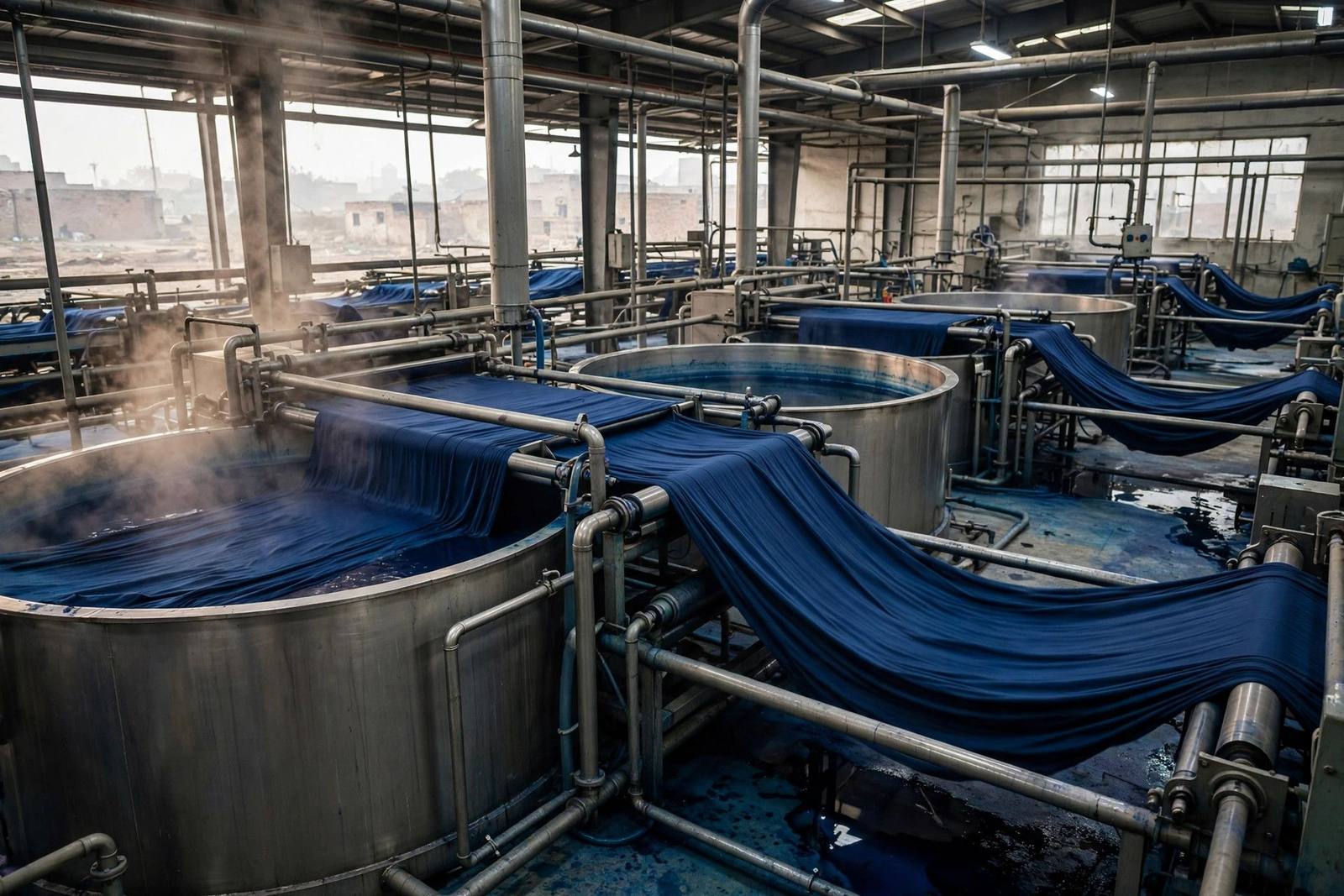
Denim looks simple and is not. A pair of jeans is cotton yarn dyed with indigo — a dye that, unusually, coats the yarn's surface rather than penetrating it, which is why jeans fade the way they do. Making denim at scale means mastering a chain of distinct crafts: opening and spinning fibre, rope dyeing — passing bundles of yarn through indigo baths in the traditional method ADM's own descriptions put at the centre of its process — weaving on dedicated looms, finishing the fabric, and then the entirely different craft of garmenting: pattern, cutting, industrial sewing, washing and finishing. Most Pakistani mills historically did one or two of these stages and sold the intermediate product onward. ADM's founding idea, shared with the small group of denim specialists that emerged in Karachi in the 1990s, was to do all of them in one company, converting cotton to finished garments inside a single gate. Our sector guide to textile stocks on the PSX places that choice in context: vertical integration swaps the flexibility of the specialist for control over quality, lead time and the margin at every stage.
The market meets the company as ADMM on the Pakistan Stock Exchange, classified among the textile names, with its plant and head office in Sector 16 of Korangi — Karachi's old industrial belt, close to the port through which its containers leave. It is not part of a sprawling multi-industry group in the manner of Pakistan's great composite houses; it is a denim company, and nearly everything in its story — its plant, its certifications, its customer list, its risks — flows from that concentration.
1992–1993: founded for the jeans age
Artistic Denim Mills was incorporated in Pakistan on 18 May 1992 under the Companies Ordinance of the day, and started production in 1993 — the company's own account of its journey dates its establishment as a vertically integrated denim manufacturer in Karachi to that year. The context was a world jeans market in one of its long expansions, and a Pakistan whose mills were discovering that denim fabric earned steadier margins than the grey cloth and yarn in which the country had specialised. Karachi had the port, the labour and the merchant networks; what it needed was mills willing to invest in rope-dyeing ranges and wide denim looms, equipment with no real use outside the one product. ADM was among the early movers, and its public listing followed soon after production began, in the mid-1990s — the exchange records an initial public offering in February 1995 — giving outside shareholders a stake in a business model that was still new enough to need explaining.
The decades since have been spent deepening rather than widening. The company's own timeline marks an expansion phase from the mid-2000s in which capacity grew and its customer base across Europe and the Americas broadened — the years when Pakistani denim as a whole moved from supplying regional traders to holding direct programmes with major brands and retailers. Later milestones in that same telling are about how denim is made rather than how much: sustainability systems in the mid-2010s, including solar energy and in-house water treatment; an in-house cotton recycling facility around 2020, turning pre- and post-consumer waste back into usable fibre; and, in the mid-2020s, product-level sustainability certification at the demanding end of the market's schemes. Read together, the timeline tells a truth about modern denim: the competitive frontier moved from looms per month to litres per pair, and ADM chose to compete there rather than in new product lines.
From fibre to finished garment
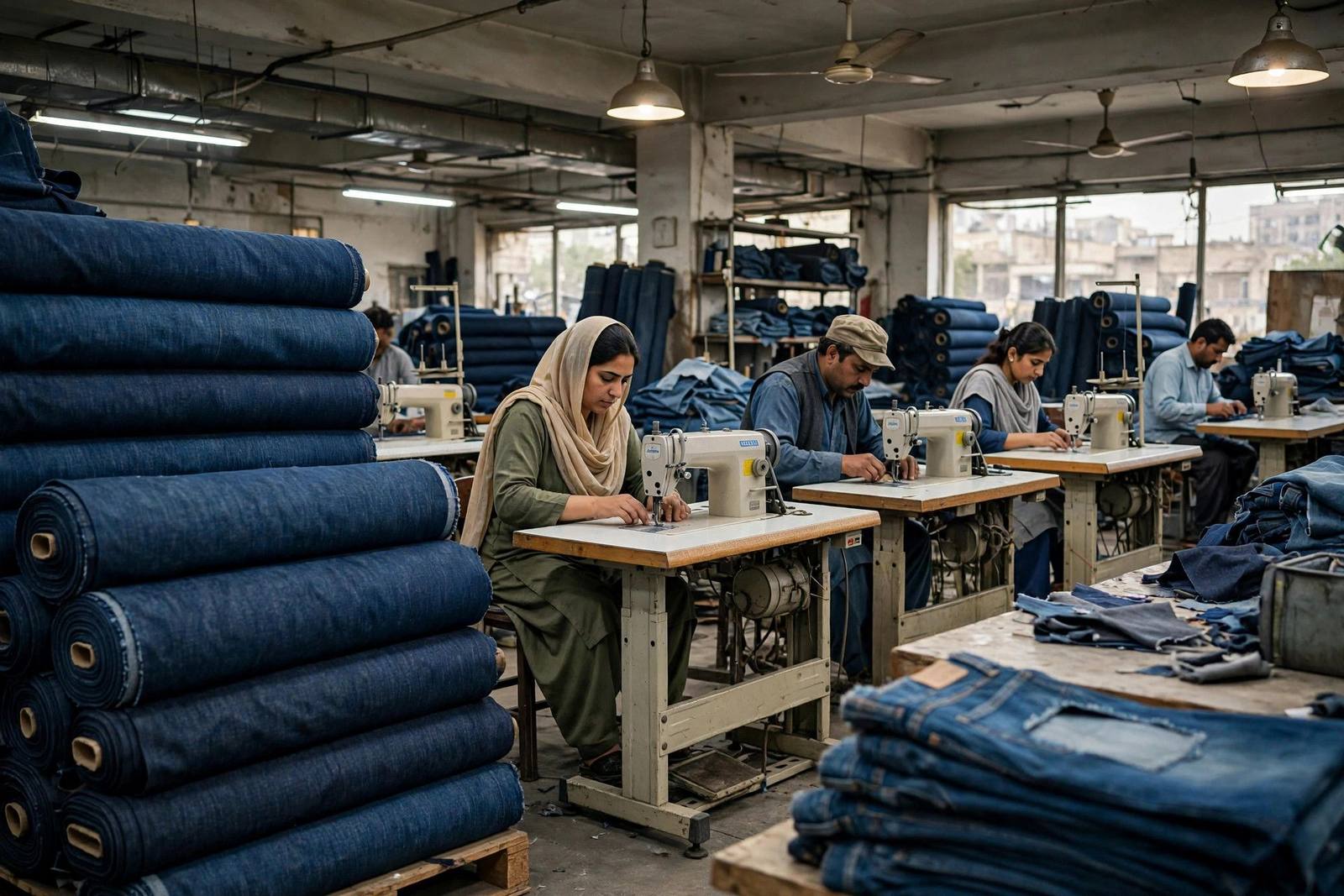
Walk the Korangi plant in the order the product does and you have the company's segment list. It begins with fibre — increasingly including recycled fibre from its own recycling operation, alongside virgin cotton and bought-in speciality fibres such as lyocell and stretch filaments that modern denim blends require. Spinning turns fibre into yarn. Dyeing follows, in two philosophies the company makes much of: traditional rope dyeing in indigo for classic denim, and fibre dyeing — colouring the fibre before spinning — which it presents as using less water and chemistry and giving more even colour for its coloured denim ranges. Weaving converts the dyed warp and natural weft into denim fabric, finishing prepares that fabric for cutting, and the garment units cut, sew, wash and finish jeans and other denim apparel. Company materials have described capacity in the region of three million yards of fabric and a million pairs of jeans a month — figures that will move with investment, but which convey the scale: this is an industrial denim platform, not a boutique mill.
The customers are the reason the plant is organised that way. ADM supplies leading international denim brands and retailers across Europe and the United States, maintains offices and showrooms abroad — its materials name New York, Bangladesh and Spain among its service points — and competes for programmes in which the brand specifies fabric construction, wash, hand-feel and compliance standards down to the chemical inventory. In that world the mill is partly a manufacturer and partly a development kitchen: samples, washes and finishes are created with the brand's designers seasons ahead of the shop floor. It is a different life from selling yarn by the container, and a more defensible one — but it ties the mill's order book to the fashion judgement of a handful of large buyers, a dependence the risk section below returns to. Comparisons help: Indus Dyeing built its story around dyeing for global denim programmes, while Azgard Nine shows the same denim promise carried through a famous debt workout.
How a denim mill makes money
ADM's revenue logic is the logic of the value chain it chose to own. A yarn seller captures one margin; a fabric seller captures two; a garment maker captures the fabric margin and the sewing margin and, if its development work is good, a small premium for being hard to replace. Against that fuller revenue stand fuller costs: cotton first, then indigo and chemicals, energy for dyeing and washing — water-intensive stages both — labour for the sewing lines, and the freight and financing of an export order book paid in dollars weeks after the goods ship. The rupee helps and hurts in the familiar exporter pattern: depreciation lifts the local-currency value of dollar sales while raising the cost of imported fibres, dyes, spares and any dollar debt. What decides the year is usually a trio an investor can follow in the company's own reporting — how fully the plant ran, what cotton cost against what the fabric and garments fetched, and how much of the mix was higher-value work: garments rather than fabric, speciality blends and certified product rather than basic denim.
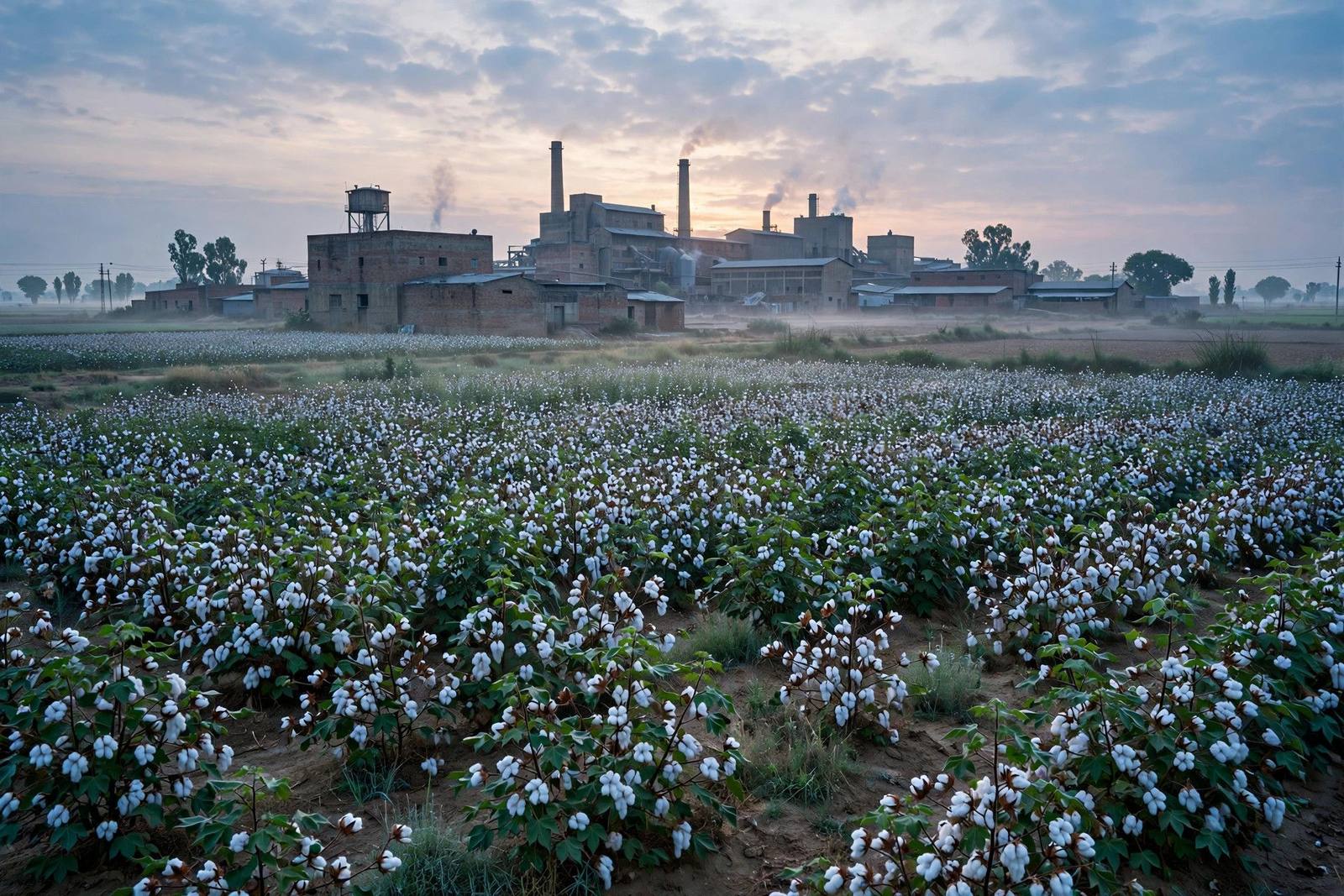
One structural feature deserves emphasis because beginners often miss it: in export textiles the customer, not the producer, usually sets the calendar. Brands place programmes seasons ahead, nominate fabric constructions, and audit factories for labour, safety and environmental compliance as a condition of ordering. A mill's certifications — ADM's materials list a long roll of international quality, social and sustainability schemes, among them organic, recycled-content and chemical-management standards — are therefore not decoration. They are the admission tickets to the order books of the buyers who pay the best prices, and keeping them is a fixed cost of staying in the premium tier. The investment case readers build around ADM is, at bottom, a judgement about Pakistan's place in that tier: close enough to the cotton, cheap enough in skilled labour, and increasingly, compliant enough in water and chemistry to hold programmes against rival denim bases in Bangladesh, Turkey, Egypt and beyond. The crop underneath it all is examined in our explainer on Pakistan's cotton economy.
Strengths, risks and the fashion cycle
The strengths begin with focus. Three decades on one product have produced deep process knowledge — in fibre-dyed denim, in stretch constructions, in wash development — that a generalist mill cannot rent quickly. Vertical integration shortens lead times, which brands value almost as much as price in a fashion category. The recycling and water-treatment investments speak to where buyer requirements are heading, and the Karachi location keeps the plant beside its port and its labour market. There is also a quiet advantage in being listed but specialised: the equity story is legible — one product, one plant system, one export market logic — in a sector where conglomerate accounts can be hard to read.
The risks are the mirror image. Concentration cuts both ways: when global jeans demand slumps — as it does in consumer downturns, when retailers destock for seasons at a time — a denim-only mill has no second engine. Customer concentration is real across the industry: a small number of brand programmes can carry a plant, and losing one is a volume event, not a rounding error. Cotton and energy costs move against the mill faster than export prices can be renegotiated, and the sustainability race that currently favours prepared mills also demands continuous capital spending simply to stay qualified. Finally there is the ordinary Karachi industrial exposure — power reliability, port congestion, security perception among visiting buyers — which management cannot diversify away from a single-site model. None of these risks is unique to ADM; what is specific is that ADM has chosen to meet them as a pure denim bet rather than spreading them.
The name on the PSX
As a listed security, ADMM behaves like the mid-cap export textile it is: followed by sector watchers, sensitive to result seasons and to the textile headlines — cotton arrivals, energy tariffs, export figures — that move the whole complex. Its dividend character over the years has been that of a cyclical manufacturer, paying when the cycle and the cash position allow rather than to a fixed promise, which is the pattern readers should expect of denim economics generally; our explainer on how PSX dividends work sets out how to read such payout histories without mistaking a good year for a guarantee. Liquidity, too, is that of a specialist mid-cap — adequate for the patient, capable of moving sharply when a results surprise or a sector shock concentrates orders.
The investor who studies ADM is usually making a considered sector wager: that premium, certified, vertically integrated denim is the part of Pakistan's textile industry best placed to keep its rich-world customers, and that a mill which has recycled its fibre, treated its water and sewn its own jeans since the 1990s has already paid most of the entry price for that future. Whether the wager pays is a question of cycles and execution — of cotton, compliance and the next jeans season. This profile is educational content, not financial advice.
Key takeaway: Artistic Denim Mills, incorporated in Karachi in 1992 and producing since 1993, is a vertically integrated denim specialist — recycling, spinning, rope dyeing, weaving and garmenting in Korangi — selling finished jeans and fabric to brands in Europe and the Americas.