KARACHI: Pakistan's textile industry is a chain — cotton in, cloth out — and most of its listed companies occupy one or two links of it. Bhanero Textile Mills Limited, BHAT on the Pakistan Stock Exchange, holds two of the foundational ones: spinning, which turns cotton into yarn, and weaving, which turns yarn into fabric. Founded in 1980 and headquartered at Umer House in Karachi's Korangi industrial area, Bhanero is the senior textile company of the Umer Group, with mills at Kotri in Sindh and in Sheikhupura district in Punjab, selling yarn and greige fabric into domestic and export markets. It is also one of the exchange's curiosities — a share with a high price per share and very thin trading, behind which sits a conservatively run, export-earning mill group. This profile explains how the company and its group are built, how spinning and weaving earn, and what kind of investor digs down to this end of the market.
Founded in 1980, anchor of the Umer Group's mills
Bhanero Textile Mills was incorporated in Pakistan on 30 March 1980 as a public limited company. Its sponsors built what became the Umer Group of Companies around it: over the following decades the group added sister mills — Faisal Spinning Mills, established in 1985, and Blessed Textiles among them — until the family's textile complex comprised, by the group's own corporate presentations, seven spinning units, three weaving units and a finishing and stitching facility, with some 225,600 spindles and 567 looms across the textile entities. Textiles remained the cornerstone even as the group diversified into footwear retail and manufacturing, real estate development, dairy farming and sugar. Bhanero itself operates two spinning units and a weaving unit, a structure rating agency VIS noted when it first rated the company — assigning it single-A category ratings with a stable outlook — and its own accounts describe it as primarily a spinning and weaving company that also generates electricity for its own consumption, a common self-help arrangement among Pakistani mills.
The shares were listed in the mid-1990s — market records date the listing to 1994, on the Karachi, Lahore and Islamabad exchanges that later merged into the PSX — and Bhanero has since lived the quiet life of a sponsor-dominated textile mid-cap: annual reports filed, dividends declared in the better years, and little public drama. Its mills' geography spreads the group's footprint sensibly: Kotri, in Sindh's Jamshoro district, sits near the Karachi port and the southern cotton belt, while the Sheikhupura unit places capacity in Punjab, close to the Faisalabad-Lahore textile corridor where most of its customers and competitors cluster.
What the mills make
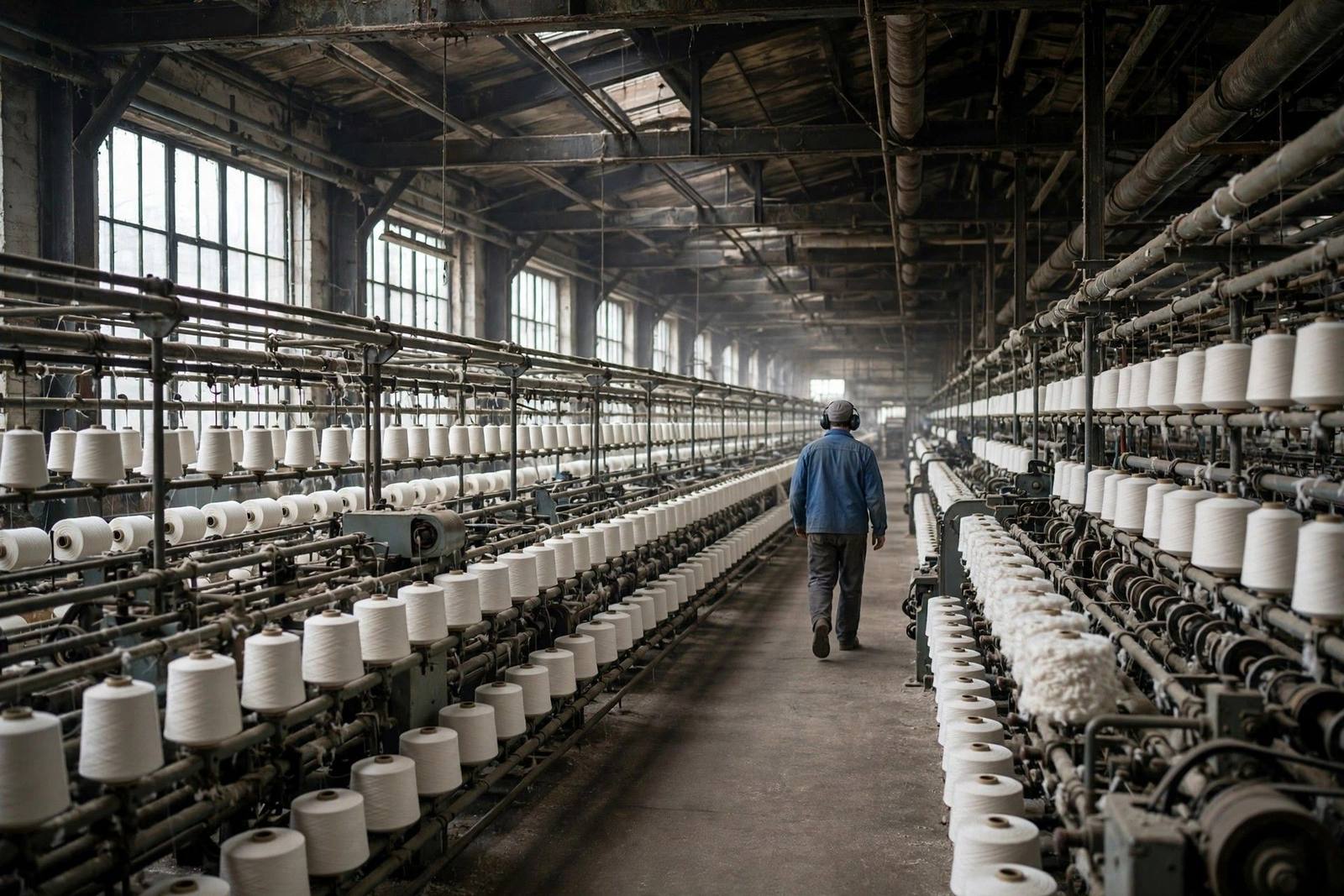
Spinning is the conversion of raw cotton — ginned, cleaned fibre — into yarn of various counts, the fineness grades that decide what the yarn can become. Weaving interlaces yarn on looms into fabric, sold in its unfinished "greige" state to processors and exporters who dye, print and stitch it into the bed linen, towels and garments for which Pakistan is known. Bhanero reports through exactly these two segments, spinning and weaving, and exports form a substantial part of the trade — the group's mills sell heavily into the United States, Europe and the Far East, as sister-company disclosures describe for the group, while yarn also feeds the domestic weaving industry.
To see Bhanero's place in the chain, set it between the cotton economy behind it and the composite and made-up exporters ahead of it — the great Karachi and Faisalabad houses such as Gul Ahmed and Nishat Chunian, which carry processing, finishing and brands further down the line. Bhanero stops earlier: its skill is fibre, yarn and cloth at volume and consistent quality, sold business-to-business. That position decides its economics completely.
How spinning and weaving make money
A mill's profit is a spread, not a price. On one side sits the cost of raw cotton — bought in a harvest season that runs through the autumn, at prices set by the local crop, the world cotton market and the exchange rate on imports when the domestic crop falls short. On the other side sit yarn and fabric prices, set in regional and export markets where Pakistan competes with India, China, Vietnam and Bangladesh. The mill keeps the difference minus its conversion costs: labour in the thousands — Bhanero employs on the order of sixteen hundred people — power and gas for the spinning frames and looms, and the finance cost of carrying cotton stocks bought in season and sold through the year.
Every phrase in that paragraph is a risk that rotates. A failed monsoon or a pest-struck cotton crop raises raw material costs for the whole industry; an energy tariff increase lands on a process that never sleeps; a strong rupee cheapens competitors' yarn in export markets while a weak one raises the local-currency cost of imported cotton and machinery spares; and a downturn in American or European clothing demand arrives at the loom within a season. The Umer Group companies' recent history illustrates the whole mechanism: after a year of heavy losses across the group's textile entities when sales stagnated and costs bit, Bhanero returned to a modest profit while its sister mills remained in loss — a spread business snapping back and forth across the break-even line with the cotton and energy cycles. The group's historically conservative borrowing — rating commentary has long noted its low leverage by industry standards, with seasonal short-term borrowing matched to the cotton-buying cycle — is the sponsors' chosen shock absorber for exactly this volatility.
The group's finishing end shows where Bhanero deliberately stops. Sister entities carry processing, finishing and stitching further toward the made-up products — the home textiles Pakistan ships worldwide — while Bhanero's own mills concentrate on the yarn and greige fabric that feed those stages and the open market. The arrangement is a group-level division of labour: capital-hungry finishing sits in the entities built for it, and Bhanero's balance sheet stays the lighter for not chasing every link of the chain. Its captive power generation fits the same philosophy of controlled self-reliance — a mill that makes part of its own electricity blunts, though it cannot escape, the tariff and supply shocks of the national grid, and in the textile business power continuity is product quality, because a loom or frame stopped mid-run leaves its mark in the cloth and the yarn.
Exports deserve one more look, because they set the group's ceiling. Pakistani greige fabric and yarn compete on reliable volume and price rather than fashion, and the buyers — importers serving American, European and Far Eastern garment and home-textile industries — allocate orders across several countries as insurance. A mill group's share of that flow depends on decades of delivered quality and on Pakistan's country competitiveness: energy prices, the exchange rate, and trade preferences such as the European Union's GSP+ scheme, which has underwritten much of Pakistan's textile access to Europe. Bhanero does not control any of those levers, but its survival across forty years of their movement — through the quota era's end, energy crises and repeated currency shocks — is the practical evidence of how the sponsors run the mills: capacity kept modern enough to hold orders, debt kept low enough to survive the years when orders vanish.
Ownership and the group pattern
Bhanero is controlled by the Umer Group's sponsoring family, whose textile interests run through the cluster of associated companies — Faisal Spinning Mills and Blessed Textiles beside Bhanero — with the listed mills sharing the Umer House Karachi headquarters and a common management culture. For the public shareholder, the salient facts are control and quietness: the sponsors set strategy across the group as a whole, the individual listed mill is run for the long term with modest leverage and retained earnings as the preferred fuel, and the free float is correspondingly small. Share registers of such companies move slowly, and so, usually, does the share.
Strengths, risks and the honest middle
The strengths are endurance and integration of a modest kind. Four and a half decades of continuous operation through every textile cycle since 1980 is itself evidence of cost discipline; two spinning units plus weaving give the company a step more integration than a pure spinner, letting it sell value-added fabric when yarn margins are poor and yarn when fabric demand fades; the group around it shares export relationships and market intelligence; and low financial leverage means a bad season is survived on the balance sheet rather than at the bank's mercy — a trait rating agencies have credited since its first ratings.
The risks are the industry's own. Commodity spreads offer no pricing power; the customer-facing end of the chain — brands, finished garments, retail — captures the steadier money, and Bhanero does not play there. Pakistan's cotton crop has trended worryingly, with the country importing fibre it once exported, which ties mills to the dollar. Energy costs for industry have risen steeply, and textiles compete for gas and power against every other sector. Add the small float's market risks — a thin order book, prices set by handfuls of shares, stretches without trades — and BHAT is a share that must be approached through its annual report, not its ticker tape. Sister companies in the same group have posted real losses in recent down years, a fact the group's own presentations state plainly; Bhanero's return to profit in the latest of those years shows resilience, not immunity.
The name on the PSX: high price, thin tape
BHAT presents a small paradox for beginners: a per-share price in the high hundreds of rupees — which sounds expensive — atop a small total capitalisation and a trickle of daily volume. The explanation is arithmetic, not quality: the company has a modest number of shares outstanding and has historically favoured retaining earnings over issuing bonus shares, so each share simply represents a larger slice of the company than a typical textile stock. Price per share says nothing by itself about cheapness or dearness — a lesson our guide to market capitalisation works through in full — and in a stock this thin, the quoted price is best read as an occasional auction result rather than a continuous verdict. Its June financial year follows the textile calendar, results arriving with the cotton season's aftermath already visible in them.
Reading a mill like Bhanero well means reading the calendar as much as the accounts. Results for the first half of its June financial year carry the new cotton crop's cost; the second half reveals whether yarn and fabric prices let the mill recover it. Export realisations arrive with a lag after shipment, and the rupee's level at shipment versus collection can add or subtract a noticeable slice of margin without a single extra metre of cloth being woven. This is why experienced textile readers compare mills on through-cycle averages rather than single years, and why Bhanero's sponsors' preference for retained earnings over generous payouts in ordinary years — building the equity that carries the mills through the bad ones — is best judged over a decade, not a dividend season. The pattern is visible in the rating history: conservative leverage, adequate liquidity, profits that arrive in waves. It is not a growth story in the technology sense, and it does not pretend to be; it is a compounding-by-survival story, of the kind Pakistan's textile belt specialises in.
What kind of investor studies it
BHAT's natural reader is the deep-value textile specialist: someone who tracks cotton prices, yarn-count spreads and energy tariffs, reads all three Umer Group mills as one system, and is comfortable holding an illiquid, sponsor-controlled share through a full commodity cycle for the dividends and asset backing of the profitable years. Others meet it while screening the sector's low-leverage survivors — the companies still standing after forty years of an industry famous for consuming the over-borrowed. Both need patience, primary sources, and the reminder that this profile is educational content, not financial advice. Bhanero's story, in the end, is the quiet core of Pakistan's export economy: cotton spun, cloth woven, dollars earned, and a family group that has outlasted most of the cycles that were supposed to finish it.
Key takeaway: Bhanero Textile Mills (BHAT), founded in 1980 and the Umer Group's senior mill, spins and weaves yarn and fabric at Kotri and Sheikhupura for home and export markets — a conservatively financed, thinly traded commodity-spread business whose profits swing with cotton, energy and the rupee.