KARACHI: Not every healthcare company on the Pakistan Stock Exchange makes medicines. IBL HealthCare Limited — IBLHL — is the listed marketing and distribution arm of the IBL group, created inside The Searle Company to sell the products that surround treatment rather than the tablets themselves: infant and adult nutrition, medical disposables, dialysis and critical-care consumables, and devices sourced under licence from international healthcare companies. If a Pakistani hospital ward stocks it, a mother buys it for a baby, or a dialysis unit consumes it, there is a fair chance IBL HealthCare's sales network touched it. This profile explains how a 1997 carve-out became a listed company, what it sells, why its economics differ from the drug manufacturers it sits beside in the PSX healthcare universe, and what followers of the stock usually watch.
Born inside Searle in 1997
IBL HealthCare started operations in 1997 as a private limited company and a wholly owned subsidiary of The Searle Company Limited, one of Pakistan's established pharmaceutical manufacturers. The logic of the carve-out was specialisation. Searle's core business was prescription medicines, made in its own plants and sold to doctors through a pharmaceutical field force. Alongside that sat a different kind of opportunity — healthcare nutrition and medical disposables — with different customers (hospitals, clinics, pharmacies and mothers rather than prescribing physicians alone), different buying logic, and growth that deserved its own dedicated team. The new company's own account of its founding is plain: it was created "to tap the potential of healthcare nutritional products and medical disposables."
The parentage matters. Searle is itself part of the wider IBL group — the International Brands Limited constellation of Karachi businesses spanning pharmaceuticals, distribution and consumer products — so IBL HealthCare grew up inside one of Pakistan's most experienced healthcare distribution families. In 2009 the company converted into a public limited company while remaining a subsidiary of Searle, a step that opened the door to the stock market and to the disclosure discipline that comes with public shareholders. It has traded on the exchange under the symbol IBLHL since that public era, headquartered in Karachi at One IBL Centre on Tipu Sultan Road, off Shahrah-e-Faisal.
A marketing affiliate, not a factory
The single most important thing to understand about IBL HealthCare is what it does not do: historically, it has not been a manufacturer in the mould of its parent. The company describes itself as a marketing affiliate. It wins the rights to sell other companies' healthcare products in Pakistan under licensing and distribution agreements, builds the local demand through its sales teams, manages importation and inventory, and places the products with hospitals, institutions, pharmacies and retailers. Its long-standing licensing relationships, as listed in its own company profile, have included Mead Johnson Nutrition in infant nutrition, Nestlé Health Science in medical and specialist nutrition, Terumo in medical devices and disposables, Meditech in critical-care and anaesthesia products, and Mepaco of Egypt, among others.
That model shapes everything else in this profile. The company's assets are relationships, regulatory registrations, a trained field force and a distribution reach — not reactors and tablet presses. Its costs are dominated by the purchase price of imported finished goods, the salaries of marketers and medical representatives, and the logistics of serving institutions across Pakistan. And its moat, such as it is, rests on the trust of two audiences at once: the international principals who renew its licences, and the hospitals and clinicians who specify its products by name. Over time the company has also developed products and brands of its own in adult nutrition and wellness, reducing — though not removing — its dependence on principals' portfolios.
What it sells: from infant formula to dialysis consumables
The catalogue falls into three broad baskets. The first is nutrition across the human lifespan: infant formulas and baby cereals at the start of life, adult and lifestyle nutrition for the middle of it, and specialist medical nutrition — the feeds and supplements used for patients whose ordinary diet is not enough — where its Nestlé Health Science and Mead Johnson lineages have been central. Nutrition is the basket the public meets: products bought in pharmacies and supermarkets, chosen by parents and patients, and sensitive to household incomes.
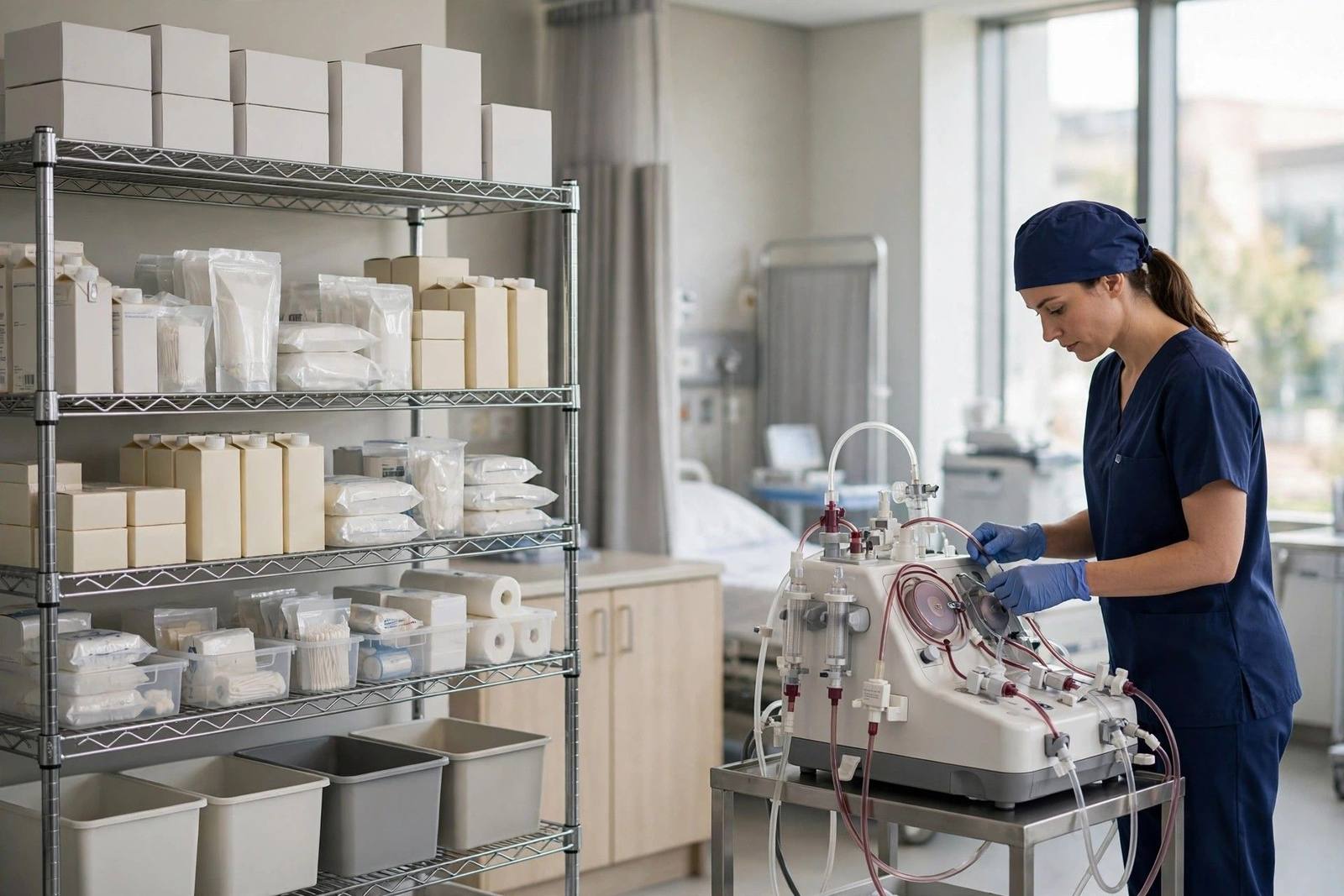
The second basket is medical disposables and devices, the unglamorous consumables that hospitals burn through daily. Company and data-provider descriptions of the range include renal-care products — hollow-fibre dialysers, blood tubing sets for haemodialysis, double-lumen catheter kits and AV fistula needles; critical-care and anaesthesia items such as connectors, breathing circuits, filters, anaesthesia and oxygen-therapy masks; and the long tail of ward consumables — gloves, infusion and transfusion sets, blood bags, IV administration sets, suction catheters, feeding tubes, urine collection bags and nebuliser masks. The third basket — vision care, hygiene and safety products, consumer health and some pharmaceutical lines — rounds out the offer. Read together, the catalogue explains the company's institutional weight: a dialysis unit or an intensive-care ward can source a large part of its daily consumables from this one supplier, which is exactly the kind of account relationship a marketing affiliate is built to hold.
How those products actually reach patients explains the company's organisation. On the institutional side, IBL HealthCare sells into hospitals, dialysis centres and clinics through medical representatives and key-account teams, and competes for institutional tenders where price, documented quality and continuity of supply decide the award. A won tender for dialysers or infusion sets can anchor a hospital relationship for years and pull through a basket of allied consumables, which is why the field force sells systems rather than single items. On the retail side, nutrition products move through pharmacies and modern trade, where shelf placement, pharmacist recommendation and brand trust in categories such as infant formula are fiercely regulated and hard won. Underpinning both channels sit the unglamorous disciplines that decide whether a distributor survives: product registration with Pakistan's drug and device regulators, cold-chain and storage standards for sensitive nutrition and sterile goods, batch traceability, and pharmacovigilance-style reporting back to principals. It is administrative work, but in healthcare distribution administration is the product — a hospital buys certainty that the right sterile item will be in the store room on the morning of a dialysis shift.
One more channel has grown quietly across all three baskets: modern retail and e-commerce for the consumer-facing lines. Nutrition and wellness products that once moved only through pharmacies are now listed on online marketplaces and the company's own digital storefronts, a shift the whole IBL group has pursued as Pakistani households moved part of their health shopping online. The volumes remain smaller than the institutional trade, but the direction matters for the mix: consumer sales carry distributor-style margins without tender cycles, and they build the company's own brands — the layer of the business no principal can take away. Watching how fast that proprietary share grows, against the licensed portfolio that still pays most of the bills, is one of the cleaner ways to judge whether IBL HealthCare is becoming a brand owner in its own right or remaining, at heart, an excellent representative of other people's products.
Ownership and group: life inside the IBL family
IBL HealthCare remains a subsidiary of The Searle Company Limited, which holds the controlling stake, and through Searle it sits inside the IBL group. That pedigree gives the company two practical advantages: credibility with international principals deciding who should represent them in Pakistan, and the ability to lean on group distribution and relationships built over decades — the same network that serves its parent, profiled separately in this series as Searle (SEARL). The corollary is that IBLHL is best analysed as a group company rather than a free-standing one: its strategy, its principal relationships and even its premises are bound up with the family's wider healthcare interests, and minority shareholders are along for a ride whose route the group sets. For readers new to that pattern, our explainer on listed subsidiaries and their parents sets out what to check when the controlling shareholder is another company.
How IBL HealthCare makes money
The revenue engine is distribution margin. The company buys finished products — largely imported, priced in foreign currency by its principals — and sells them on at Pakistani prices that recover the landed cost, the field force, warehousing and delivery, credit to institutional buyers, and a profit. Institutional sales to hospitals and dialysis centres are relationship business won on reliability and clinical support as much as price; retail nutrition sales are brand business won on shelf presence and parental trust. In recent years the company has also worked to localise more of its economics — including toll-manufacturing arrangements and its own formulations — because every rupee of value added at home is a rupee less exposed to freight, import delays and the exchange rate.
Those exposures define the risk side of the ledger. A weaker rupee lifts the landed cost of an imported portfolio immediately, while selling prices — especially to institutions buying through tenders and annual contracts — adjust with a lag. Working capital is a constant discipline: hospitals and institutions pay slowly, inventories of dated nutrition and sterile disposables must be held deep enough never to stock out, and the cash tied up in the gap has often been financed with short-term borrowing, which makes finance costs a line that followers of the company watch closely when interest rates are high. When rates fall, the same structure works in its favour.
Strengths, risks and the honest limits
The strengths are those of a well-placed intermediary in a growing market. Pakistan's healthcare spending rises with its population, its hospital capacity and the slow spread of organised dialysis, critical care and clinical nutrition — categories in which IBL HealthCare has specialised for over twenty-five years. Its principal list, built around names like Mead Johnson and Nestlé Health Science, is difficult for a newcomer to replicate quickly, and its institutional relationships in renal and critical care are sticky: a dialysis centre does not casually change the dialyser its protocols are built around.
The limits are the mirror image. A marketing affiliate's licence can be renegotiated, reshaped or not renewed, and a principal's global strategy — a merger abroad, a decision to go direct — can rewrite the local business through no fault of its own. Imported-goods economics leave margins hostage to the currency and to customs and regulatory friction. Competition comes from both directions: manufacturers selling their own devices and nutrition, and nimble local distributors undercutting on price in the commoditised end of disposables. And the stock itself, as a smaller group subsidiary, has the thin trading and modest free float typical of such names, which readers should weigh alongside the business — our guide to free float and what it means for trading explains why that matters in practice.
The name on the PSX and who studies it
IBLHL reports on a June financial year, and its results tell a characteristic distributor's story: sales growth set by volumes, hospital demand and new principal wins; margins set by the rupee and the product mix; and a bottom line that interest costs can swing. It has not been one of the market's heavy dividend payers — in many periods earnings have been retained or absorbed by working capital and finance costs — so it tends to be studied as a growth-and-turnaround name within healthcare rather than an income holding, a useful contrast with the dividend habits described in our guide to dividend investing in Pakistan.
The investor who studies IBLHL is typically looking for leveraged exposure to Pakistan's healthcare-consumption growth without owning a drug factory: more dialysis, more hospital care, more clinical nutrition, monetised through distribution margins. The things they track are the principal portfolio (wins, losses, renewals), the mix between institutional and retail sales, gross margin against the exchange rate, and the debt and finance-cost lines that decide how much of the operating story reaches shareholders. This profile is educational content, not financial advice. IBL HealthCare is, in the end, a study in the economics of the middleman done well — a company whose factory is a sales force, and whose inventory is trust on both sides of the transaction.
Key takeaway: IBL HealthCare (IBLHL), a Searle subsidiary founded in 1997 and public since 2009, is the IBL group's listed marketing arm for nutrition, medical disposables and devices — a distributor whose fortunes turn on its international licences, institutional relationships, the rupee and the cost of funding its working capital.