KARACHI: In thousands of Pakistani shops, the chest freezer humming beside the counter carries a single swirling word: Waves. Behind that freezer stands one of Lahore's oldest appliance businesses — and one of the Pakistan Stock Exchange's more complicated family trees. The share that trades as WAVES belongs to Waves Corporation Limited, a Lahore company that Pakistan knew for years as Waves Singer Pakistan, formed when the Singer retail business and the Waves manufacturing business — built by Cool Industries, founded in 1973 — came together in 2017. In 2021–22 the group rearranged itself again: the home-appliances business was carved out into a sister listed company, Waves Home Appliances Limited, which Waves Corporation now parents as its majority shareholder. So a beginner asking "what is the Waves share?" is really asking about a holding company over Pakistan's best-known deep-freezer brand. This profile untangles the names, tells the Singer and Cool Industries stories, and explains how freezers and refrigerators turn into shareholder returns.
Two businesses: a sewing-machine retailer and a freezer factory
The Singer half of the story is the older name in Pakistani commerce. Singer — the American sewing-machine giant — was for over a century a fixture of South Asian high streets, and its Pakistan operation evolved from sewing machines into a retail and trading network for domestic appliances and light engineering products, incorporated in Pakistan as a public company under the Companies Ordinance, 1984, and quoted on the stock exchange. By the modern era, Singer Pakistan's business was the retailing, trading, manufacturing and assembly of home appliances — but it did not own the country's most famous appliance factory. That belonged to somebody else.
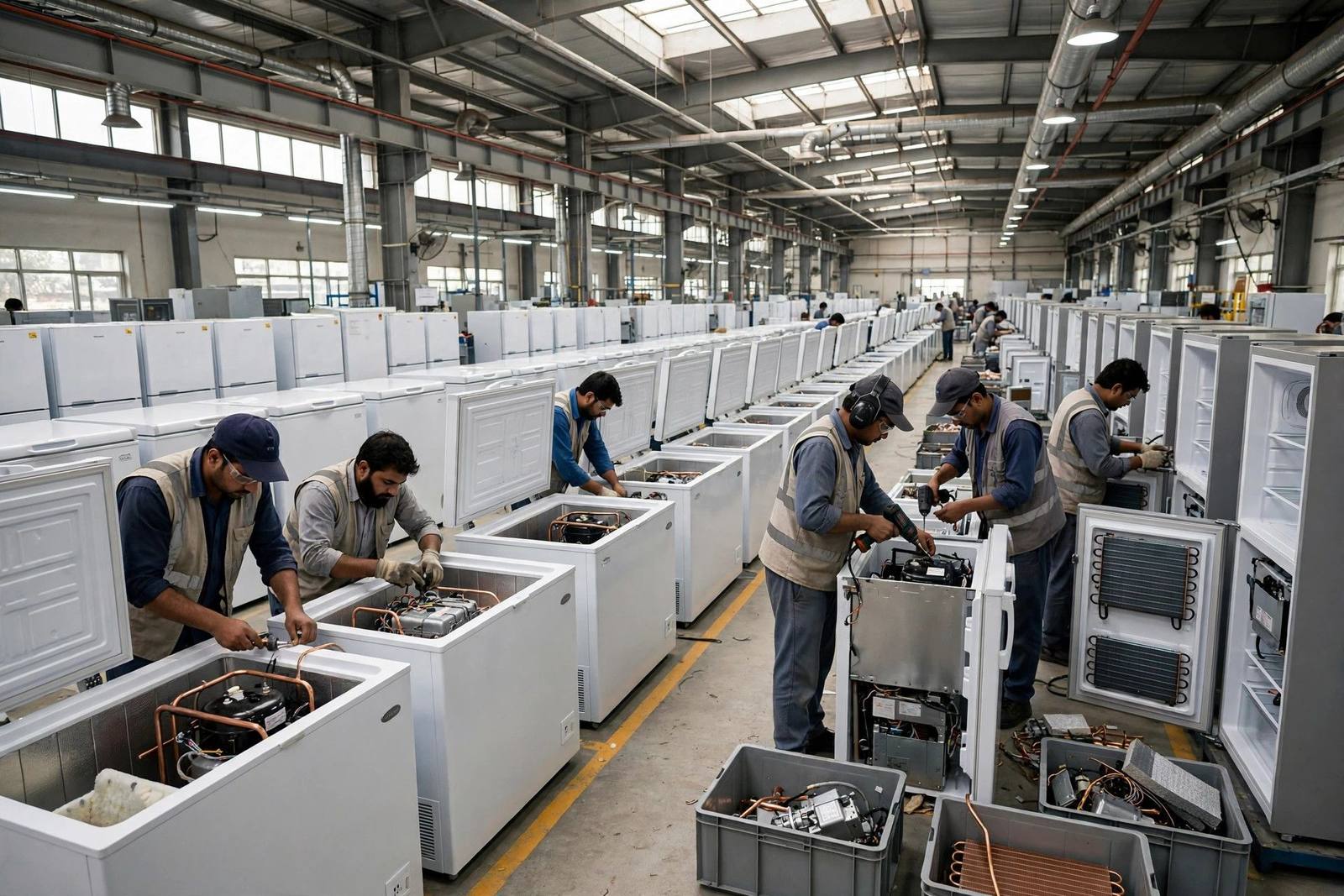
The factory half began in 1973, when Cool Industries (Private) Limited was established in Lahore. Cool Industries grew, over the following decades, into a leading Pakistani home-appliance manufacturer under the Waves brand — refrigerators, deep freezers, air conditioners, washing machines, microwave ovens and other household appliances, made at Lahore. The Waves deep freezer in particular became a category-defining product: the standard chest freezer through which Pakistan's small retailers — the karyana stores, dairies, ice-cream sellers and restaurants of every bazaar — kept their stock cold, and the visi-cooler that put branded drinks within arm's reach at the counter. Manufacturing sat at 9-KM Multan Road, Hanjarwal, in Lahore — still the group's registered home — with further facilities in the Kasur district as the group expanded.
2017: Singer meets Waves, and a listed giant is assembled
The two halves came together in 2017, when Singer Pakistan acquired Cool Industries, and the combined business took the name Waves Singer Pakistan Limited — in the words of contemporary reporting, the company "came into being after the acquisition of Cool Industries by Singer Pakistan during 2017". The combination was logical on paper: Singer brought a national retail and dealer footprint and a listed vehicle; Cool Industries brought manufacturing depth and the stronger product brand. The merged company described its business as the manufacture and assembly of domestic consumer appliances alongside retailing and trading of the same and other light-engineering products, run from Lahore with plants in Lahore and Kasur district.
The combined group traded through Pakistan's difficult appliance years — the currency and demand shocks that periodically empty showrooms of big-ticket goods — and management showed an appetite for expansion beyond appliances, publicly expressing interest in assets such as the state-owned Heavy Electrical Complex in 2020–21 as a route into power equipment. That bid story came to nothing of record, but it signalled how the sponsors saw the listed vehicle: not merely a freezer maker, but a platform for Lahore-based industrial ambitions. The decisive reshaping, however, was internal.
2021–22: the carve-out that created Waves Home Appliances
Under a Scheme of Arrangement sanctioned by the Lahore High Court on 27 May 2022, with an effective date of 1 September 2021, Waves Singer Pakistan separated its home-appliances business — the assets, liabilities, contracts and undertakings of manufacturing and selling Waves appliances — and amalgamated it into Waves Home Appliances Limited, a related listed company formerly known as Samin Textiles Limited, in exchange for shares in that company. Waves Singer Pakistan then renamed itself Waves Corporation Limited, and restated its principal business as managing its investments in subsidiaries principally engaged in manufacturing, assembling, retailing and trading domestic appliances, together with real-estate development. In the group's more recent consolidated reporting, Waves Corporation holds about 55 per cent of Waves Home Appliances, alongside wholly owned subsidiaries in marketplace retail — Waves Marketplace, formerly Electronics Marketing Company — and in property, Waves Builders & Developers.
Read that again slowly, because it decides what a WAVES shareholder actually owns. The freezers and refrigerators are made and sold one level down, inside Waves Home Appliances — which has its own PSX quote and its own minority shareholders, and whose own reporting describes a network, in the group's telling, of more than 1,500 dealers, sixteen after-sales service centres and over five hundred service workshops, with a new purpose-built factory under construction at a measured pace through the recent downturn. WAVES, the parent, is the controlling mind and majority owner of that business, plus the retail and property arms. Anyone comparing the two tickers is really deciding at which floor of the same building they prefer to own a room — the exact sum-of-the-parts question our explainer on Pakistan's conglomerates and holding companies teaches.
What the Waves business sells
The appliance range, as the operating company lists it, covers the big white goods of Pakistani domestic life: deep freezers — the founding glory, in household and commercial chest formats; visi-coolers, the glass-door retail coolers; refrigerators; air conditioners; washing machines; microwave ovens; and water dispensers. Two features distinguish the business from a pure consumer brand. First, the commercial channel: a large share of freezer and cooler volume flows to shops, restaurants and beverage and ice-cream companies rather than households, tying demand to small-business health as much as to weddings and housing. Second, the service promise: appliances are bought on the strength of the network that will repair them, and the group's dealer and workshop footprint — built over decades since Cool Industries' 1973 start — is a genuine competitive asset against imported brands, in the same Lahore-centred industry as rivals such as Pak Elektron, the maker of PEL appliances.
How appliance making makes money
The economics are those of cyclical consumer durables. Revenue arrives in large tickets — a refrigerator or freezer is among the biggest purchases a household makes — and is therefore hostage to interest rates, instalment availability, electricity prices and consumer confidence. Demand peaks with summer heat, the marriage season and the replacement cycle; it collapses when the rupee falls and imported compressors, steel and electronics suddenly cost more in local currency. On the cost side, the assembler-manufacturer buys a mix of local fabrication and imported components, so margins live in the gap between the showroom price the Pakistani consumer can bear and a bill of materials priced substantially in dollars — the same squeeze described for the wider industry in our guide to Pakistan's protected manufacturing economy.
For the WAVES shareholder there is a second translation layer. The parent's consolidated accounts fold in the appliance subsidiary's results, its retail arm and its property interests; its standalone accounts are mostly the holding company's own position. Cash reaches the parent as dividends and management flows from below, after the operating company's own needs — including that long-gestating new factory — are met. Reported results for the appliance business in recent hard years have shown the strain plainly, with thin profits in periods when volumes and pricing were squeezed simultaneously, which is the honest texture of this industry: spectacular in a consumer boom, unforgiving in a bust.
Strengths, risks and name confusion
The core strength is the brand's fifty-year presence in the cold chain of Pakistani retail — a position built by Cool Industries from 1973 that money alone cannot quickly buy — reinforced by the dealer and service network and by the commercial freezer franchise. The 2022 restructuring also clarified, at least in design, who does what: a listed operating company for appliances, a listed parent for strategy, retail and property.
The risks follow from the same structure. Complexity is the first: two listed companies, similar names, a shared brand and interlocking shareholdings have confused investors before, and the operating company's ticker has itself appeared under more than one symbol in market data as the new name settled — anyone trading these shares should verify, in the PSX company directory itself, exactly which legal company a ticker denotes before placing an order, a habit our guide to reading PSX announcements exists to build. Cyclicality is the second: appliances are among the most interest-rate-sensitive purchases in the economy. Import dependence is the third. And the holding-company discount is the fourth: parents of listed subsidiaries often trade below the look-through value of their stakes, which can be opportunity or judgement depending on how the market rates the sponsors' capital allocation between freezers, retail and real estate.
The name on the PSX: WAVES
WAVES is the parent's ticker — Waves Corporation Limited, formerly Waves Singer Pakistan Limited — quoted on the PSX with a December financial year-end, and followed mainly as a leveraged way to hold the Waves appliance franchise with retail and property attached. Its subsidiary, Waves Home Appliances, trades separately as the pure appliance operating company. Neither is a large index constituent; both sit in the exchange's second tier, where liquidity is modest and announcements — scheme documents, factory updates, results from the operating arm — matter more than index flows. Dividend flow has been constrained in the recent difficult cycle, as the operating company's own board decisions in lean years have put payouts on hold to protect the balance sheet; the general machinery of declarations is covered in how PSX dividends work.
The product frontier in front of the operating business is energy. Pakistani households now interrogate an appliance's electricity appetite as closely as its price: inverter refrigerators and air conditioners that sip rather than gulp power, freezers that hold temperature through load-shedding hours, and compatibility with the rooftop-solar systems spreading across Lahore's rooftops have moved from premium options to purchase criteria, a shift our explainer on rooftop solar and net metering traces from the grid's side. For a manufacturer with local fabrication depth — its own cabinets, coils and assembly rather than imported finished units — that shift is an opportunity as much as a cost: efficiency is engineered, not decorated, and the brands that can redesign compressors, insulation and electronics locally can follow the consumer's new priorities faster than a pure importer. The commercial cold chain pushes the same direction, as food retailers and pharmacies count spoilage and running costs together. Whether the Waves range holds its fifty-year shelf position will be decided in that engineering race as much as in its showrooms. The raw material of victory is already on the road: every Waves freezer keeping a small shop's stock cold through a hot, load-shed night is an argument, repeated at dawn, for buying the same swirl again.
What kind of investor studies Waves
WAVES rewards the reader who enjoys structure: someone willing to open both companies' accounts, trace the 55-per-cent bridge between them, follow appliance demand, compressor and steel costs, electricity tariffs and the new factory's progress, and then decide which level of the group offers the exposure they want. It is also a living lesson in Pakistani corporate history — a sewing-machine retailer, a 1973 Lahore freezer maker, a merger, and a court-sanctioned carve-out, all inside one brand. This article is educational content, not financial advice, and nothing in it is a recommendation to buy or sell any security.
Key takeaway: WAVES is Waves Corporation — the former Waves Singer Pakistan — parent of the listed Waves Home Appliances business built by Cool Industries since 1973; read the group at both levels before judging either share.