KARACHI: If Karachi's steel names grew up around the port, Lahore's grew up around the building trade of Punjab — and the name over the gate on Sheikhupura Road is Mughal. Mughal Iron & Steel Industries Limited, MUGHAL on the Pakistan Stock Exchange, is one of the country's large producers of long-rolled steel: the bars that reinforce concrete, and the girders, beams and sections that frame factories, warehouses and bridges. The business began in 1950 as Mughal Traders, importing iron and steel for local consumption in a country that made almost none of its own, spent six decades turning itself into a manufacturer, and listed in 2015. Few Pakistani companies span the full journey from import merchant to integrated listed steelmaker in one continuous family story; Mughal is the clearest example in the northern market, and at times a constituent of the market's leading index group — a scale none of its founders could have pictured in 1950.
Mughal Traders: the import years, 1950–2010
The founding date the company and its chroniclers use is 1950, and the founding form was trade, not manufacture. Mughal Traders imported iron and steel products for local consumption — the standard business model of the early Pakistani steel trade, when domestic melting and rolling capacity was minimal and construction ran on imported sections and bars distributed through merchant houses in cities like Lahore. A trading house learns things a factory does not: which sizes actually move, which customers pay on time, how the government's import policy and the rupee change the landed price of a beam between order and arrival. That commercial education is the foundation the later manufacturing business was built on.
The turn from merchant to maker came in stages, as it usually does. The company's own milestones mark 2008 as the year Mughal acquired the plant and machinery of Al-Bashir Steel Industries — buying its way into production assets rather than building entirely from greenfield. In 2010 the business was incorporated in its modern form as Mughal Iron & Steel Industries Limited, gathering the trading heritage and the manufacturing assets into a single company. Five years later came the public listing: Mughal was listed on the Karachi Stock Exchange in 2015 following an initial public offering. The head office remained in Shadman, Lahore, and the factory at its site about 17 kilometres out on Sheikhupura Road — Lahore geography that places the plant on the historic industrial corridor serving Punjab's construction heartland.
What Mughal makes: long products, ferrous and beyond
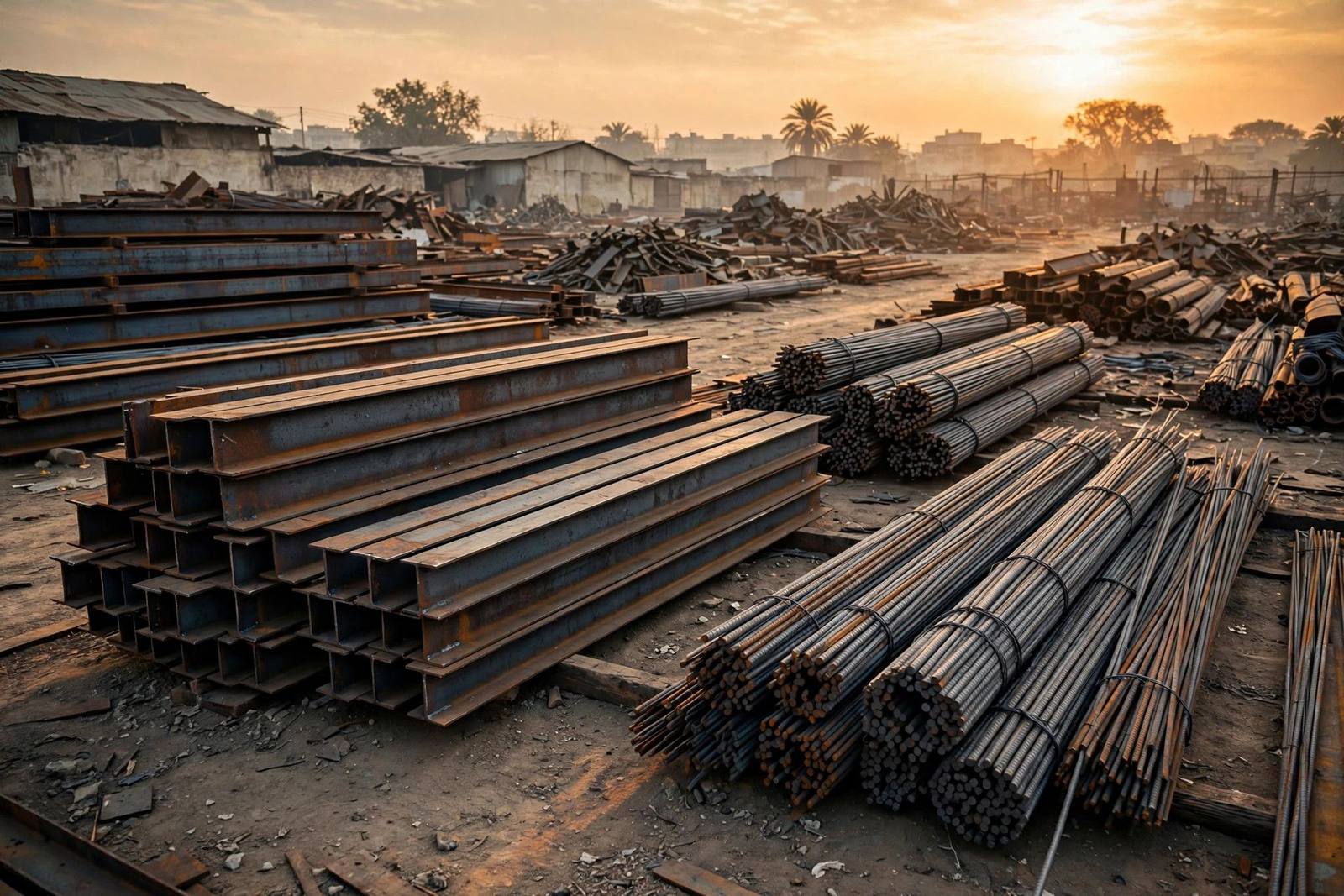
Mughal describes itself as one of the largest steel producers in Pakistan's long-rolled products industry, and its reporting divides the business into two segments that repay attention. The ferrous segment is the core: long-rolled mild steel products including reinforcement bars, structural sections — girders and beams in the I, H, C, L and T profiles that frame industrial buildings — spring steels, and the carbon billets that are both a product and the feedstock of rolling. The non-ferrous segment is the surprise for beginners: copper and related items, a business that grew from the scrap and metals currents running through any large steel operation, and which gives Mughal an exposure — to copper prices and electrical demand — that pure steel rivals do not have.
The plant behind those products has been written about in the company's own reports with some pride. Its melt shop, based on induction furnaces first installed in the late 1990s and expanded since, feeds a bar rerolling operation and a dedicated tandem section mill which the company introduced as a first of its kind in Pakistan, using European tandem technology for continuous rolling of sections, alongside mini section mills for smaller profiles. The company has also described a captive power arrangement supporting the works — essential infrastructure in an industry where a furnace cannot simply pause when the grid does. End users are the familiar ones: building and infrastructure construction at home, with the company historically also supplying export demand in Afghanistan from its northern base.
How Mughal makes money
The engine is the long-steel spread, run at Lahore scale: sell bars and sections by the ton; pay for scrap — much of it imported, all of it effectively dollar-linked — for electricity in industrial quantities, for rolls, refractories and freight across Punjab, and for the financing that a scrap-to-bar pipeline constantly consumes. Mughal's particular shape modifies the generic model in three ways. First, breadth: sections and girders face a different competitive set from commodity rebar, and a mill that can roll the full structural catalogue can serve project contractors as a single supplier. Second, the non-ferrous line adds a second, uncorrelated price book — copper does not move with Pakistani construction — though it also adds a second set of price risks. Third, position: a Lahore plant sits inside the largest provincial construction market in the country, close to demand but far from the port, so scrap logistics and freight are a permanent part of its cost identity, just as port access is part of Agha Steel's and Amreli's.
Management continuity is part of the operating story. The company's public materials name Mr Mirza Javed Iqbal as chairman and Mr Khurram Javaid as chief executive — leadership associated with the transformation from trading house to listed manufacturer, and with the continuous-improvement and cost programmes the company has highlighted over the years, presenting itself as among the lower-cost producers in its segment. In a spread business, cost position is not a detail; in bad years it is the difference between the mills that idle and the mills that close.
A familiar brand, in a market of brands
The hook of this profile calls Mughal the steelmaker behind a familiar brand, and the familiarity is geographic as much as national. In Punjab's building trade, Mughal bars and sections are part of the standard vocabulary of contractors, steel dealers and engineers, distributed through the dealer networks that actually decide which mill's product goes into a house in Gujranwala or a warehouse in Faisalabad. That kind of recognition is built the slow way — consistent sizing and quality across decades, presence in the bazaar, and a name that predates most of its customers. It is the northern counterpart to the branding achievement of Amreli in the south, arrived at by a longer road: where Amreli branded a manufacturer's product, Mughal's name carried a merchant's reputation for reliability into manufacturing with it.
Strengths, risks and controversies
Mughal's strengths are scale, range and survival. It is among the larger long-products producers in the country, with a product catalogue broader than pure rebar, a second segment in non-ferrous metals, captive power supporting its works, and a seventy-year name in its home market. Its listing history and index presence at various times have also given it a broader institutional following than most Pakistani steel names enjoy.
The risks are the steel sector's standard four, in Lahore dosage. The construction cycle decides volumes, and Punjab's building booms and busts are amplified by public-sector development spending and remittance flows, neither of which management controls. Scrap and energy costs decide margins, and an inland plant pays freight on both its inputs and, for export hopes, its outputs. The non-ferrous segment, while diversifying, ties part of earnings to volatile world copper and scrap markets, which can flatter one year and punish the next. And the expansion habit of the industry — induction furnaces added across the sector whenever times are good — periodically floods the northern market with capacity chasing the same projects. None of these are secrets; they are the reasons MUGHAL's profits, like those of Aisha Steel in flat products, arrive in waves rather than lines.
The name on the PSX
MUGHAL listed in 2015 and is among the more liquid of Pakistan's steel shares, helped by its size and by periods of inclusion in the KSE-100 — Wikipedia and market sources have described it as a KSE-100 component, a status that index funds and benchmark-watchers notice even when steel sentiment is poor. Its dividend behaviour follows the sector's cyclical grammar: distributions belong to the good years, and are best studied as a full record rather than a single announcement. For a beginner, Mughal also offers a small lesson in ticker literacy — the symbol is the family and company name itself, one of the PSX's more memorable, and a reminder that many of the exchange's industrial tickers are simply the names over factory gates, formalised.
What kind of investor studies Mughal
Mughal attracts the steel sector's generalists: investors who want the northern market's bellwether, who track Punjab construction, development budgets, scrap and copper prices together, and who value the liquidity to enter and exit a cyclical position as the cycle turns. Their observation points are utilisation across the bar and section mills, the ferrous–non-ferrous earnings mix, power costs and captive generation, working-capital discipline in scrap buying, and the state of the order book from project contractors. The Aktzien learning library covers the spread-business and cycle concepts that Mughal's reports assume their readers know. This article is educational content, not financial advice.
From the bazaar to the benchmark
The distance Mughal has travelled can be measured in its own paperwork. A 1950s importing house kept its knowledge in family memory and its accounts in ledgers; the listed company of today publishes audited segment results, holds analyst briefings and answers to thousands of shareholders it will never meet. That transition — repeated across Pakistan's industrial families but rarely over so long a span in one name — changed what the business is for. The trading house existed to move metal profitably; the manufacturer exists to run furnaces and mills through cycles its founders could not have imagined, including energy regimes, environmental expectations and capital markets that reprice the company every trading day. Lahore's industrial identity was built by houses like this one, and Mughal's Sheikhupura Road works — induction furnaces, tandem and mini section mills, captive power — are the physical form of the city's argument that Punjab does not merely consume steel, it makes it. For the student of the PSX, that makes MUGHAL a double document: a steel company to be analysed on spreads and utilisation, and a seventy-year record of how a Pakistani merchant family becomes an industrial institution without changing its name.
One more feature of the Lahore model deserves note: proximity shapes product. A northern mill far from the sea lives closer to the agricultural and small-industry demand of Punjab — the tube wells, workshops, warehouses and farm structures that consume sections and bars in steady, unglamorous quantities between the headline projects. Serving that demand well means holding sizes in stock, extending the informal credit rhythms of the bazaar through dealers, and keeping quality consistent enough that a fabricator in a small town specifies the same name his father did. It is a less visible moat than a dam contract, but across a full cycle it is the demand that keeps furnaces warm when the mega-projects pause — and it helps explain why the northern market's leading names have survived every downturn the sector has produced since the trading years.
For the reader comparing the northern and southern steel stories on this site, Mughal completes a triangle. Karachi's integrated makers grew around imported scrap at the port and branded rebar for a megacity; the flat-steel maker at Port Qasim grew around imported coil and the vehicle industry; Mughal grew around a merchant's knowledge of Punjab, accumulated since 1950, and turned it into furnaces where its customers already were. Three different answers to the same question — where does a ton of Pakistani steel come from, and who stands behind it — and three different share registers pricing the answers. The Lahore answer has the longest pedigree of the three, and its next chapters will be written by the same forces that wrote the first: the building ambitions of Punjab's families and factories, the price of scrap on world markets, and the cost of the electricity that turns that scrap back into the girders of the next warehouse on Sheikhupura Road.
Key takeaway: Mughal Iron & Steels grew from a 1950 Lahore importing house, Mughal Traders, into an incorporated manufacturer in 2010 and a listed long-products steelmaker in 2015 — bars, girders and sections from Sheikhupura Road, plus a copper sideline — and its earnings ride Punjab's building cycle, scrap prices and power costs.